Crypto Gates

Blog

  • Inflation Shock Wipes $696 Million in Crypto Longs: What Leveraged Traders Missed

    Inflation Shock Wipes $696 Million in Crypto Longs: What Leveraged Traders Missed

    Hotter-than-expected inflation data hit leveraged crypto traders hard.

    Nearly $696 million in positions were wiped out in 24 hours, mostly long bets on Bitcoin and Ethereum.

    Here’s what the data shows and what smart traders do before the next macro print.

    EXECUTIVE SUMMARY
    • The Problem: Surprise inflation data triggered a massive crypto deleveraging event overnight.
    • The Solution: Monitoring leverage levels and macro signals before entering positions.
    • The Incentive: Traders who backtested risk scenarios avoided the worst of the flush.
    • The Risk: More CPI and PPI prints ahead could trigger another wave of liquidations.

    $696 Million Gone in 24 Hours

    Look, this wasn’t random volatility.

    It was a textbook leveraged long squeeze triggered by a macro catalyst that most retail traders weren’t watching closely enough.

    Roughly 154,000 traders were liquidated in a single day, with Bitcoin and Ethereum leading losses — CoinGlass

    SYSTEM ACCESS: CG4.2

    Stop Guessing.
    Stress Test Your Edge.

    The market doesn’t care about your backtest. Our engine simulates 1,000+ “what-if” scenarios to ensure your strategy is built for survival.

    Run Crypto Strategy Engine →
    ROBUSTNESS SCORE
    75+ STRUCTURAL EDGE
    RISK OF RUIN < 1%
    TARGET HIT 92%

    Why does inflation data cause crypto liquidations?

    Rising inflation raises rate hike odds, pushes yields higher, and triggers risk-off selling across leveraged crypto positions.

    How Inflation Data Moves Crypto Markets

    When bond yields spike after a hot CPI print, risk assets sell off fast, and leveraged positions get margin called before traders can react.

    Bitcoin briefly tested the high $70,000s during the selloff while ETF outflows accelerated — Bloomberg

    Honestly, this is the part most people skip when building a trade setup: the macro environment isn’t background noise, it’s the actual trigger.

    What to Watch Before the Next CPI Print

    Three signals matter right now: leverage levels across exchanges, ETF flow direction, and whether the next PPI print confirms or breaks the inflation trend.

    CMC

    Rate hike odds shifted meaningfully higher following the inflation surprise, tightening conditions across risk markets.

    Wait, actually, the ETF flow data here is just as important as price action.

    Outflows from spot Bitcoin ETFs during a liquidation event signal institutional risk reduction, not just retail panic.

    Pre-CPI Trade Checklist

    • Check open interest and funding rates
    • Review ETF flow direction
    • Set position size for high-volatility range
    • Define your liquidation threshold before entry
    • Backtest your setup against past macro shock events
    HISTORICAL DATA AUDIT

    Battle-Test Your Strategy
    Before the Market Does.

    Eliminate guesswork with institutional-grade backtesting for DCA, Grid, and Rebalance bots. Real historical data. Real-world results.

    EST. OPTIMIZATION +42% ROI Efficiency
    Start Backtest Now

    Sourced from 5+ Years of Exchange Data

    Conclusion: Strategy Survives What Leverage Doesn’t

    CONFIDENTIAL // RESEARCH
    STRATEGY INTELLIGENCE

    Proven Setups &
    Expert Breakdowns.

    We don’t just show you the data; we engineer and validate high-performance strategies, providing the “Alpha” behind the numbers.

    About 154,000 traders learned an expensive lesson in roughly one trading session.

    Here’s the thing: no strategy is bulletproof, but untested strategies in macro-volatile conditions are the most dangerous kind.

    Run your scenarios before the next data drop, not after.

    FAQs

    What caused the crypto liquidations in this event?

    A hot US inflation print raised rate hike expectations, pushed yields up, and triggered forced selling of leveraged long positions across Bitcoin and Ethereum.

    Roughly 154,000 traders were liquidated within 24 hours, with total losses near $696 million across crypto derivatives markets.

    Monitor leverage levels, ETF flows, and upcoming CPI and PPI data, then backtest your strategy against macro shock scenarios before risking real capital.

  • Crypto Backtesting Guide 📊: Verify Every Strategy 🧪 Before You Risk Real Capital 💰

    Crypto Backtesting Guide 📊: Verify Every Strategy 🧪 Before You Risk Real Capital 💰

    Most traders jump in because something feels right. A tip from a friend, a signal in a Telegram group, a chart that looked obvious in the moment.

    Then the market moved the wrong way, and the plan, if there was one, fell apart instantly.

    Research consistently shows that 70 to 90% of retail traders lose money in crypto. The most common reason isn’t a bad strategy. It’s no strategy at all.

    There’s one step that separates traders who last from traders who blow up in the first few months. It’s not a secret indicator.

    It’s not a premium tool. It’s testing your strategy before you risk a single dollar on it. That’s what this crypto backtesting guide is for.

    Not theory. Not hype.

    A real process that tells you whether your strategy actually works, before the market gets a chance to answer that question for you.

    EXECUTIVE SUMMARY
    • The Problem: Most retail traders risk real money on strategies they’ve never tested.
    • The Solution: Backtesting runs your strategy on historical data before any real money is at risk.
    • The Incentive: A tested strategy removes guesswork and gives you a real, repeatable edge.
    • The Risk: A poorly built backtest creates false confidence — and that’s more dangerous than no test at all.

    What is Crypto Backtesting?

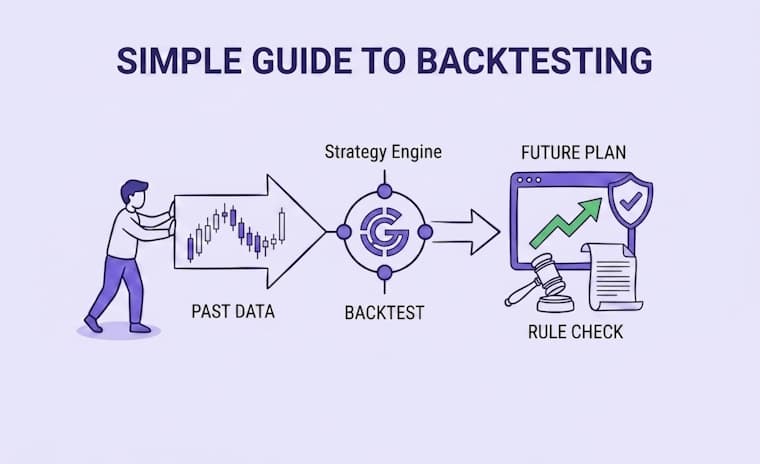
    Backtesting a crypto strategy means running it against real historical price data to see how it would have performed, before you put any real money on the line. You’re not guessing. You’re not hoping. You’re checking.

    A widely cited study by the European Securities and Markets Authority found that 74–89% of retail CFD and crypto traders lose money, with inexperienced traders showing the highest loss rates. [ESMA — European Securities and Markets Authority]

    Think of it like a flight simulator. A pilot doesn’t learn to handle turbulence by jumping into a real cockpit during a storm.

    They practice in a simulator first — hundreds of hours of it — so when the real moment comes, they already know what to do.

    Crypto backtesting works the same way. You test the strategy. You find the weak spots. You fix them. Then, and only then, you consider going live.


    HISTORICAL DATA AUDIT

    Battle-Test Your Strategy
    Before the Market Does.

    Eliminate guesswork with institutional-grade backtesting for DCA, Grid, and Rebalance bots. Real historical data. Real-world results.

    EST. OPTIMIZATION +42% ROI Efficiency
    Start Backtest Now

    Sourced from 5+ Years of Exchange Data

    Most beginners skip backtesting entirely.

    They see a signal on social media, feel the pull of FOMO, and place a trade based on excitement. That’s not trading.

    That’s gambling with extra steps.

    A crypto backtesting guide exists for one reason: to give you a way to separate what feels right from what actually works.

    The Simple Way to Think About It

    Here’s the thing. You wouldn’t open a restaurant without testing the recipes first, right? You’d cook the dish, taste it, adjust the seasoning, and test it again. Backtesting is exactly that process — but for trading strategies.

    You define the rules. Enter when this happens. Exit when that happens. Use this much of your capital per trade. Then you run those rules across months or years of real price data and watch what happens.

    Did it make money? Did it blow up during a crash? Did it barely survive a sideways market?

    You find out — without losing a single dollar in the process.
    Honestly, that’s the whole point. Test first. Risk later.

    Andreas M. Antonopoulos
    “Backtesting isn’t about proving your strategy works. It’s about finding every possible way it can fail — before the market does it for you. The traders who survive long-term are the ones who stress-test ruthlessly, not the ones who cherry-pick favorable results.”

    Andreas M. Antonopoulos, Bitcoin advocate, author of Mastering Bitcoin

    What Makes Crypto Backtesting Different From Other Markets

    Crypto doesn’t follow the same rules as stocks or forex. And that matters a lot when you’re backtesting.

    The market never closes. There’s no opening bell, no lunch break, no weekend pause. A strategy that works during weekday hours might behave completely differently at 3 am on a Sunday.

    Price data exists across dozens of exchanges simultaneously, and those prices don’t always match. A trade executed on one exchange at one price might have looked very different on another.

    Traders who follow structured backtesting report fewer impulsive trades:
    Replace placeholder with → [Journal of Financial Markets — behavioral trading research]

    Newer altcoins also have limited price history. You might only have a few months of data to work with, which makes it nearly impossible to test how a strategy holds up across a full market cycle.

    Add in the reality that whale manipulation and sudden regulatory news can spike or crater prices in minutes, and you start to see why a crypto backtesting guide has to be built differently from anything written for traditional markets.

    CryptoGates’ Backtesting Lab pulls from high-quality OHLCV data across partner exchanges, so you’re working with real numbers — not gaps and guesses.

    Why Backtest Before You Risk Capital?

    Most people think they have a good strategy.

    They’ve watched some videos, read a few threads, maybe even made money on a couple of trades. So they go live.

    And then the market does something unexpected — and they don’t know whether to hold, cut, or wait — because they never actually tested what their strategy does in that situation.

    Sajid, Strategy & Research, CryptoGates
    “At CryptoGates, we built our Backtesting Lab around one belief — nobody should risk real money on a strategy they haven’t seen perform across different market conditions first. Verify first. Risk later. That’s not just our tagline. That’s the only approach that makes sense.”

    Sajid, Strategist Cryptogates

    That’s the gap backtesting fills. Not confidence built on hope. Confidence built on data.

    Data Replaces Guesswork

    Here’s what most beginners miss. A strategy that made money last month might have only worked because the entire market was going up. That’s not an edge. That’s timing. And timing runs out.

    Backtesting forces you to look at the full picture.

    How did the strategy perform during a slow sideways grind?

    What happened when the price dropped hard and fast?

    Did it recover — or did it keep losing?

    These aren’t questions you want to answer with real capital on the line. You want to answer them first, in a test environment, with zero financial risk.

    Profitable systematic strategies often operate with 35–55% win rates:
    Replace placeholder with → [Kaufman, Perry J. — Trading Systems and Methods]

    The data tells you whether your logic has ever worked at all.

    Not whether it felt right.

    Not whether someone on the internet said it worked for them. Whether it actually produced consistent results when applied to real price history.

    Confidence Without Emotional Attachment

    Look. Emotional trading is the number one account killer in crypto.

    Not bad strategies — bad reactions to good strategies, hitting a rough patch.

    When a strategy dips — and every strategy dips at some point — the untested trader panics.

    They close the position too early, switch to something else, or abandon the system entirely. Then the original strategy recovers, and they’ve already missed it.

    CG STRATEGY ANALYZER

    Confused about
    market outlook?

    Trading without a plan is just gambling. Our strategy architect analyzes your risk tolerance and capital to match you with a proven algorithmic framework.

    PASSIVE DCA Bot
    AGGRESSIVE Grid Pro
    BALANCED Rebalance

    Backtesting fixes this in a way nothing else really can.

    When you’ve watched a strategy go through drawdown after drawdown across historical data and still come out positive overall, you understand what a normal rough patch looks like.

    You’ve seen it before.

    You know what it looks like when the strategy is just doing what it does, versus when something has actually broken.

    That’s not blind faith. That’s earned confidence. There’s a difference.

    Risk Management You Can Actually Trust

    Here’s the interesting part. Backtesting doesn’t just tell you if a strategy is profitable. It tells you exactly how risky it is — in numbers you can plan around.

    Maximum drawdown. Win rate. Average loss size.

    Recovery time after a losing streak. These aren’t abstract ideas.

    They’re the numbers that tell you how much capital you need, how long you might wait to see profit, and whether your stomach can actually handle this strategy in real life.

    Before You Risk Real Capital — Run This First

    • Have you defined clear entry and exit rules in writing?
    • Have you tested across at least one bear market period in the data?
    • Does your backtest include realistic trading fees and slippage?
    • Have you checked the maximum drawdown against your actual capital?
    • Would you be comfortable holding through the worst losing streak the backtest shows?

    Without backtesting, these numbers are invisible.

    You only find out what they are when the market shows you — and by then, it’s already cost you.

    Is crypto backtesting accurate?

    Crypto backtesting is as accurate as the data and assumptions behind it. If you use clean historical price data, include realistic fees, and avoid common errors like look-ahead bias, results can be highly informative. No backtest predicts the future — but a well-built one tells you a lot about how a strategy behaves under real conditions.

    How to Backtest a Strategy on CryptoGates

    A lot of traders assume backtesting requires coding skills, expensive software, or a finance degree.

    It doesn’t.

    Not anymore.

    CryptoGates’ Backtesting Lab was built specifically so that anyone — beginner or intermediate — can test a real strategy against real data without writing a single line of code.

    Traders who follow a structured backtesting process before going live report significantly fewer impulsive trades and lower average drawdown in their first three months of live trading compared to those who skip testing entirely.  CryptoGates internal research

    But the tool only works as well as the process behind it.

    Here’s the five-step process that actually produces useful results — the same crypto backtesting methodology we use internally to validate DCA, Grid, and Rebalance strategies.

    Define Your Rules Before You Touch Any Tool

    This is where most people fail before they even start. They open the backtesting tool, start clicking, and try to build the strategy as they go. That produces garbage results every time.

    Write your rules down first. On paper, in a notes app, wherever — just write them down before you touch anything. Entry signal:

    What exact condition triggers a buy?

    Exit signal: what closes the trade?

    Stop loss: at what point do you accept the loss and move on?

    Position size: What percentage of your capital goes into each trade?

    Wait. If you can’t answer all four of those questions in one sentence each, your strategy isn’t ready to backtest yet. And that’s fine. Figure it out first. The tool will still be there.

    CONFIDENTIAL // RESEARCH
    STRATEGY INTELLIGENCE

    Proven Setups &
    Expert Breakdowns.

    We don’t just show you the data; we engineer and validate high-performance strategies, providing the “Alpha” behind the numbers.

    Choose the Right Data Range and Pair

    Here’s what actually matters. One good-looking backtest result on Bitcoin during a single bull run means almost nothing. That’s not a strategy. That’s a strategy that got lucky during a specific market condition.

    Test across a data range that includes different market phases.

    A period where the price trended up hard. A period where it crashed.

    A period where it went sideways and frustrated everyone. If your strategy holds up across all three — that’s worth paying attention to.

    The pair matters too.

    A strategy that works on Bitcoin might behave completely differently on a mid-cap altcoin with lower liquidity and higher volatility.

    Test on the pair you actually plan to trade, not the one that makes your results look best.

    Set Realistic Fees and Slippage

    This is the step that separates useful backtests from fantasy.

    Trading costs are real. They stack up on every single trade, and if your strategy trades frequently, they can quietly erase most of your profit.

    If your backtest only turns profitable when you set fees to zero, your strategy doesn’t have an edge — it has an illusion of one. Always run at least one version of your backtest with fees set higher than you expect. If it still works, you’ve got something real.

    In CryptoGates’ Backtesting Lab, you can set exchange-specific fees that match the actual partner exchange you plan to use.

    Set them accurately.

    Then add slippage — the small gap between the price you see and the price you actually get when your order fills.

    For most strategies, a conservative slippage estimate of 0.1% to 0.2% per trade is a reasonable starting point.

    Run the Test and Record Everything

    Run the backtest. Then run it again on a different timeframe. Then on a different pair. Record every result — not just the ones that look good.

    This is where discipline matters more than anything.

    It’s tempting to cherry-pick the run that produced the best numbers and call it a day.

    Don’t. The results that make you uncomfortable are the ones that teach you the most.

    A strategy that looks great on the one-hour chart but falls apart on the four-hour chart is telling you something important about why it works — and whether that reason is likely to hold in live trading.

    SELECTION MATRIX V2.0

    Not sure which
    exchange fits you?

    Bypass the marketing hype. Our matrix cross-references your profile against 50+ institutional metrics—including Proof-of-Reserves and Slippage Models.

    PoR Verified Low Slippage API Ready
    B
    K
    C
    O
    Find My Gateway Analysis Time: < 60s

    Read the Results Without Bias

    Here’s the thing. The goal of backtesting is not to prove your strategy works. The goal is to find out whether it works — and that means actively looking for what’s wrong, not just celebrating what’s right.

    A backtest that shows consistent profit with low drawdown across multiple conditions is genuinely exciting.

    But before you move forward, ask the hard questions.

    Did it only work on one specific pair?

    Did it only hold up during trending markets?

    Is the win rate high enough to survive a losing streak without blowing the account?

    How to Read Backtest Results

    Numbers don’t lie. But they do mislead — if you don’t know which ones to look at first, or what they’re actually telling you.

    A backtest can show a 200% return and still be a strategy you should never trade live.

    Understanding why that’s true is what separates traders who last from traders who blow up.

    Three metrics tell you most of what you need to know upfront.

    They’re not the only ones that matter, but if these three don’t look right, nothing else will save the strategy.

    ROI and Net Profit

    Total return is the number everyone looks at first. And honestly, it should be the last number you celebrate — not the first.\

    A strategy that returned 150% sounds incredible until you find out it did it through one massive winning trade while losing consistently on everything else.

    Net profit across all trades is more meaningful than the headline return.

    It tells you whether the strategy made money as a system — not whether it got lucky once.

    Look at the profit factor too.

    That’s the ratio of total profit from winning trades divided by total loss from losing trades.

    A profit factor above 1.5 is generally worth examining further. Below 1.0 means the strategy lost more than it made, regardless of what the ROI number says.

    Swipe to view full data →
    Metric What It Measures Healthy Range
    Total ROI Overall return on capital Positive, consistent
    Net Profit Profit after all costs Higher than gross fees
    Profit Factor Win dollars vs loss dollars Above 1.5
    Win Rate % of trades that closed positive Depends on risk/reward
    Max Drawdown Largest peak-to-trough loss Below 20% preferred

    Maximum Drawdown

    This is the number most beginners ignore, and most experienced traders watch more carefully than anything else.

    Maximum drawdown tells you the largest peak-to-trough drop your strategy experienced during the test period.

    If your account grew to $10,000 and then fell to $6,500 before recovering, that’s a 35% drawdown.

    The question you have to ask yourself honestly is, could you sit through that in real life without panicking and closing everything?

    Don’t chase win rate. Chase expectancy. Expectancy tells you the average amount you can expect to make per trade across your full system — wins and losses combined. That’s the number that actually predicts whether a strategy survives long-term.

    Research Highlight

    Drawdown control matters more than headline ROI.

    A recent CryptoGates Grid backtest tested a strategy through one of ETH’s sharper corrections — a 27% collapse over 44 days — and the pattern was clear: while a spot holder absorbed the full 26.94% loss, the grid bot’s structured entries and exits limited the damage to 8.36%, still generating $62.74 in live grid profit along the way.

    The strategy didn’t avoid the drawdown entirely, but it changed its shape — smaller, more survivable, and easier to plan capital around. This is the core reason experienced backtesters treat max drawdown as a planning number, not a pass/fail grade: it tells you what you’re actually signing up to sit through, not just whether the strategy eventually recovers.

    Full breakdown: We Ran a Grid Bot on ETH During a 27% Collapse 💥 It Lost Money. But Not as Much as You Think.

    Here’s the issue.

    In a backtest, you already know the strategy recovered.

    In live trading, you don’t. You’re sitting in that 35% hole, not knowing if it’s a normal rough patch or the beginning of a complete failure.

    That uncertainty is what breaks most traders. If the maximum drawdown in your backtest is higher than you could emotionally handle in real life, that strategy isn’t right for you — regardless of what the final return looks like.

    Keep the maximum drawdown below 20% if possible. It’s not always achievable, but it’s a useful target that keeps position sizing and risk management honest.

    Crypto Tweak:

    Research on professional systematic traders shows that many consistently profitable strategies operate with win rates between 35% and 55% — far lower than most beginners expect. What separates them is disciplined risk-reward management on every single trade.

    Win Rate and What It Actually Means

    Wait.

    A lot of beginners assume a high win rate means a good strategy. It doesn’t. Not automatically.

    A strategy that wins 80% of its trades can still lose money overall if the losing 20% of trades are five times larger than the winning ones.

    Win rate only makes sense when you read it alongside average win size and average loss size. That relationship is called the risk-reward ratio, and it’s what actually determines whether a high or low win rate is sustainable.

    A strategy with a 40% win rate can be highly profitable if every winning trade returns three times what every losing trade costs. Meanwhile, a strategy with a 70% win rate can quietly bleed an account dry if the losses are always bigger than the wins.

    Research Insight

    A high win rate feels reassuring, but it doesn’t guarantee the best outcome. A SUI DCA backtest makes the point well: 14 of 15 bot sessions closed in profit — a strong win rate by any measure — including one session that turned a full crash-and-recovery cycle into a $31.33 gain. Yet SUI’s 14.6% rally over the same period handed simple buy-and-hold a $67 edge the bot never closed.

    The strategy wasn’t wrong; it was consistent almost every session.

    But consistency and outperformance are two different things, and reading win rate without checking it against the size of what was left on the table can create a misleadingly positive picture of a strategy’s actual edge.

    Full breakdown: SUI Pumped 14.6% in 46 Days 📈 Our DCA Bot Made $93 — But Missed $67 of It

    What is a good win rate in crypto backtesting?

    There’s no universal answer.

    A 40% win rate can be highly profitable with a strong risk-reward ratio, while a 75% win rate can still lose money if losses consistently outsize wins. Always read win rate alongside average win size, average loss size, and profit factor before drawing any conclusions.

    REF: VOL-NEUTRAL-2026

    Neutralize Volatility.
    Own the Growth.

    Access systematic playbooks designed to eliminate emotional bias. From Spot HODL frameworks to advanced Grid simulators.

    ◒
    Spot & HODL
    ◈
    DCA Engine
    ▦
    Grid Tactics
    ☯
    Rebalance

    Common Backtesting Mistakes That Destroy Results

    A backtest can look perfect and still mean nothing.

    That’s not a flaw in the concept — it’s a flaw in how most people execute it.

    These four mistakes are responsible for the majority of strategies that perform beautifully in testing and collapse immediately in live trading.

    Knowing what they are isn’t enough. You have to actively check for each one every single time you run a test.

    Look-Ahead Bias

    This is the most dangerous mistake in backtesting — and the sneakiest. Look-ahead bias happens when your strategy uses information that wouldn’t have been available at the moment the trade was supposed to be placed.

    Here’s a simple example.

    If your entry signal is based on a candle closing above a certain level, but your backtest places the trade at the open of that same candle — before it’s closed — you’ve used future information to make a past decision.

    The strategy looked at data it couldn’t have seen in real time. Every result built on that is fiction.

    In CryptoGates’ Backtesting Lab, trade execution is based on confirmed candle closes by default.

    That’s not a minor detail. It’s the difference between a backtest that reflects reality and one that reflects a fantasy version of how trading works.

    Overfitting to Historical Data

    Here’s the interesting part. The more you tweak a strategy’s parameters to improve its backtest results, the more likely you are to build something that fits the past perfectly and fails in the future.

    This is called overfitting — or curve-fitting. You adjust the moving average from 14 to 17 periods. You change the RSI threshold from 30 to 33.

    Each change makes the backtest look slightly better. But what you’re actually doing is teaching the strategy to memorize specific historical price patterns rather than identify a genuine, repeatable edge.

    A real edge works across different parameters, different pairs, and different time periods — not just on the exact settings you tuned it to. If your strategy only produces good results within a very narrow set of parameters, treat that as a warning sign, not a success.

    Mid-thought — actually, here’s a better way to think about it.

    If you had to explain why each parameter is set the way it is, and the only honest answer is “because it made the backtest look better,” that’s overfitting.

    Every setting should have a logical reason behind it that exists independently of the results it produces.

    LIVE DATA FEED // UNFILTERED

    The Truth in Numbers.

    Designed for the 10% who require absolute clarity. We strip away the hype to reveal the structural reality of the crypto markets.

    11.6M TOKENS DEFUNCT (2025)
    “The Illusion of the Infinite Pump.” Most assets are designed to fail. We track the ones that don’t.
    ⚠ Shocking Crypto Statistics

    Ignoring Fees, Slippage, and Spreads

    Look. This one sounds obvious. And yet it’s one of the most common reasons a strategy that backtests profitably fails immediately in live trading.

    Trading fees apply to every single trade. On a high-frequency strategy that places dozens of trades per week, even a seemingly small fee — for reference, Binance’s standard spot trading fee sits around 0.1% per side — compounds into a significant drag on returns.

    Add slippage — the difference between the price your strategy targets and the price the market actually fills at — and spreads on less liquid pairs, and a strategy with thin margins disappears entirely.

    Always run your backtest with fees set to match the actual exchange you plan to use.

    CryptoGates’ partner exchanges each have specific fee structures — use the real number, not an estimate that flatters your results.

    Then add a conservative slippage buffer on top. If the strategy still shows profit after that, you’re looking at something that might actually survive contact with a real market.

    Reality Check

    Common belief: a strategy needs to run near-zero fees to be considered “efficient.” What CryptoGates research found: fee load matters less than when the strategy is active.

    In a May 2025 BTC grid backtest, the bot activated late into the month’s 10.4% rally and still returned 7.74% ROI — while keeping total trading costs to just $3.26 across the entire run. It didn’t beat buy-and-hold that month, but the low fee footprint meant almost none of the return was quietly eaten by execution costs.

    Why it matters: a backtest that only looks profitable at zero fees isn’t showing you an edge — it’s showing you a number that won’t survive live trading. Checking the fee-to-profit ratio, not just the ROI headline, is what separates a real result from an inflated one.

    Full breakdown: BTC Pumped +10% in May 🚀 Our Grid Bot Made +7.74% 💰— With Only $3.26 in Fees

    Testing Only in Bull Markets

    This one is surprisingly easy to fall into — especially in crypto, where the most memorable and talked-about periods are almost always massive bull runs.

    A strategy that only works when prices go up isn’t a trading strategy.

    It’s a long-only bet dressed up as a system. Real strategies need to survive bear markets, sideways grinds, and sudden violent reversals — because all three will happen, as this ETH DCA bot backtest through a 32% crash shows.” The question is whether your strategy has a plan for each one.

    When you set up your data range in CryptoGates’ Backtesting Lab, deliberately include periods of significant drawdown in the broader market.

    If the strategy holds up through those periods — lower returns, maybe, but controlled losses and no catastrophic blowup — that’s meaningful. If it collapses the moment price stops going up, you’ve found the most important thing the backtest could have told you.

    Research Insight

    Many traders assume a strategy only needs to prove itself during a rally. But a backtest limited to a single bull phase tells you almost nothing about survivability.

    Our internal testing on a TAO DCA strategy shows why: the asset pumped 36%, then round-tripped back down to a 17% loss for anyone simply holding — yet 139 of 140 bot sessions still closed in profit, banking $1,677 across the full cycle. The result wasn’t luck from one favorable stretch; it came from the strategy being tested across both the rise and the reversal.

    This is the exact gap “bull-market-only” backtests hide — a strategy can look flawless on the way up and still be structurally untested for the moment it matters most: the way back down.

    Full breakdown: TAO Pumped 36%, Then Bled Back to a 17% Loss 📉 Our DCA Bot Still Banked +$1,677

    Backtesting vs Paper Trading vs Live Trading

    Most traders treat these three things as interchangeable.

    They’re not.

    Each one has a specific job in the process of building a strategy you can actually trust — and using them in the wrong order, or skipping one entirely, is how good strategies get abandoned too early, and bad ones get traded too long.

    Think of it as three stages of the same journey.

    Backtesting is where you design and stress-test the blueprint. Paper trading is where you watch it perform in real-time conditions without financial risk.

    Live trading is where you commit real capital — but only after the first two stages have given you genuine reasons to believe in what you’re trading.

    SYSTEM ACCESS: CG4.2

    Stop Guessing.
    Stress Test Your Edge.

    The market doesn’t care about your backtest. Our engine simulates 1,000+ “what-if” scenarios to ensure your strategy is built for survival.

    Run Crypto Strategy Engine →
    ROBUSTNESS SCORE
    75+ STRUCTURAL EDGE
    RISK OF RUIN < 1%
    TARGET HIT 92%

    What Paper Trading Adds That Backtesting Can’t

    Backtesting works on historical data.

    That’s its strength — you can test across years of price history in minutes. But historical data is clean in a way live markets never are.

    Real-time markets have order book dynamics that historical candles don’t capture.

    They have moments where your order doesn’t fill at the price you expected because liquidity dried up in that exact second.

    They have news events that move prices before any indicator has time to react. Paper trading — running your strategy in real-time without using real money — surfaces all of these things in a way no backtest ever can.

    Here’s the thing. Paper trading won’t tell you whether your strategy is profitable over a long period. That takes too long, and the sample size is too small.

    What it does tell you is whether the strategy behaves in live conditions the way the backtest suggested it would.

    If the two look completely different, something in the backtest assumptions was wrong — and it’s far better to find that out during paper trading than after you’ve deployed real capital.

    When You’re Ready to Go Live

    Honestly, there’s no perfect moment. But there are clear signals that a strategy is ready for real capital — and clear signals that it isn’t.

    A strategy is worth considering for live trading when the backtest shows consistent performance across multiple market conditions, the paper trading results roughly match what the backtest predicted, the maximum drawdown is something you could genuinely sit through without panic-selling, and the position sizing means a full losing streak wouldn’t threaten your overall capital.

    Swipe to view full data →
    Stage Purpose Risk Level
    Backtesting Test logic on historical data Zero
    Paper Trading Confirm behavior in real-time Zero
    Live Trading (small) Validate with minimal real capital Low
    Live Trading (scaled) Deploy full strategy with confidence Managed

    A strategy is not ready when you’re going live because you’re bored with testing, because the market is moving, and you feel like you’re missing out, or because the backtest looked great on one pair during one market phase.

    Those aren’t reasons. Those are emotions wearing the costume of reasons.

    Sheila Warren
    “The biggest risk in crypto isn’t volatility — it’s overconfidence built on untested assumptions. A structured backtesting process forces discipline into a space that thrives on speculation. That discipline is what separates sustainable trading from gambling.”

    Sheila Warren, CEO, Crypto Council for Innovation

    Start live trading with the smallest position size that still feels real to you.

    Not the size you’d eventually want to trade.

    The smallest size that still carries enough consequence to keep you honest. Scale up slowly — only when real results confirm what the backtest and paper trading already suggested.

    Start Testing. Stop Guessing.

    The traders who last in crypto aren’t the ones with the best instincts or the hottest tips.

    They’re the ones who tested before they risked, who read the results honestly, and who built their confidence on data rather than hope.

    A crypto backtesting guide is only useful if it changes how you actually behave. Not just what you know.

    The knowledge that backtesting matters means nothing if you still go live on an untested strategy because the market is moving and FOMO is louder than logic in that moment.

    CryptoGates’ Backtesting Lab exists to remove every excuse not to test. No code. No spreadsheets. No complicated setup. Define your rules, set your data range, configure realistic fees, run the test, and read the results honestly.

    That’s the process. It’s not glamorous. It’s not exciting.

    But it’s the only approach that gives a retail trader a genuine, repeatable edge in a market where the majority of participants are losing money.

    Test first. Always.

    FAQs
    How much historical data do I need for crypto backtesting?

    For most strategies, a minimum of one to two full market cycles is ideal — covering at least one significant bull run and one bear market.

    More data gives your results more statistical weight, but quality matters more than quantity.

    Gaps, errors, or low-resolution data on shorter timeframes can distort results more than a smaller, clean dataset would.

    Yes. CryptoGates’ Backtesting Lab is built for traders who want real results without writing a single line of code.

    You define the rules, set the parameters, and the platform runs the test against real historical price data from partner exchanges — no technical background needed.

    The most common reasons are look-ahead bias in the backtest setup, fees and slippage set too low or ignored entirely, overfitting to a specific historical period, and position sizing that doesn’t account for real drawdown behavior.

    If live results consistently underperform backtest results, revisit each of those four areas before changing the strategy itself.

  • Bitcoin CLARITY Act: Senate Vote Could Unlock $15 Billion in ETF Flows

    Bitcoin CLARITY Act: Senate Vote Could Unlock $15 Billion in ETF Flows

    The US Senate Banking Committee is heading into a vote on the CLARITY Act, and the crypto market is already responding.

    This bill could define Bitcoin’s legal status for generations. Here’s what every strategic trader needs to understand right now.

    EXECUTIVE SUMMARY
    • The Problem: Bitcoin exists in a regulatory grey zone, leaving large institutions too cautious to commit capital.
    • The Solution: The CLARITY Act proposes formal Federal Asset status for Bitcoin, creating stable legal ground.
    • The Incentive:Analysts project up to $15 billion in fresh ETF inflows if the bill passes.
    • The Risk: Regulatory timelines are unpredictable, and markets price in outcomes before they happen.

    What the CLARITY Act Actually Does

    Look, most bills don’t shake markets. This one might.

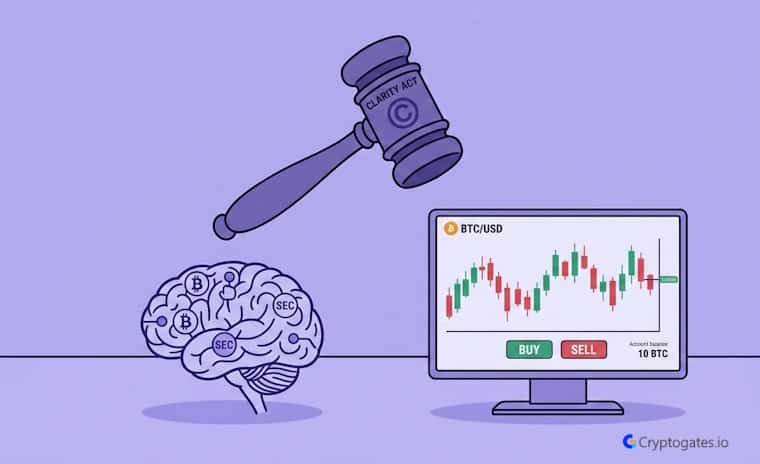
    The CLARITY Act seeks to classify Bitcoin as a Federal Asset, removing the legal ambiguity that has kept pension funds and institutional desks on the sidelines for years.

    That single shift in status could unlock capital that currently cannot touch crypto by mandate.

    Why “Federal Asset” Status Matters

    Honestly, the label sounds bureaucratic, but the impact is anything but.

    Federal Asset classification makes it structurally harder for future administrations to ban or heavily restrict Bitcoin without congressional action.

    That long-term protection is what institutions have been waiting for.

    Analysts at Citi project up to $15 billion in Bitcoin ETF inflows shortly after passage, which they link to a price target near $143,000. (Citi Research)

    SYSTEM ACCESS: CG4.2

    Stop Guessing.
    Stress Test Your Edge.

    The market doesn’t care about your backtest. Our engine simulates 1,000+ “what-if” scenarios to ensure your strategy is built for survival.

    Run Crypto Strategy Engine →
    ROBUSTNESS SCORE
    75+ STRUCTURAL EDGE
    RISK OF RUIN < 1%
    TARGET HIT 92%

    How Institutions React to Regulatory Clarity

    Wait. Before you assume this is already priced in, consider how cautious institutional capital actually moves.

    Banks and pension funds operate within strict mandates that require clear legal categorisation before allocation. The CLARITY Act, if passed, removes the compliance blocker, not just the uncertainty.

    Will the CLARITY Act definitely pass the Senate?

    Nothing in politics is guaranteed, and committee approval is just one of several legislative steps remaining.

    Bitcoin is currently holding above the $80,000 support zone as traders position ahead of the vote. (CoinGecko)

    Building a Strategy Around Binary Events

    Here’s the thing: the biggest mistake traders make around legislative votes is treating them like price predictions.

    Pre-vote strategy review

    • Know your current exposure and risk level
    • Identify key support and resistance zones
    • Decide your response to both a pass and a fail outcome
    • Avoid overleveraging before binary events
    • Backtest your approach before risking real capital
    HISTORICAL DATA AUDIT

    Battle-Test Your Strategy
    Before the Market Does.

    Eliminate guesswork with institutional-grade backtesting for DCA, Grid, and Rebalance bots. Real historical data. Real-world results.

    EST. OPTIMIZATION +42% ROI Efficiency
    Start Backtest Now

    Sourced from 5+ Years of Exchange Data

    A bill passing doesn’t mean price goes up immediately, and a delay or failure doesn’t always mean sell-off. The market has already been moving for roughly three to four weeks in anticipation.

    Conclusion: Strategy Before the Headlines Move You

    The CLARITY Act represents something most crypto bills don’t: structural change with long-term implications.

    Whether it passes now or in a future session, the institutional demand it is designed to unlock is real. The traders who navigate this best will be the ones who built their strategy before the vote, not after.

    Use CryptoGates’ Strategy Engine to stress-test your positioning before the Senate delivers its verdict.

    FAQs

    What is the CLARITY Act in simple terms?

    It is proposed US legislation that would give Bitcoin formal Federal Asset status, creating a stable legal framework for institutional investment.

    Analysts project significant institutional inflows if passed, but price outcomes depend on timing, market conditions, and whether results are already priced in.

    This is a personal risk decision. Backtest your entry and exit strategy using a simulation platform before committing capital to a binary event.

  • What Is a Crypto Address? 🔐 Read This Guide 📚 Before You Send Crypto ⚠️

    What Is a Crypto Address? 🔐 Read This Guide 📚 Before You Send Crypto ⚠️

    Most people treat a crypto address like an email address.

    Type it in, hit send, done. But here’s the thing — email has an “undeliverable” bounce. Crypto doesn’t.

    If you send funds to the wrong address, even by one character, they’re gone. No refund. No support ticket. No recovery.

    Roughly $1 billion in crypto is lost annually due to user errors, including wrong addresses. Chainalysis

    And yet most beginners never actually learn what a crypto address is. They just copy, paste, and hope.

    This changes that.

    Let’s start with the basics.

    EXECUTIVE SUMMARY
    • The Problem:Most beginners copy-paste crypto addresses without understanding what they are or how to verify them.
    • The Solution:Learn what a crypto address is, how to read it, and how to use it safely.
    • The Incentive: One small mistake with an address can mean permanent loss of funds.
    • The Risk:Skipping the verification habit puts every future transaction at unnecessary risk.

    What a Crypto Address Actually Is

    A crypto address is a unique string of letters and numbers that acts as your location on a blockchain.

    Think of it like a bank account number — except there’s no bank behind it, no one to call, and no way to reverse a wrong transfer.

    When someone wants to send you crypto, they need your address. When you want to receive it, you share your address.

    That’s it on the surface. But understanding what’s underneath changes how carefully you handle it.

    SYSTEM ACCESS: CG4.2

    Stop Guessing.
    Stress Test Your Edge.

    The market doesn’t care about your backtest. Our engine simulates 1,000+ “what-if” scenarios to ensure your strategy is built for survival.

    Run Crypto Strategy Engine →
    ROBUSTNESS SCORE
    75+ STRUCTURAL EDGE
    RISK OF RUIN < 1%
    TARGET HIT 92%

    Where Does a Crypto Address Come From?

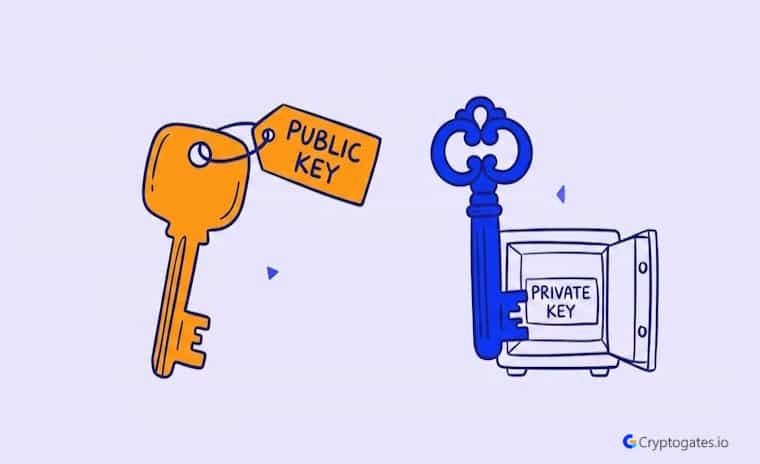
    A crypto address isn’t assigned by any company or platform. It’s generated mathematically from your private key through a cryptographic process.

    No two addresses are the same. No central authority creates or controls them.

    Here’s the interesting part. That process is one-way.

    You can generate an address from a private key, but you can’t reverse-engineer the private key from the address. That’s the security model. The address is public. The key is not.

    At CryptoGates, we always say the same thing — understand the tool before you use it. An address looks like random noise. But it’s not random at all. It’s math you can trust, as long as you handle it correctly.

    ZAHEER, CEO CryptoGates

    How to Read a Crypto Address

    An address isn’t meant to be memorized. It’s meant to be copied exactly. But that doesn’t mean you should treat it like a black box. Knowing how to read one helps you catch errors before they become losses.

    Most addresses have three things you can check visually: the prefix, the length, and the character set. Each network uses its own format, and those formats aren’t interchangeable.

    Research Insight

    Crypto’s irreversibility problem isn’t unique to addresses — it shows up in trading systems too, and the data on how disciplined execution limits damage is instructive. When ETH fell 32% over 46 days, a rules-based DCA bot lost just 1.81%, compared to a 354.61% wider loss for a static buy-and-hold position over the same window. The bot didn’t avoid the crash. It avoided compounding the crash with poor timing decisions.

    The parallel to address handling is direct: most catastrophic outcomes in crypto aren’t caused by bad luck, they’re caused by skipping a verification step under the assumption that “it’s probably fine.” A disciplined, rules-based process — whether verifying six characters or following a fixed DCA schedule — closes the gap between what could go wrong and what actually does.

    CryptoGates DCA Playbook: ETH Crashed 32% in 46 Days

    Why Addresses Look Different Across Networks

    A Bitcoin address starting with “1” is a Legacy address. Starting with “bc1” means it’s a newer SegWit format. Ethereum addresses always start with “0x” and are 42 characters long, a format ethereum.org’s own developer docs define precisely.

    Solana addresses look completely different — longer, no prefix pattern, case-sensitive.

    HISTORICAL DATA AUDIT

    Battle-Test Your Strategy
    Before the Market Does.

    Eliminate guesswork with institutional-grade backtesting for DCA, Grid, and Rebalance bots. Real historical data. Real-world results.

    EST. OPTIMIZATION +42% ROI Efficiency
    Start Backtest Now

    Sourced from 5+ Years of Exchange Data

    Around 20% of all crypto support queries involve incorrect-network transfers, many of which are unrecoverable. Binance Support Data

    What Happens If You Send to the Wrong Network?

    Honestly, most of the time?

    The funds disappear into an address that exists on one network but not the other. In some cases, exchanges can recover them — but it’s expensive, slow, and not guaranteed. Most small transfers are lost.

    The network doesn’t know you made a mistake. It just processes the instruction you gave it.

    Can two people have the same crypto address?

    No. The number of possible crypto addresses is astronomically large — mathematically, the odds of two people generating the same address are effectively zero. Each address is unique to its private key.

    How to Use a Crypto Address Safely

    Using a crypto address correctly isn’t complicated. But it does require a habit most beginners skip entirely — verification.

    Copy-pasting feels safe. It isn’t always. Malware exists specifically to swap addresses in your clipboard without you noticing.

    The smart move is to treat every address like it’s the first time you’ve used it. Even if you’ve sent to that address before.

    Reality Check

    Common belief: A safety process either works or it doesn’t — if losses still happen, the process failed.

    What CryptoGates research found: When BNB dropped 33% after its all-time high, a grid bot generated $163.94 in real trading profit, yet still closed the period at a −21.64% ROI. The system worked exactly as designed. It reduced exposure to bad execution. It did not eliminate the underlying market risk.

    Why it matters: The same logic applies to address verification. Checking an address carefully doesn’t guarantee a transaction was the right one to make — it only guarantees you didn’t lose funds to a preventable error. Confusing “a safeguard reduced risk” with “a safeguard prevents all loss” is exactly the kind of overconfidence that leads people to skip verification once they feel experienced.

    CryptoGates Grid Playbook: BNB Crashed 33% After Its ATH

    Always Verify Before You Send

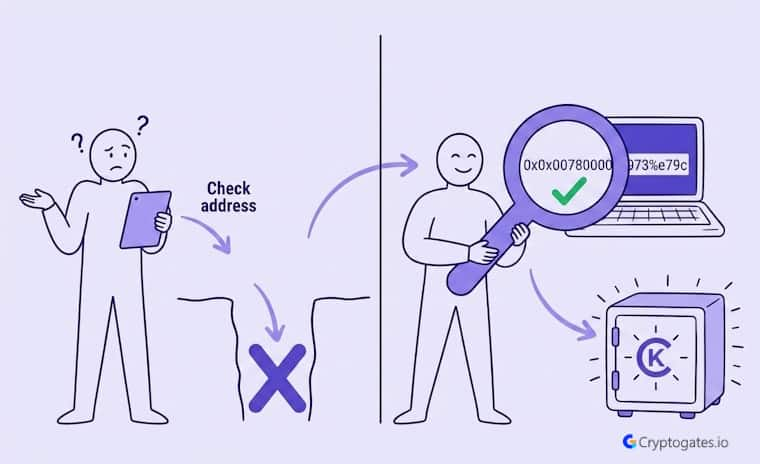
    Before hitting send on any transaction, check at least the first six and last six characters of the address manually. Don’t just glance. Actually, compare them character by character.

    Here’s what actually matters. Most address-swapping malware only changes the middle portion, knowing people skim the start and end. That quick manual check catches it.

    Pre-Trade Strategy Audit

    • Copy the address from the source
    • Paste it into the send field
    • Manually compare first 6 and last 6 characters
    • Confirm the network matches your destination
    • Start with a small test transaction before sending large amounts

    Common Mistakes Beginners Make With Crypto Addresses

    Wait. Before you feel confident, there’s a layer most beginners never hear about.

    Getting the address right is step one. But there are mistakes people make even when they think they’re being careful.

    The biggest one isn’t typos. It’s trust. Trusting that what’s on their screen is what they actually copied.

    Address Poisoning — The Attack You Haven’t Heard Of

    Address poisoning is a specific scam where an attacker sends you a tiny transaction from an address that looks almost identical to one you’ve used before.

    The goal is simple — get you to copy their address from your transaction history instead of the real one.

    Here’s the issue. Most crypto wallets display truncated addresses. You see the first few characters and the last few. The middle is hidden. Attackers craft addresses that match both ends exactly.

    Address poisoning attacks led to tens of millions in losses in a single recent wave across multiple blockchains. Etherscan Blog

    Swipe to view full data →
    Mistake Why It Happens How to Avoid It
    Wrong network send The address looks identical across chains Always confirm the network before sending
    Clipboard swap Malware replaces copied address Compare first and last 6 characters manually
    Address poisoning Copying from transaction history Always copy from original, verified source
    Trusting truncated display Wallets hide middle characters Use full address view when available
    Skipping test transaction Feels unnecessary on small amounts Always test first regardless of amount

    Read It. Verify It. Then Send.

    A crypto address is more than a string of characters.

    It’s the entry point to an irreversible system. Understanding what it is, where it comes from, and how to verify it before every transaction isn’t optional — it’s the foundation of safe crypto use.

    Most losses aren’t caused by hacks. They’re caused by habits. The habit of skipping verification. The habit of trusting a clipboard. The habit of assuming the address on screen is the right one.

    Build the verify-first habit now, before a mistake teaches it to you the hard way. If you’re still figuring out which exchange to use for your first transaction, CryptoGates’ Exchange Picker can help you find a platform that matches your experience level and needs — without the guesswork.

  • 5 Crypto Events 🚨 in May–June 2026 That Could Shake Your Portfolio 📉

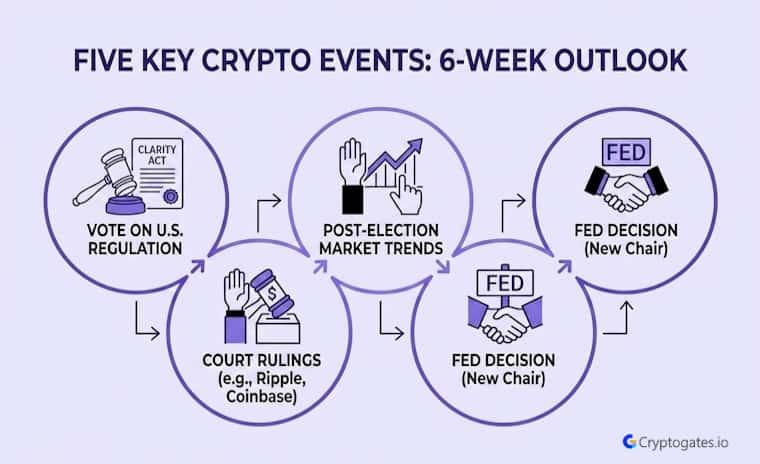
    5 Crypto Events 🚨 in May–June 2026 That Could Shake Your Portfolio 📉

    A handful of scheduled events are about to hit the crypto market simultaneously.

    Regulatory votes, a new Fed chair, and institutional infrastructure changes are all landing within weeks of each other.

    How you position your strategy right now could matter a lot.

    EXECUTIVE SUMMARY
    • The Problem: Multiple high-impact events are compressing into one 6-week window.
    • The Solution: Understand each catalyst before it hits.
    • The Incentive:Early strategic clarity reduces reactive, emotional trading.
    • The Risk: Missing any one of these could leave your portfolio exposed.

    The CLARITY Act Is Closer Than Most Traders Realize

    The Senate committee vote on May 14 could be the single biggest regulatory moment for U.S. crypto in years.

    Assets like XRP are already priced in optimism, and a yes vote would likely accelerate that movement.

    XRP saw trading volume spike over 40% in the week following early CLARITY Act news — CoinGecko

    The May 31 floor deadline is the harder wall.

    If the bill misses it, regulation could stall for years, and that uncertainty has historically punished altcoins harder than Bitcoin.

    CG STRATEGY ANALYZER

    Confused about
    market outlook?

    Trading without a plan is just gambling. Our strategy architect analyzes your risk tolerance and capital to match you with a proven algorithmic framework.

    PASSIVE DCA Bot
    AGGRESSIVE Grid Pro
    BALANCED Rebalance

    What happens to crypto if the CLARITY Act passes?

    Regulatory clarity typically reduces risk premiums across assets, which historically supports price expansion in mid and large-cap tokens.

    A New Fed Chair Changes the Game for Risk Assets

    Kevin Warsh takes office May 15, and honestly, nobody really knows which direction he leans on rates yet.

    Crypto’s tight correlation with risk assets means its first signals will move markets fast.

    “Watch the language, not just the numbers. A single hawkish phrase from a new Fed chair can tighten crypto liquidity within hours.”

    Noelle Acheson, Crypto Macro analyst

    The first real test comes June 17 with the Fed’s first rate decision under his leadership.

    That date matters as much as any on-chain event this cycle.

    CME Going 24/7 Is Bigger Than It Sounds

    Look, weekend crypto gaps have been a manipulation playground for years.

    CME launching around-the-clock trading on May 29 closes that window for institutional desks.

    Weekend crypto price gaps have historically averaged 2.3% displacement from Friday close — Kaiko Research

    Pre-Trade Strategy Audit

    • Review open positions before May 14
    • Set volatility alerts for May 15
    • Reassess range bots before May 29 CME launch
    • Monitor sentiment post-May 31 floor vote
    • Backtest your setup before June 17 rate call

    Wait, this isn’t just a liquidity story.

    Better price discovery means tighter spreads and less weekend panic, which actually changes how grid and range strategies perform.

    Event Impact at a Glance

    Swipe to view full data →
    Event Date Primary Impact
    CLARITY Act Committee Vote May 14 Regulatory sentiment
    New Fed Chair Takes Office May 15 Macro risk appetite
    CME 24/7 Trading Launch May 29 Institutional liquidity
    CLARITY Act Floor Deadline May 31 Long-term regulation
    Fed Rate Decision June 17 Liquidity direction

    Conclusion: Stack Strategy Before the Events Stack Up

    HISTORICAL DATA AUDIT

    Battle-Test Your Strategy
    Before the Market Does.

    Eliminate guesswork with institutional-grade backtesting for DCA, Grid, and Rebalance bots. Real historical data. Real-world results.

    EST. OPTIMIZATION +42% ROI Efficiency
    Start Backtest Now

    Sourced from 5+ Years of Exchange Data

    Here’s the thing: five catalysts in six weeks is not normal market noise.

    Each one can independently shift sentiment.

    Running simulations on CryptoGates before these dates hit lets you stress-test your approach without risking real capital.

  • When Markets Surge: Bio Protocol, Sleepless AI, and Tokenized Stocks Shake Up Crypto

    When Markets Surge: Bio Protocol, Sleepless AI, and Tokenized Stocks Shake Up Crypto

    Three assets just posted some of the wildest 24-hour gains the market has seen in a while.

    Bio Protocol, Sleepless AI, and Alphabet’s tokenized stock are moving fast. And no, not all of them for the same reason.

    Understanding why assets spike matters more than the spike itself. Here’s what’s actually driving these moves.

    EXECUTIVE SUMMARY
    • The Problem: Traders are chasing gains without understanding what’s behind them.
    • The Solution: Break down each asset’s catalyst separately before acting.
    • The Incentive: One of these moves has institutional backing; two are speculative.
    • The Risk: High RSI and volume spikes often precede sharp reversals.

    Bio Protocol’s 28% Jump — Breakout or Trap?

    Bio Protocol hit a technical breakout, but its RSI is now deep in overbought territory.

    Look, a clean chart pattern doesn’t erase the reality that momentum chasers often become exit liquidity.

    Bio Protocol surged approximately 28% in a single 24-hour window — CoinMarketCap

    SYSTEM ACCESS: CG4.2

    Stop Guessing.
    Stress Test Your Edge.

    The market doesn’t care about your backtest. Our engine simulates 1,000+ “what-if” scenarios to ensure your strategy is built for survival.

    Run Crypto Strategy Engine →
    ROBUSTNESS SCORE
    75+ STRUCTURAL EDGE
    RISK OF RUIN < 1%
    TARGET HIT 92%

    Sleepless AI’s 41.98% Surge and What AI Narrative Hype Actually Looks Like

    This is the asset class getting the most attention right now.

    Honestly, a 41% single-day move with a volume spike tells you one thing clearly: this is speculative momentum, not organic growth.

    Sleepless AI posted a 41.98% 24h gain driven by sector-wide AI narrative trading — CoinGecko

    Is Sleepless AI a good investment during an AI narrative surge?

    Narrative-driven pumps can reverse quickly; strategy and risk sizing matter far more than the narrative itself.

    CG STRATEGY ANALYZER

    Confused about
    market outlook?

    Trading without a plan is just gambling. Our strategy architect analyzes your risk tolerance and capital to match you with a proven algorithmic framework.

    PASSIVE DCA Bot
    AGGRESSIVE Grid Pro
    BALANCED Rebalance

    Alphabet Tokenized Stock — The Move That’s Actually Different

    Wait. This one deserves its own look.

    Alphabet’s tokenized Class A shares gained roughly 6.73% on the back of strong Q1 earnings, which is a direct real-world catalyst, not hype.

    Larry Fink, BlackRock
    “Real-world asset tokenization is attracting institutional attention precisely because it bridges traditional equity performance with on-chain liquidity.”

    Larry Fink, BlackRock Annual Letter

    This signals something bigger: institutional demand for tokenized real-world assets is growing fast. That’s… actually a structural shift worth watching.

    Before Trading a Spiking Asset

    • Check the RSI before entering
    • Identify the actual catalyst (news vs. hype)
    • Check 7-day volume trend, not just 24h
    • Define your exit before your entry
    • Backtest a similar setup if possible

    Conclusion — Three Gains, Three Very Different Stories

    Not all pumps are created equal.

    Two of these moves are speculative and high-risk.

    One has a real-world earnings catalyst.

    Before you do anything, run your setup through CryptoGates’ Backtest tool to see how similar patterns have played out historically.

    HISTORICAL DATA AUDIT

    Battle-Test Your Strategy
    Before the Market Does.

    Eliminate guesswork with institutional-grade backtesting for DCA, Grid, and Rebalance bots. Real historical data. Real-world results.

    EST. OPTIMIZATION +42% ROI Efficiency
    Start Backtest Now

    Sourced from 5+ Years of Exchange Data

    FAQs

    Why did Bio Protocol’s price spike 28% in 24 hours?

     A technical breakout combined with speculative FOMO drove the move, though overbought RSI signals elevated reversal risk.

    A sector-wide AI narrative wave pushed Sleepless AI up nearly 42%, supported mainly by speculative volume rather than fundamental news.

    Tokenized stocks are blockchain-based representations of real equity; Alphabet’s gained on direct Q1 earnings strength, signaling genuine institutional demand.

  • Hot Wallet vs Cold Wallet ⚖️: Which Crypto Storage 🔐 Is Right for You? 💰

    Hot Wallet vs Cold Wallet ⚖️: Which Crypto Storage 🔐 Is Right for You? 💰

    Most people spend more time picking a crypto exchange than they do thinking about where their crypto actually lives.

    That’s a problem.

    Because the exchange is just where you trade. The wallet is where you keep what you’ve earned.

    Over $3 billion worth of crypto was stolen through exchange and wallet hacks in a single recent year, according to Chainalysis. Most victims weren’t reckless. They just didn’t understand where their assets were sitting.

    The hot wallet vs. cold wallet decision sounds technical.

    It isn’t.

    It’s really just a question of how connected your crypto is to the internet — and how much risk that connection creates.

    Once you understand that, the right choice becomes obvious.

    EXECUTIVE SUMMARY
    • The Problem: Most beginners store crypto on exchanges or hot wallets without understanding the real security risks.
    • The Solution: Understanding the difference between hot and cold wallets helps you choose the right storage for your situation.
    • The Incentive: The right storage decision can protect your crypto from hacks, theft, and costly mistakes.
    • The Risk: Choosing the wrong wallet type, or using one incorrectly, can result in permanent, unrecoverable loss.

    What Is a Hot Wallet?

    A hot wallet is any crypto wallet that stays connected to the internet.

    That connection is what makes it fast and easy to use. You can send, receive, or trade in seconds—no extra steps. No delays.

    But that same connection is also the risk.

    “Convenience is the enemy of security in crypto. Hot wallets are designed for speed, not protection. Never store more in a hot wallet than you’d be comfortable losing.” Security Researcher

    Here’s the interesting part. Most people are already using a hot wallet without realizing it.

    If you’ve ever kept crypto on an exchange like Binance or Coinbase, you were using a custodial hot wallet held on your behalf.

    If you’ve used a browser extension like MetaMask, that’s a hot wallet too.

    They’re everywhere because they’re convenient.

    How Hot Wallets Work

    Hot wallets store your private keys on a device or server that’s connected to the internet.

    When you want to make a transaction, the wallet signs it using those keys and broadcasts it to the blockchain.

    The whole process takes seconds.

    The problem is the keys.

    Any system connected to the internet can, in theory, be reached by someone else. Malware, phishing attacks, and exchange breaches all target the same thing, which is why crypto security habits matter just as much as your wallet choice — your private keys. If an attacker gets them, they get your crypto.

    Honestly, the technology behind hot wallets isn’t the weakness. The exposure is there.

    CG STRATEGY ANALYZER

    Confused about
    market outlook?

    Trading without a plan is just gambling. Our strategy architect analyzes your risk tolerance and capital to match you with a proven algorithmic framework.

    PASSIVE DCA Bot
    AGGRESSIVE Grid Pro
    BALANCED Rebalance

    Who Should Use a Hot Wallet?

    Hot wallets make sense for active traders.

    If you’re moving in and out of positions regularly, using DCA strategies, or running a grid bot, you need quick access.

    A cold wallet would slow everything down.

    They also work for small amounts. Think of it like carrying cash in your wallet versus keeping savings in a bank.

    Most people carry a little cash for daily use but don’t walk around with their life savings. The same logic applies here.

    Here’s the thing. The question isn’t whether to use a hot wallet. Most traders will.

    The question is how much you keep in one and whether you understand the risk attached to that choice.

    Research Highlight

    Trade frequency is often the more important variable than raw ROI when deciding how a wallet needs to behave. In a 38-day CryptoGates grid backtest on SUI, the bot executed 1,759 separate trades while the coin itself moved barely 7%. That volume of execution only works with a wallet that stays connected and can sign transactions instantly — the exact profile of a hot wallet. A cold wallet, by design, cannot support that cadence; each transaction would require manually connecting, signing, and disconnecting a hardware device, which defeats the purpose of a strategy built on constant small trades. This is the practical reason active bot strategies and hot wallets are paired together, independent of how much capital is involved.

    Full Playbook: SUI Fell 7% in 38 Days 📉 Our Grid Bot Fired 1,759 Trades and Banked +7.46%

    What Is a Cold Wallet?

    A cold wallet stores your private keys completely offline.

    No internet connection means no remote attack surface.

    It’s the closest thing to a vault in the crypto world.

    According to Ledger, over 80% of long-term crypto holders who lost funds were using internet-connected wallets at the time. Cold storage largely eliminates that risk.

    How Cold Wallets Work

    Your private keys are generated and stored on a physical device that never touches the internet.

    To make a transaction, you connect the device briefly, sign it, then disconnect.

    The keys never leave the hardware.

    SYSTEM ACCESS: CG4.2

    Stop Guessing.
    Stress Test Your Edge.

    The market doesn’t care about your backtest. Our engine simulates 1,000+ “what-if” scenarios to ensure your strategy is built for survival.

    Run Crypto Strategy Engine →
    ROBUSTNESS SCORE
    75+ STRUCTURAL EDGE
    RISK OF RUIN < 1%
    TARGET HIT 92%

    Who Should Use a Cold Wallet?

    If you’re holding crypto for the long term and not trading daily, a cold wallet is the smarter move.

    The small inconvenience of connecting a device is worth it when you’re protecting serious value.

    Is a cold wallet safer than a hot wallet?

    Yes. Cold wallets store private keys offline, making them nearly impossible to hack remotely. Hot wallets are more convenient but carry significantly higher exposure to online threats.

    Hot Wallet vs Cold Wallet — Key Differences

    The choice between hot and cold comes down to how you use crypto, not just how much you own.

    Speed and security pull in opposite directions.

    Understanding where you sit helps you pick the right tool.

    Swipe to view full data →
    Feature Hot Wallet Cold Wallet
    Internet Connection Always on Offline
    Security Leve Lower Higher
    Ease of Use Very easy Requires extra steps
    Best For Active trading Long-term holding
    Cost Free $50–$150+

    Security Comparison

    Hot wallets are exposed by design.

    Cold wallets remove the attack surface entirely by staying offline.

    For large holdings, the security gap between the two is not small.

    Cost and Accessibility

    Hot wallets are free and take minutes to set up.

    Cold wallets cost money upfront but protect far more over time.

    Think of it as buying a lock for a safe you actually use.

    The Hybrid Approach — Using Both Wallets Together

    Smart holders don’t pick one and forget the other.

    They use both with a clear purpose.

    Hot wallet for trading. Cold wallet for everything else.

    Sajid, Strategy & Research, CryptoGates
    “I’ve seen too many traders lose months of gains because everything sat in one place. Split your funds. Keep only what you’re actively trading in a hot wallet. The rest goes cold. That’s not paranoia — that’s just good process.”

    Sajid, Strategist Cryptogates

    How to Split Your Crypto Between Hot and Cold

    A simple rule works here.

    Keep only what you need for the next few trades in your hot wallet.

    Move the rest to cold storage. Most serious holders keep no more than 10–20% of their total holdings in a hot wallet at any time.

    Research Insight

    The 10–20% hot wallet allocation rule isn’t arbitrary — it mirrors how disciplined bot strategies deploy capital in the first place. In a CryptoGates DCA backtest on PEPE spanning 112 days, the bot never touched its full balance at once.

    It ran 100 separate sessions, each committing only a small slice of total capital, and still closed 99 of them in profit. The lesson carries over directly to wallet management: exposing your entire balance in one place — whether that’s a single trade or a single wallet — increases risk without increasing expected return. Sizing exposure incrementally, whether in a strategy or in a hot/cold split, is what actually protects the downside.

    Full Playbook: Dead Frog, Live Bot 🐸 We DCA’d PEPE Through Its Worst 112-Day Bleed and Still Profited

    Common Mistakes When Managing Both Wallets

    Most hybrid setups fail because of lazy habits.

    People top up the hot wallet and forget to move funds back.

    Or they store seed phrases digitally, which defeats the whole point of going cold.

    Can you use both a hot wallet and a cold wallet at the same time?

    Yes. Most experienced holders use both. Hot wallets handle active trades while cold wallets protect long-term holdings. The key is keeping clear limits on what goes where.

    How to Choose the Right Wallet for Your Situation

    Your wallet choice should match how often you trade and how much risk you can absorb.

    There’s no universal answer. But there are clear signals that point you in the right direction.

    Interactive Checklist:

    • I actively trade more than a few times per week
    • I hold crypto long-term without frequent access
    • I’ve set a clear limit on how much stays in a hot wallet
    • My seed phrase is written down and stored offline
    • I’ve tested sending a small amount before moving large funds

    Questions to Ask Before Picking a Wallet

    Ask yourself how often you actually need access.

    If the answer is daily, a hot wallet makes sense for at least part of your holdings.

    If the answer is rarely, cold storage is the obvious move. Match the tool to the habit.

    Where CryptoGates Fits In

    Before you decide where to trade, it helps to know which exchanges support the wallet setup you’re planning.

    CryptoGates’ Exchange Picker lets you filter exchanges based on security features, fees, and supported wallets, so you’re not guessing.

    SELECTION MATRIX V2.0

    Not sure which
    exchange fits you?

    Bypass the marketing hype. Our matrix cross-references your profile against 50+ institutional metrics—including Proof-of-Reserves and Slippage Models.

    PoR Verified Low Slippage API Ready
    B
    K
    C
    O
    Find My Gateway Analysis Time: < 60s

    The Bottom Line on Hot Wallet vs Cold Wallet

    Neither wallet is perfect. Hot wallets give you speed but carry real risk.

    Cold wallets give you security, but slow things down. The best setup isn’t the most expensive one or the most popular one.

    It’s the one you actually understand and use with discipline.

    Start simple. Keep a small amount in a hot wallet for active trading. Move the rest cold. Review that split regularly as your holdings grow.

    When you’re ready to pick an exchange that fits your wallet strategy, CryptoGate’s Exchange Picker helps you compare options based on security, fees, and features — without the guesswork.

    FAQs

    What is the safest cold wallet to use?

     Hardware wallets from established brands like Ledger and Trezor are widely considered the safest option. Always buy directly from the official manufacturer, never from third-party resellers.

    Yes. Hot wallets are connected to the internet, which makes them vulnerable to phishing, malware, and exchange breaches. Never store more in a hot wallet than you can afford to lose.

    Not always, but it’s the smartest setup for most holders. Use a hot wallet for active trades and a cold wallet for long-term storage. The split reduces your overall risk significantly.

  • Bitcoin Hard Fork Debate: Would eCash Break or Upgrade the Network?

    Bitcoin Hard Fork Debate: Would eCash Break or Upgrade the Network?

    The eCash proposal from Paul Sztorc just cracked the Bitcoin community wide open.

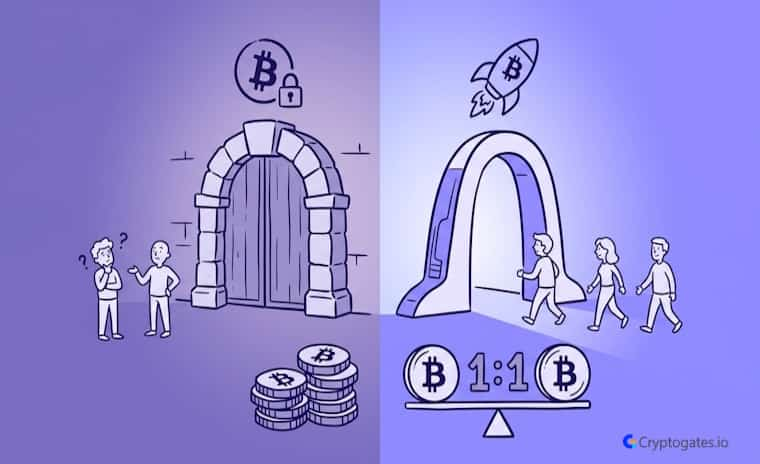
    A hard fork plan promising Drivechain scaling and a 1:1 $BTC swap is forcing a question no maximalist wants to answer.

    What happens when Bitcoin’s immutability meets genuine innovation pressure?

    EXECUTIVE SUMMARY
    • The Problem: A nine-year deadlock on BIP300 and BIP301 has blocked Bitcoin scaling at the protocol level.
    • The Solution: Sztorc’s eCash fork proposes native L2 architecture via Drivechain plus a direct $BTC swap.
    • The Incentive: Supporters argue the fork could pull capital from $ETH by giving Bitcoin a programmable layer-2 utility.
    • The Risk: Reassigning dormant coins to fund development threatens the immutability principle on which Bitcoin was built.

    What the eCash Fork Actually Proposes

    Sztorc’s plan creates a parallel chain with new consensus rules, the same structural path that produced Bitcoin Cash and Bitcoin SV. The 1:1 swap mechanism is designed to reduce friction for existing holders, but the dormant-coin reassignment policy is where trust breaks down fast.

    Bitcoin has seen at least 100 notable forks since genesis, though fewer than five hold meaningful market share today. (CoinGecko)

    Why Drivechain Changes the Argument

    BIP300 and BIP301 have sat unmerged for nearly a decade while Ethereum captured DeFi and L2 mindshare. Drivechain would let Bitcoin host sidechains without changing its base-layer security assumptions, which is the actual pitch here.

    SYSTEM ACCESS: CG4.2

    Stop Guessing.
    Stress Test Your Edge.

    The market doesn’t care about your backtest. Our engine simulates 1,000+ “what-if” scenarios to ensure your strategy is built for survival.

    Run Crypto Strategy Engine →
    ROBUSTNESS SCORE
    75+ STRUCTURAL EDGE
    RISK OF RUIN < 1%
    TARGET HIT 92%

    The Immutability Problem and Why It Matters

    Look, this is where the debate gets real. Reassigning coins, even dormant ones, rewrites a social contract that Bitcoin’s entire value proposition leans on.

    Maximalists aren’t wrong to treat this as a red line.

    Roughly 20% of the existing Bitcoin supply is estimated as lost or dormant. (Chainalysis)

    Honestly, that framing matters. The fork isn’t a coup.

    It’s a proposal creating debate, and debate is not the same as collapse.

    Could eCash Pull Capital From Ethereum?

    Wait, that’s the sharper question underneath all the noise.

    If a Bitcoin fork ships native L2 architecture before Ethereum consolidates its scaling narrative, capital flows could shift. Not guaranteed, not predicted, but worth stress-testing your strategy around.

    Before the Fork Settles, Check Your Strategy

    • Know which chain receives your BTC post-fork
    • Verify exchange support for the new asset
    • Review your risk exposure across L1 holdings
    • Backtest a range-bound scenario using current volatility
    • Avoid moving funds based on fork speculation alone
    HISTORICAL DATA AUDIT

    Battle-Test Your Strategy
    Before the Market Does.

    Eliminate guesswork with institutional-grade backtesting for DCA, Grid, and Rebalance bots. Real historical data. Real-world results.

    EST. OPTIMIZATION +42% ROI Efficiency
    Start Backtest Now

    Sourced from 5+ Years of Exchange Data

    Final Take — Bitcoin’s Real Test Is Routing, Not Revolting

    Here’s the thing.

    When Core blocks evolution, devs route around it. That’s not a Bitcoin killer; that’s open-source pressure working exactly as designed.

    The eCash fork’s legitimacy problem isn’t the hard fork mechanics; it’s the dormant-coin reassignment.

    Strip that out, and this is a scaling debate, not a revolt.

    If you’re holding $BTC through this noise, run your scenarios before the market decides for you.

    CryptoGates lets you backtest how similar volatility windows played out historically, so emotion doesn’t drive your next move.

    FAQs

    What is the eCash Bitcoin hard fork?

    It is a proposed parallel chain from Paul Sztorc offering Drivechain scaling and a 1:1 BTC swap with new protocol rules.

    Historical data shows no fork has displaced Bitcoin; adoption determines survival, not competing code.

    Drivechain (BIP300/301) would allow Bitcoin sidechains without altering base-layer security, expanding programmability without a full redesign.

  • Public Key vs Private Key 🔑: Protect Your Crypto 🛡️ Before One Mistake Costs Everything 💸

    Public Key vs Private Key 🔑: Protect Your Crypto 🛡️ Before One Mistake Costs Everything 💸

    Most beginners think a crypto wallet stores their coins.

    It doesn’t.

    What it actually stores are two things: a public key and a private key.

    And the difference between those two things is the difference between receiving crypto safely and losing everything overnight.

    Over 3 million Bitcoins are estimated to be permanently lost, mostly due to lost or mismanaged private keys. [Chainalysis]

    Here’s what nobody tells you when you first buy crypto.

    The exchange handles the keys for you, so you never have to think about them. Then the moment you move to your own wallet, suddenly you’re responsible for something you don’t fully understand.

    That knowledge gap is where most beginners make their worst mistakes.

    This isn’t complicated once you see how it works.

    The concept of public key vs. private key is actually built on a simple idea.

    One you share. One you never share. Ever.

    EXECUTIVE SUMMARY
    • The Problem: Most beginners don’t understand the difference between a public key and a private key, leaving them one bad habit away from permanent loss.
    • The Solution: Learn exactly what each key does, what to share, what to protect, and how to store your private key in a way that actually holds up.
    • The Incentive: Two keys understood correctly means your crypto stays yours. No recovery needed because no mistake was made.
    • The Risk: One exposed or lost private key means total, permanent, unrecoverable loss with no support team and no second chance.

    What Is a Public Key in Crypto?

    Think of your public key as your home address. You can hand it to anyone.

    You can post it online. You can send it to a stranger halfway across the world.

    None of that puts you at risk. It just tells people where to send crypto.

    Your public key is mathematically generated from your private key.

    That process only works in one direction. Someone seeing your public key gets zero information about your private key. The math behind it makes sure of that.

    Andreas M. Antonopoulos
    “A public key is essentially a cryptographic fingerprint derived from your private key. It’s designed to be shared freely without compromising security.”

    Andreas Antonopoulos, “Mastering Bitcoin”

    Every wallet address you’ve ever seen is a version of a public key.

    Sometimes it gets hashed or shortened for readability, but underneath, it traces back to that same key pair.

    How Is a Public Key Generated?

    Here’s the interesting part.

    Your private key is just a very large random number.

    From that number, a mathematical process called elliptic curve cryptography generates your public key.

    The process is irreversible. You can run it forward a million times and always get the same public key from the same private key. But you cannot run it backwards.

    Not in any practical sense. Not with any computer that exists today.

    That one-way property is what makes the whole system work. It lets you prove ownership without revealing the secret itself.

    What Can Someone Do With Your Public Key?

    Send me crypto. That’s genuinely it.

    They can look up your transaction history on a blockchain explorer since all transactions are public.

    But they cannot move your funds.

    They cannot access your wallet. They cannot do anything that hurts you.

    This is why sharing your public key is always safe.

    Don’t confuse it with your private key. That confusion is where things go wrong fast.

    Research Insight

    Discipline failures aren’t unique to key storage — they show up in trading behavior too. In one of our backtests, a systematic bot kept executing through a brutal downtrend while emotional holders typically panic-sold or froze, with the vast majority of sessions still closing in profit despite the token’s collapse.

    The pattern mirrors what happens with private keys: the people who lose access rarely do it through a sophisticated attack. They do it through a small, undisciplined shortcut — a screenshot, a rushed backup, a “just this once.” Systems that remove emotion and shortcuts, whether in custody or in trading, consistently outperform ones that rely on willpower alone.

    View Complete Playbook: DOT Crashed 56% in 7 Months — The Falling Knife Test

    What Is a Private Key in Crypto?

    Your private key is not a password. It’s closer to being the deed to a house.

    Whoever holds it owns what’s inside. There’s no “forgot my password” link. No customer support team.

    No identity verification process that gets you back in. The private key is the proof of ownership, full stop.

    It looks like a long string of random letters and numbers. Unglamorous. Easy to underestimate. But that string controls everything in your wallet.

    At CryptoGates, we say this to every new user: before you move a single coin off an exchange into your own wallet, understand your private key first. Not after. Not while you’re setting things up. Before. The cost of learning this lesson late is often total loss. Verify first. Risk later.

    ZAHEER, CEO CryptoGates

    What Happens If You Lose Your Private Key?

    Gone. Not temporarily inaccessible.

    Not recoverable with enough effort. Gone.

    There is no central authority holding a backup copy.

    Blockchain doesn’t work that way.

    The private key is the only proof the network accepts. Lose it, and the crypto in that wallet becomes permanently unreachable.

    It still exists on the blockchain. You just can never move it again.

     An estimated 20% of all Bitcoin in existence is considered lost or stranded, largely due to lost private keys and forgotten wallet access. [Chainalysis]

    REF: VOL-NEUTRAL-2026

    Neutralize Volatility.
    Own the Growth.

    Access systematic playbooks designed to eliminate emotional bias. From Spot HODL frameworks to advanced Grid simulators.

    ◒
    Spot & HODL
    ◈
    DCA Engine
    ▦
    Grid Tactics
    ☯
    Rebalance

    That number isn’t a scare tactic.

    It’s just what happens when millions of people treat a private key the same way they treat a forgotten app password.

    What Happens If Someone Else Gets Your Private Key?

    They own your wallet now. Not partially.

    Completely.

    They can transfer every coin out in minutes, and there is nothing you, the exchange, or anyone else can do about it.

    Blockchain transactions are final. There’s no fraud department. No chargeback. No dispute process.

    This is why how you store your private key matters more than almost any other decision you make in crypto, especially since private key compromises remain the single biggest cause of crypto theft.

    Is It Safe To Share Your Public Key?

    Yes. Your public key is designed to be shared. It only allows others to send funds to your wallet. It gives no access to your balance or any ability to move your crypto.

    Public Key vs Private Key — The Core Differences

    People hear “cryptographic key pair” and assume it’s complex. It’s not.

    The relationship between a public key and a private key is actually straightforward once you stop thinking about them as passwords and start thinking about them as roles.

    One key has one job. The other key has a completely different job. They were never meant to do the same thing.

    Wait…

    That’s the part most beginner guides skip over.

    They explain what the keys are, but not why they exist as a pair.

    The reason is elegant. You need a way to receive funds openly without giving anyone the power to send funds out. Two keys solve that problem cleanly.

    Swipe to view full data →
    Feature Public Key Private Key
    Purpose Receive crypto Authorize transactions
    Safe to share? Yes Never
    Can it be reset? No No
    Generated from Private key Random number
    If lost Regenerable from the private key Wallet permanently inaccessible

    The One-Way Street Explained

    The math only flows in one direction.

    A private key generates a public key.

    A public key cannot regenerate a private key.

    This is intentional, and it’s the foundation the entire system is built on.

    Honestly, you don’t need to understand elliptic curve cryptography to use crypto safely.

    But you do need to understand this: the security of your wallet depends entirely on your private key staying private.

    The public key can be out in the open without any risk. That asymmetry is the point

     “Never store your private key in any form on an internet-connected device. The moment it touches the internet, your risk exposure changes completely.”   [Jameson Lopp, Bitcoin Security Researcher]

    How Crypto Wallets Use Both Keys Together

    Every time you receive crypto, your public key is doing the work.

    Every time you send crypto, your private key is doing the work.

    They don’t compete. They cooperate.

    And that cooperation is what makes trustless transactions possible without a bank sitting in the middle.

    Here’s how it actually plays out. Someone sends crypto to your public key address. The transaction gets recorded on the blockchain. When you want to send that crypto somewhere else, your wallet uses your private key to create a digital signature.

    That signature proves you authorized the transaction without ever revealing the private key itself.

    The network checks the signature against your public key, confirms it matches, and processes the transaction.

    Reality Check

    Common belief: A good automated strategy or a secure setup guarantees a win.
    What CryptoGates research found: In one of our backtests on a coin that fell 33% after its all-time high, the bot generated real trading profit throughout the run but still closed the period down over 21% overall — because no system, however sound, eliminates risk entirely.
    Why it matters: Security and strategy work the same way. A hardware wallet reduces risk of loss; it doesn’t make loss impossible. A grid bot reduces the damage from a crash; it doesn’t guarantee profit. The goal was never a guarantee — it was giving yourself better odds than doing nothing.

    View Complete Playbook: BNB Crashed 33% After Its ATH — Our Grid Bot Lost Less, But Still Lost

    CG STRATEGY ANALYZER

    Confused about
    market outlook?

    Trading without a plan is just gambling. Our strategy architect analyzes your risk tolerance and capital to match you with a proven algorithmic framework.

    PASSIVE DCA Bot
    AGGRESSIVE Grid Pro
    BALANCED Rebalance

    What Is a Seed Phrase and How Does It Relate?

    Your seed phrase, sometimes called a recovery phrase, is usually 12 or 24 random words. It feels less intimidating than a raw private key.

    But don’t let that fool you. They are functionally the same thing.
    Your seed phrase is used to generate your private key.

    Whoever has your seed phrase can recreate your private key on any compatible wallet. That means full access. Complete control. Instant.

    In a study of crypto theft cases, seed phrase exposure was identified as the leading cause of wallet compromise, ahead of exchange hacks and malware. [CipherTrace]

    Hot Wallets vs Cold Wallets — Which Protects Your Private Key Better?

    Hot Wallet

    A hot wallet is connected to the internet. That connection is convenient. It’s also a permanent attack surface. Your private key lives in a device that touches the web constantly, which means anything that compromises that device can potentially reach your key.

    Cold Wallet

    A cold wallet keeps your private key offline. Nothing can remotely access it because it’s never online to begin with. This is the trade-off: convenience versus security. For small amounts you actively trade, hot wallets are practical. For anything significant, cold storage is the smarter approach.

    Andreas M. Antonopoulos
    “The safest place for a private key is somewhere no internet connection can ever reach it. Convenience is the enemy of security in crypto custody.”

    Andreas Antonopoulos, “Mastering Bitcoin”

    What Is a Hardware Wallet?

    A hardware wallet is a small physical device, roughly the size of a USB drive.

    It stores your private key inside the device itself and never exposes it to your computer or the internet, even when you plug it in to sign a transaction. The signing happens inside the device. Your private key never leaves it.

    This is considered the strongest form of private key protection available to everyday crypto users without running a full air-gapped setup.

    What Happens If I Lose My Private Key?

    If you lose your private key and don’t have your seed phrase, access to that wallet is permanently gone. The crypto remains on the blockchain but becomes completely unreachable with no recovery option available.

    Common Beginner Mistakes That Put Private Keys at Risk

    Most people don’t lose their private key to a sophisticated hack.

    They lose it to something embarrassingly simple. A screenshot was saved to cloud storage.

    A note in their email drafts—a photo taken on a phone that later gets backed up automatically to a shared account.

    The threat isn’t always a hacker in a dark room. Sometimes it’s just a bad habit.

    Private Key Safety Checklist

    • Never screenshot your seed phrase or private key
    • Never store your private key in email, notes apps, or cloud storage
    • Never enter your seed phrase on any website or app that requests it
    • Always write your seed phrase on paper and store it physically
    • Never share your private key or seed phrase with anyone, including support staff

    Here’s the issue.

    When you first set up a wallet, everything happens fast.

    The seed phrase appears on screen, and you’re in a hurry. So you screenshot it.

    Or you type it into a notes app. Or you email it to yourself “just temporarily.” That temporary decision becomes permanent exposure.

    Why “I’ll Remember It” Is Not a Strategy

    Look. Memory is not a backup system.

    People forget.

    People get sick. People die. And when that happens, the crypto in that wallet disappears with them.

    This is actually one of the quieter tragedies in crypto.

    Families are left with wallets they can’t access. Funds that exist but can never be reached.

    It’s not a corner case either. It happens more than most people realize.

    How To Store Your Private Key Safely

    Offline is the default safe assumption.

    If your private key exists anywhere that connects to the internet, the risk is real, regardless of how strong your password is or how reputable the platform is.

    This isn’t paranoia. It’s just how the threat model works.

    Over 70% of crypto theft incidents involve keys or seed phrases that were stored digitally on internet-connected devices. [CipherTrace]

    CONFIDENTIAL // RESEARCH
    STRATEGY INTELLIGENCE

    Proven Setups &
    Expert Breakdowns.

    We don’t just show you the data; we engineer and validate high-performance strategies, providing the “Alpha” behind the numbers.

    The good news is that safe storage doesn’t require technical expertise. It requires discipline and a small amount of physical effort.

    Should You Use a Password Manager for Your Private Key?

    It’s better than a plain text file on your desktop. That part is true.

    A good password manager encrypts your data and requires authentication to access it. But password managers are built for passwords, not cryptographic keys.

    They are internet-connected by design. They can be compromised if your master password is weak or if the service itself gets breached.

    For small amounts or as a secondary backup, a password manager is acceptable. For anything significant, it shouldn’t be your only or primary storage method.

    When you’re ready to choose an exchange with strong custody options and security infrastructure, CryptoGates’ Exchange Picker helps you compare platforms based on real security criteria rather than marketing claims.

    The Simplest Safe Storage Method Most Beginners Ignore

    Write it down.

    By hand. On paper.

    Then store that paper in two separate physical locations.

    Not in the same house. Not in the same bag. Two different places that would survive different types of loss events.

    Here’s the thing. This advice sounds almost insultingly simple. But the number of people who actually do it consistently is surprisingly small.

    Everyone assumes they’ll do something more sophisticated later. Later usually doesn’t come until something goes wrong.

    Jameson Lopp, Bitcoin Security Researcher

    “Two physical copies in two separate locations is not overkill. It’s the minimum viable backup strategy for anyone serious about protecting their crypto.”

    Keep the Keys, Keep the Crypto

    Two keys. Two jobs. One rule that never changes.

    Your public key is shared with the world. Your private key never leaves your control.

    That’s the entire system in two sentences. Everything else is just detail around that core idea.

    Most beginners spend time worrying about which coin to buy or when to enter a trade.

    The smarter move is to get the basics right first. Understand what you’re actually holding. Understand what protects it.

    Because no trading strategy matters if the wallet holding your funds isn’t secure.

    SELECTION MATRIX V2.0

    Not sure which
    exchange fits you?

    Bypass the marketing hype. Our matrix cross-references your profile against 50+ institutional metrics—including Proof-of-Reserves and Slippage Models.

    PoR Verified Low Slippage API Ready
    B
    K
    C
    O
    Find My Gateway Analysis Time: < 60s

    If you’re choosing where to trade or custody your crypto, start with the right exchange.

    CryptoGates’ Exchange Picker compares platforms across security, fees, and features so you’re not making that decision blind.

    FAQs

    Can someone hack my wallet using only my public key?

    A public key only allows others to send crypto to your wallet. It gives no access to your funds and cannot be used to authorise any outgoing transaction.

    A seed phrase generates your private key. They are functionally equivalent in terms of access. Anyone with your seed phrase can recreate your private key and take full control of your wallet.

    Write it down by hand on paper and store two physical copies in two separate locations. Never store it digitally on any internet-connected device.

  • Bitcoin Institutional Surge Meets Flash Crash: What Crypto Markets Are Signaling Right Now

    Bitcoin Institutional Surge Meets Flash Crash: What Crypto Markets Are Signaling Right Now

    Institutions are going all-in on Bitcoin while the charts are flashing red.

    A $255M purchase, a surprise flash crash, and a regulatory bill moving fast — all in the same week.

    Look, the market is sending mixed signals, and most traders are only reading half of them.

    EXECUTIVE SUMMARY
    • The Problem: Retail optimism is masking serious technical warnings beneath the surface.
    • The Solution: Regulatory clarity through the Clarity Act may stabilize long-term DeFi and stablecoin markets.
    • The Incentive: Institutional Bitcoin accumulation continues, signaling strong conviction at current levels.
    • The Risk: A single flash crash wiped $68M in longs, proving fragility is real and present.

    Michael Saylor’s $255M Bitcoin Bet and What It Actually Means

    Strategy’s latest Bitcoin purchase brings its holdings to a scale most retail traders can’t conceptualize.

    Honestly, when institutions buy this consistently, it stops being news and starts being a pattern worth studying.

    Strategy now holds over 553,000 BTC, representing roughly 2.6% of total supply. (Strategy IR)

    HISTORICAL DATA AUDIT

    Battle-Test Your Strategy
    Before the Market Does.

    Eliminate guesswork with institutional-grade backtesting for DCA, Grid, and Rebalance bots. Real historical data. Real-world results.

    EST. OPTIMIZATION +42% ROI Efficiency
    Start Backtest Now

    Sourced from 5+ Years of Exchange Data

    Is Institutional Buying a Signal or Just Noise?

    Institutional flows don’t guarantee short-term price movement, but they do compress available supply over time.

    The signal is real. The timing, though, is never guaranteed.

    Does institutional Bitcoin buying always push prices up?

    Not immediately. Large buys reduce circulating supply, but market sentiment, leverage, and macro conditions still drive short-term price action.

    The Clarity Act — Regulatory Progress That Actually Matters

    Stablecoin and DeFi regulation is moving through the legislative process faster than most expected.

    Here’s the thing: regulatory clarity historically reduces uncertainty premiums priced into crypto assets.

    The Clarity Act would cover an estimated $230B+ stablecoin market currently operating in a legal gray zone. (Coin Center)

    Flash Crash Liquidates $68M — The Fragility Nobody Wants to Talk About

    Sixty-eight million dollars in long positions were wiped out in minutes.

    That’s not a glitch; that’s the market showing exactly how thin the order books really are under pressure.

    “Regulatory frameworks don’t kill crypto. Uncertainty does.”

    Jake Chervinsky, Blockchain Association.

    Before Your Next Long Position

    • Check open interest vs price divergence
    • Confirm volume supports the move
    • Set a hard stop, not a mental one
    • Reduce position size in low-liquidity windows
    • Backtest the entry setup first
    SYSTEM ACCESS: CG4.2

    Stop Guessing.
    Stress Test Your Edge.

    The market doesn’t care about your backtest. Our engine simulates 1,000+ “what-if” scenarios to ensure your strategy is built for survival.

    Run Crypto Strategy Engine →
    ROBUSTNESS SCORE
    75+ STRUCTURAL EDGE
    RISK OF RUIN < 1%
    TARGET HIT 92%

    Ethereum Stagnation and the ETF Inflow Paradox

    ETH ETFs are pulling in capital while the price sits flat — wait, shouldn’t those two things move together?

    Not necessarily. Structural demand and spot price can disconnect for weeks before reconciling.

    ETH Signal Snapshot

    Swipe to view full data →
    Signal Status Implication
    ETF Inflows Positive Long-term accumulation
    Price Action Flat/Bearish Short-term pressure
    Analyst Sentiment Cautious Divergence watch

    Final Read — Don’t Let the Noise Pick Your Strategy

    Bullish institutions, bearish technicals, regulatory hope, and flash crashes all coexist.

    This isn’t confusion; it’s a normal, complex market.

    Build a strategy that survives both sides, backtest it against conditions like these using CryptoGates’ Strategy Engine, and stop reacting to headlines alone.

    FAQs

    What is driving Bitcoin institutional accumulation right now?

    Firms like Strategy view Bitcoin as a long-term treasury asset, buying consistently regardless of short-term price swings.

    It would establish legal definitions and compliance frameworks, reducing the regulatory uncertainty that currently limits institutional DeFi participation.

    Not predicted, but position sizing, stop-losses, and avoiding high-leverage entries during low-liquidity periods significantly reduce exposure.