
 Bitcoin
  Ethereum
  BNB
BNB  XRP
XRP  Solana
  TRON
TRON  Dogecoin
  Hyperliquid
  Zcash
Zcash  Stellar
  Cardano
  Monero
  Chainlink
  Hedera
  Sui
Sui  Shiba Inu
  Bittensor
  World Liberty Financial
  Aster
Aster  Ripple USD
  Polkadot
  Uniswap
  Render
  Artificial Superintelligence Alliance
Here’s the thing.
The single biggest reason traders fail isn’t the market. It’s timing. They buy when excitement peaks. They sell when fear hits bottom. They repeat this cycle until their account is empty.
A DCA bot exists to solve exactly that problem. It doesn’t feel exciting. It doesn’t feel fear. It just executes — on schedule, on your terms, without hesitation.
84% of retail crypto traders lose money in their first year — and 58% lose almost all of their capital within that same period.
NFTevening Retail Crypto Trader Survey, August 2025 — 1,005 traders
But here’s what most guides won’t tell you.
A DCA bot running on untested settings is still a gamble. You’ve just automated the gamble.
This guide fixes that.
You’ll learn what a DCA bot actually is, how every type works, which settings matter, when DCA fails, and — most importantly — how to backtest your strategy before risking a single dollar.
Verify first. Risk later. Scale slowly. That’s the only way this works.
- The Problem: Most traders activate DCA bots with zero testing — then blame the bot when settings they never verified fail with real money.
- The Solution: Backtest every DCA parameter on real historical data before going live.
- The Incentive: A backtested DCA bot removes emotion, lowers average cost, and runs 24/7 without you watching charts.
- The Risk: DCA into the wrong asset with the wrong settings doesn't protect you, it just slows down the loss. Asset selection and parameter testing are not optional steps.
What Is Dollar Cost Averaging — And Why Crypto Changes Everything
Dollar cost averaging isn’t a new idea. It didn’t start in crypto. But the way it behaves in crypto is fundamentally different from where it came from — and most guides skip that part entirely.
Understanding the difference matters. Applying traditional DCA logic to crypto without adjusting for volatility is one of the most common setup mistakes beginners make.
Where DCA Originally Came From
DCA started in traditional finance. Index fund investors used it for decades, put a fixed amount into the S&P 500 every month, regardless of price. Buy more units when the price is low, fewer when the price is high.
Over time, your average cost stays below the average market price.

Andreas M. Antonopoulos, Mastering Bitcoin
It worked because the underlying assets, broad market index funds, had decades of historical upward trend behind them.
The recovery was almost always coming. Patience paid off.
Why Crypto DCA Hits Differently
Crypto volatility runs 5–10x higher than traditional markets. That changes everything about how DCA performs.
Bitcoin has historically experienced annualized volatility of 60–80%, compared to roughly 15–20% for the S&P 500 — making it 3 to 4 times more volatile than traditional equity markets.
Fidelity Digital Assets Research — “A Closer Look at Bitcoin’s Volatility”
Higher volatility means bigger price swings. That creates more opportunity to accumulate at lower prices, but it also means the drawdowns DCA has to survive are far more severe. A 50% drop in a stock index is a crisis. In crypto, it’s a regular bear market.
There’s another difference. Crypto trades 24 hours a day, seven days a week. No market hours. No holidays. That means more entry points, more automation opportunities, and more moments where emotion could derail a manual strategy.
A bot solves that.
Honestly, the biggest difference is this: traditional markets have a near-guaranteed long-term recovery. Crypto doesn’t. DCA into Bitcoin or Ethereum has strong historical backing. DCA into an unproven altcoin is a different risk entirely.
The Math That Makes DCA Work
Look at a simple example. You invest $100 every week for four weeks. Prices are $40,000 — $35,000 — $30,000 — $38,000.
| BTC Pricec | Units Bought | Cumulative Avg Cost |
|---|---|---|
| $40,000 -Week 1 | 0.0025 | $40,000 |
| $35,000 -Week 2 | 0.00286 | $37,313 |
| $30,000 -Week 3 | 0.00333 | $34,483 |
| $38,000 -Week 4 | 0.00263 | $35,531 |
Total invested: $400. Average cost: $35,531. A lump sum on Week 1 would have cost $40,000 per BTC.
That gap — $4,469 lower average cost — is what DCA delivers. Not through prediction. Through consistency.
Battle-Test Your Strategy
Before the Market Does.
Eliminate guesswork with institutional-grade backtesting for DCA, Grid, and Rebalance bots. Real historical data. Real-world results.
What Is a DCA Bot — And How Does It Actually Work
Most people understand DCA as a concept. Buy regularly. Stay consistent. Don’t panic. But doing that manually, week after week, through crashes and rallies, is harder than it sounds.
Life gets in the way. Emotions get louder. Buys get skipped exactly when they matter most.
A DCA bot removes that problem entirely. It doesn’t need motivation. It doesn’t check the news before buying. It just executes — every time, on schedule, without hesitation.
From Manual DCA to Automated DCA
Here’s the issue with manual DCA. It works perfectly in theory and fails quietly in practice.
You plan to buy it every Monday. Then Bitcoin drops 20% in a weekend. Suddenly Monday feels wrong. You tell yourself you’ll wait for it to stabilize.
It drops another 10%. Now you’re scared. You skip the buy. Then it recovers — and you’ve missed the lowest entry of the entire cycle.

ZAHEER, CEO CryptoGates
That skipped buy isn’t a small mistake. It’s the exact moment DCA was designed for.
A bot doesn’t skip it. A bot buys more of it.
The Mechanical Flow Inside a DCA Bot
A DCA bot isn’t complicated.
It follows a fixed sequence every cycle.
| Sequence | Detailed Description |
|---|---|
| Step 1 | You define your parameters. Asset, investment amount per interval, frequency, take-profit target, stop-loss level. |
| Step 2 | The bot connects to your exchange via API. Read and trade permissions only. Your funds stay on the exchange. The bot never holds them. |
| Step 3 | At your scheduled interval, the bot places a buy order regardless of price. No hesitation. |
| Step 4 | The bot tracks your cumulative average entry cost across all purchases. |
| Step 5 | When your take-profit target is hit, the bot exits the position. Or you exit manually. |
| Step 6 | The bot restarts the cycle. |
That’s it. Six steps. Repeat until you tell it to stop.
What a DCA Bot Is NOT
Wait. Before going further — this matters more than most guides admit.
A DCA bot is not a prediction engine. It has no view on where the price is going. It doesn’t analyze news, sentiment, or on-chain data. It executes on schedule. That’s its entire job.
It’s not a profit guarantee. DCA into a failing asset still loses money. The bot just loses it more slowly and more consistently than panic selling would.
It’s not a replacement for research. The bot automates HOW you buy.
It has nothing to say about WHAT you buy. Asset selection remains entirely your responsibility.
And it’s not fire-and-forget. A DCA bot needs periodic health checks — not daily watching, but regular review. More on that in Section 10.
Every Type of DCA Bot — Explained
Here’s what most guides get wrong about DCA bots. They describe one type, fixed interval, and call it a complete picture.
It isn’t. Six distinct types exist, each designed for different market conditions, different risk tolerances, and different trader goals.
Knowing which type fits your situation isn’t optional. Using the wrong type in the wrong market condition is one of the most common reasons DCA bots underperform.

DCA buys only — building a position over time with the expectation that price will move higher. Grid trading buys and sells repeatedly within a defined price range, profiting from oscillation without a directional view. DCA fits trending or volatile markets. Grid fits sideways, ranging markets.
Fixed Interval DCA Bot
This is the simplest type. Buy a fixed dollar amount at fixed time intervals, daily, weekly, biweekly, monthly. Price doesn’t matter. Schedule does.
Best for complete beginners who want automation without complexity.
The weakness is equally simple, it buys at peaks and dips without distinction. In a strong uptrend, it accumulates efficiently. In a prolonged bear market, it keeps buying through extended pain.
Example: $100 every Monday at 9am, regardless of Bitcoin’s price that day.
Value-Weighted DCA Bot
This type is smarter. It compares the current price to a moving average, typically 30 or 50 days.
When the price is below the average, it buys more. When the price is above, it buys less.
Backtests across multi-year BTC data show value-weighted DCA outperforming fixed interval DCA by 8–15% in volatile market conditions.
CryptoGates Strategy Lab
Proven Setups &
Expert Breakdowns.
We don't just show you the data; we engineer and validate high-performance strategies, providing the "Alpha" behind the numbers.
It’s not market timing.
It’s systematic price awareness.
Best for intermediate users who want to optimize entries without manually watching charts.
Price Deviation DCA Bot
This type only triggers when price drops by a set percentage. Set it to buy only when BTC drops 3% from the last purchase price, the bot stays idle until that threshold is hit.
The advantage is clear.
You accumulate only on dips, not on schedule. The risk is equally clear. In a strong bull market where price only goes up, the bot never triggers.
Capital sits idle while the market runs.
Multi-Asset DCA Bot
Instead of one asset, this type runs DCA across multiple assets simultaneously. You set the allocation — 50% BTC, 30% ETH, 20% SOL — and the bot executes all three on schedule, rebalancing as each DCA runs.
Best for long-term holders building a diversified crypto portfolio automatically. Requires more capital and more careful weight-setting than single-asset DCA.
Spot DCA Bot vs Futures DCA Bot
This distinction is the most important one in this entire section.
Spot DCA buys actual cryptocurrency. You own the asset. If price drops 60%, your position is down 60% but it still exists. There’s no forced exit.
Future DCA uses leverage. The bot builds a leveraged position over time. Gains are amplified.
So are losses.
And unlike spot, a futures DCA bot can be liquidated. If the price drops far enough, the exchange closes your position and you lose the capital, not gradually, but completely.

Nic Carter, Castle Island Ventures
CryptoGates’ position is simple: backtest on spot first.
Never run futures DCA without fully understanding your liquidation level and how far price has historically dropped in your chosen asset.
Reverse DCA Bot
This one most guides never mention. Instead of buying gradually, it sells gradually.
Use case: you hold a large crypto position and want to de-risk without dumping everything at once , which would crash the price and destroy your own exit.
A reverse DCA bot sells a fixed amount at fixed intervals, capturing profit methodically while keeping part of the position running.
It’s not an entry strategy. It’s an exit strategy. And for anyone sitting on significant unrealized gains, it’s one of the most underused tools in crypto.
DCA Bot Parameters — What to Set and Why It Matters
Most traders spend more time picking an asset than they spend on parameter settings.
That’s backwards.
Two DCA bots running on the same asset with different parameters can produce completely different results — one profitable, one not.
Parameters aren’t just configuration fields. Every single one has a consequence.
Get it right and the bot works as intended. Get it wrong and you’ve automated a losing strategy.
There's no universal minimum — it depends on your chosen exchange, the asset, and your frequency. The practical floor is an amount where trading fees don't consume a significant percentage of each buy. On most major exchanges, $25–$50 per interval is a reasonable starting point for weekly DCA on major assets.
Core Parameters Every Bot Has
These five settings exist in every DCA bot on every platform.
Understanding what each one does. and what happens when it’s wrong, is non-negotiable before going live.
Asset
What you’re buying. This is the most important decision in the entire setup.
A DCA bot running on Bitcoin has historical data going back over a decade.
A DCA bot running on a newly launched altcoin has nothing to validate against.
Choose assets with strong long-term fundamentals and meaningful price history. The bot automates the how. What is entirely on you.
Investment amount per interval
How much you buy each cycle. The rule is simple, never more than you can afford to lock up for three to twelve months.
DCA is not a short-term strategy. Capital committed to a DCA bot is not available for other opportunities. Size accordingly.
Frequency
How often the bot buys. Daily, weekly, biweekly, monthly.
Here’s the interesting part, backtests consistently show weekly and biweekly outperforming daily on most major assets.
Daily buying looks more thorough, but trading fees compound faster than the cost-averaging benefit delivers on small portfolios.
Take-profit target
The percentage gain at which the bot exits the position.
Set this too high and the bot never exits, capital stays locked indefinitely.
Set it based on what your backtest shows is historically achievable, not what you hope is possible.
Not necessarily — but Bitcoin is the strongest starting point for most users. It has the longest track record, the deepest liquidity, and the most validated backtest data. DCA into Ethereum carries similar logic with slightly higher volatility. DCA into altcoins introduces meaningfully higher risk and requires stronger fundamental conviction before committing.
Stop-loss
The percentage loss at which the bot closes to protect remaining capital.
This is the setting most beginners either skip entirely or set too tight.
No stop-loss means one black swan event can erase months of accumulation.
Too tight a stop-loss means normal volatility triggers an exit before DCA has time to work.
Advanced Parameters
Once core parameters are solid, these settings allow meaningful optimization.
Safety orders
Additional buy orders that trigger when price drops by a set percentage below your last purchase.
They deepen your position on dips and pull your average cost down faster. Think of them as planned dip-buying, built into the bot’s logic.
Volume scaling
Each safety order is larger than the previous one.
Instead of buying the same amount at each dip level, you buy more as the price falls further.
This accelerates average cost reduction, but it also requires significantly more capital in reserve.
Price deviation percentage
How far the price must fall before a safety order activates.
Set it too tight and safety orders trigger on normal intraday noise. Set it too wide and they never trigger in moderate corrections.
Max safety orders
A hard cap on how many additional buys the bot makes.
This is your capital exposure control. Without a cap, a deep enough crash keeps triggering safety orders until your account is empty.
The bot mechanism itself is straightforward and well-tested on major platforms. The risks are elsewhere — in asset selection, parameter settings, platform security, and API permission management. A DCA bot on a reputable exchange with trade-only API permissions and a backtested strategy is as safe as any automated crypto tool gets. No crypto tool eliminates market risk.
Trailing take-profit
Instead of a fixed exit point, the take-profit level moves upward as price moves up.
In a strong rally, this locks in significantly more profit than a static target would capture.
The Most Common Parameter Mistakes
Here’s what actually goes wrong — not in theory, but in practice.
Setting take-profit too high is the most common error. Traders set 50% or 80% targets based on hope, not historical data. The bot accumulates faithfully for months and never exits because the target was never realistic. Capital stays locked. Opportunity cost grows.
Setting stop-loss too tight is the second most common. A 5% stop-loss on Bitcoin — an asset that regularly moves 10–15% in a week — means the bot gets stopped out during normal volatility before DCA has a chance to work.
Too many safety orders without enough capital is quietly dangerous. Each safety order requires reserved capital. If you set six safety orders but only have enough capital for three, the bot runs out of funds mid-position. Your average cost stays higher than planned. Your take-profit becomes harder to hit.
DCA frequency too high on small portfolios destroys returns through fees. Buying $20 of Bitcoin daily on an exchange charging 0.1% per trade costs $7.30 annually in fees alone — before any other costs. On a small account, that matters.
No stop-loss at all works until it catastrophically doesn't. Most traders who skip stop-loss have never lived through a genuine black swan event. Backtesting one will change that perspective immediately.
Parameter Setup Checklist — Before You Configure Any DCA Bot
- Asset has at least 2 years of price history to backtest against
- Investment amount per interval is money you can lock up for 6–12 months
- Frequency set to weekly or biweekly — not daily on small portfolios
- Take-profit target validated against historical backtest data — not guesswork
- Stop-loss set wide enough to survive normal volatility, tight enough to limit black swan damage
When DCA Bots Work — And When They Fail
This section doesn’t exist in any competitor guide.
Every other DCA resource sells you on the benefits and moves on. That’s not honest. And it’s not useful.
DCA bots are powerful in the right conditions.
In the wrong conditions, they compound losses with the same consistency they’d otherwise compound gains.
Knowing the difference isn’t pessimism — it’s how you protect your capital.
Market Conditions Where DCA Bots Excel
Bear markets are where DCA earns its reputation.
When price is falling consistently, every scheduled buy accumulates more units at lower cost. By the time recovery arrives, the average cost is well below the recovery price. The bot did exactly what it was designed to do.
Ranging or sideways markets are equally strong for DCA.
Price oscillates without a clear trend. Regular buying at different points in the range builds an average cost near the middle — and when the range eventually breaks upward, the position is well-placed.
Early bull markets reward DCA bots that started accumulating during the preceding bear phase. The low average cost built during the downturn means strong unrealized gains as the rally develops.
High-volatility assets create more price swings, which means more opportunity to accumulate at lower points within each swing.
The same volatility that makes crypto uncomfortable to hold manually is what makes DCA mechanically effective.
Bear markets are actually where DCA bots perform best. Consistently buying at lower prices through a prolonged decline builds a cost basis well below the eventual recovery price. The traders who benefit most from DCA are typically the ones who kept the bot running through the hardest months — not the ones who stopped it when prices dropped.
Market Conditions Where DCA Bots Underperform
A strong straight-line bull market is actually DCA’s weakest environment.
If price only goes up from day one, a lump sum at the start would have outperformed every DCA buy that came after.
But here’s the reality, nobody knows in advance which bull runs will be straight-line and which will be volatile.
DCA’s underperformance in straight-line rallies is the cost of protection against every other scenario.
Post-bubble accumulation at inflated prices is a subtler risk.
DCA started near a market top and accumulated at prices that may take years to revisit. The strategy still works long-term on strong assets — but the timeline extends dramatically.
Asset-Specific DCA Risks
Not all DCA is equal.
The asset determines the risk profile far more than the bot settings do.
DCA into Bitcoin or Ethereum carries the strongest historical backing. Both have survived multiple 80%+ crashes and recovered to new highs. The track record exists.
Backtesting can validate it.
DCA into established altcoins with real utility and adoption carries moderate risk. Higher volatility creates bigger average cost opportunities — but recovery is less certain than BTC or ETH.
DCA into meme coins isn’t a strategy. It’s speculation with a schedule. Backtesting usually confirms this within the first few test runs.
DCA into new or unproven projects — anything without at least two to three years of price history — means backtesting can’t give you meaningful data. Without data, you’re guessing. And guessing with automation is still guessing.
Backtests consistently show weekly or biweekly outperforming daily on most major assets. Daily buying looks more thorough but trading fees compound faster than the cost-averaging benefit delivers — especially on smaller portfolios. Monthly DCA reduces fees further but misses more intramonth price variation. Weekly sits in the optimal middle for most configurations.
The Psychological Failure Points of DCA
Here’s what actually kills DCA strategies. Not the market. The trader.
Failure point one:
Stopping the bot during a crash. A 30% drop feels catastrophic. It’s also exactly when DCA is working hardest — accumulating more units at the lowest prices of the cycle. Stopping the bot at this moment locks in the loss and misses the recovery buys.
Failure point two:
Increasing the investment amount during FOMO peaks. The price is surging. Excitement builds. The trader doubles the buy amount — right at the top. Average cost spikes. Recovery takes longer.
Failure point three:
Abandoning the strategy after three months without giving it a full cycle. DCA is designed for full market cycles — accumulation, recovery, take-profit exit. Judging it at the three-month mark is like judging a harvest in the first week of planting.
Failure point four:
Running DCA with no take-profit plan. The position grows. Price rises. But there’s no exit trigger. The trader holds through the next crash and gives back everything DCA built.
The Truth in Numbers.
Designed for the 10% who require absolute clarity. We strip away the hype to reveal the structural reality of the crypto markets.
Why You Must Backtest Before Going Live
Most DCA bot guides end at setup. Connect API, set parameters, press start. That’s where CryptoGates begins a completely different conversation.
Because here’s what those guides don’t say. Two traders running the same asset with different parameters can produce completely different outcomes. One exits profitably after three cycles. The other holds an underwater position for eight months wondering what went wrong. The difference wasn’t luck. It was testing.
Backtesting isn’t a bonus feature. It’s the step that separates informed automation from expensive guessing.
The Problem With Untested DCA Strategies
Look at what actually happens when traders skip backtesting.
They choose a take-profit target that feels reasonable — say, 25%. They go live.
Months pass. The target never hits because historical data would have shown that 25% was only reached twice in three years on that asset. A backtest would have caught that in sixty seconds.
They set daily buys without checking fee impact. On a $50 daily investment, trading fees quietly consume 1–2% of returns annually. A backtest surfaces immediately. A live bot surfaces it six months later when the numbers don’t add up.
They run safety orders without knowing how many were historically triggered in real bear markets. They budget for three triggers.
Real market data would have shown seven triggers during the last correction. They run out of capital mid-position. Average cost stays elevated. Take-profit becomes harder to reach.
Yes. You can pause or stop a DCA bot at any time through your exchange or platform interface. The key is deciding your stop and pause conditions before going live — not in the heat of a market crash when emotion is loudest. A written exit plan made in advance is what separates disciplined stops from panic stops.
What Backtesting Proves for DCA Bots
A proper backtest doesn’t just show you returns.
It shows you the full picture of how your strategy behaves across different market conditions.
It tells you whether your chosen frequency — daily versus weekly — actually performs better on your specific asset over real historical data. Not in theory. On actual price movement.
It shows whether your take-profit target was historically achievable or whether it sat unreached across entire market cycles. That distinction alone saves months of locked capital.
It reveals how many safety orders were triggered during real bear markets, corrections, and black swan events. You see the capital requirement before it’s your capital on the line.
“Every experienced DCA user on CryptoGates reports the same pattern — the traders who backtest first almost never abandon their strategy mid-cycle. The ones who skip it almost always do.”
Most importantly, it shows you the maximum drawdown — the worst the strategy got before recovering.
That number matters more than the return figure. Because if you can’t emotionally and financially handle the drawdown, you’ll stop the bot at exactly the wrong moment.
Knowing the number in advance is the difference between holding through it and panic-stopping at the bottom.
How to Backtest a DCA Bot on CryptoGates
The process is straightforward. Seven steps from setup to go-live decision.
Step one — go to the CryptoGates DCA Backtest Tool and select DCA Bot as your strategy type.
Step two — choose your asset and timeframe. Test a minimum of twelve to twenty-four months of historical data. Shorter timeframes only show you one market condition. You need to see how the strategy behaves across a full cycle — accumulation, bear market, recovery, bull run.
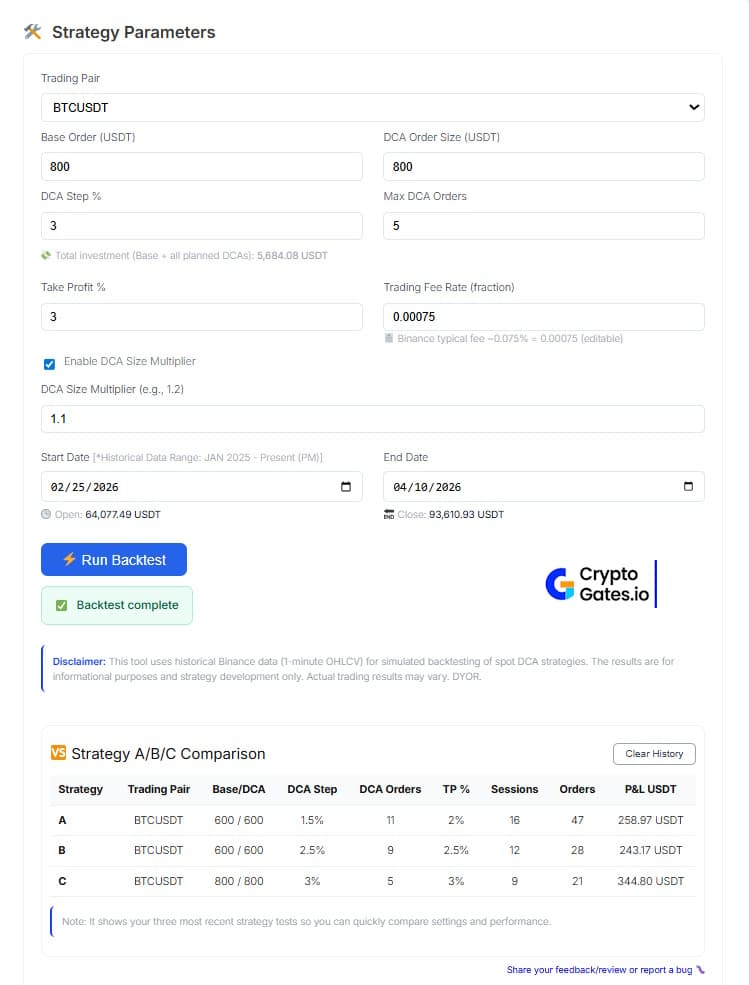
Step three — enter your parameters. Investment amount, frequency, take-profit, stop-loss, safety orders, volume scaling. Exactly as you’d configure them on a live exchange.
Step four — run the backtest on CryptoGates’ one-minute OHLCV historical data. Minute-level data catches intraday moves that daily data misses entirely — including stop-loss triggers and safety order activations that daily candles would hide.
Step five — read the results carefully. ROI, maximum drawdown, number of completed cycles, win rate, comparison to simple HODL of the same capital. Each metric tells a different part of the story.
Step six — adjust parameters based on what the data shows. Lower the take-profit if it was historically unreachable. Widen the stop-loss if it was triggering on normal volatility. Add or remove safety orders based on historical trigger frequency.
Step seven — only after the backtest results show a strategy you understand, can survive emotionally, and can fund completely — go live on your exchange.

Sheila Warren, World Economic Forum
Is a DCA bot good for beginners?
Yes — with one condition.
A DCA bot is one of the most beginner-friendly automation tools in crypto because it removes emotional decision-making and runs on a fixed schedule.
But beginners should backtest their settings on historical data before going live. Starting without testing is still a risk, regardless of how simple the strategy looks.
DCA Bot vs Other Strategies
A DCA bot is not the right tool for every situation. Knowing when a different strategy fits better isn’t a weakness, it’s how experienced traders protect capital and match tools to market conditions.
This section keeps comparisons brief. Each of these strategies has a dedicated guide on CryptoGates for deeper analysis. Here the goal is simple — help you understand which tool belongs in which situation.
DCA Bot vs Grid Bot
DCA buys only. It builds a position over time, accumulating units with the expectation that price will eventually move higher. It performs best in trending or volatile markets where long-term direction is upward.
Grid buys and sells repeatedly within a defined price range. It doesn’t care about long-term direction — it profits from price oscillation. Every time the price crosses a grid line downward, it buys. Every time it crosses upward, it sells. Best in sideways, ranging markets.
The deciding question is simple.
Do you believe this asset will be worth more in twelve months than it is today? If yes — DCA. Do you want to profit from price moving back and forth without a directional view?
Grid.
Advanced users run both simultaneously. DCA for long-term accumulation. Grid for generating income from the same asset’s volatility while the DCA position builds.
DCA Bot vs Rebalancing Bot
DCA grows your position in one or more assets through fixed, scheduled buys. It’s an accumulation tool.
A rebalancing bot maintains a target allocation across a portfolio. If Bitcoin grows to represent 60% of a portfolio originally set at 50%, the rebalancing bot sells some Bitcoin and buys underweight assets to restore the target ratio. It’s a maintenance tool.
They work together naturally. Use DCA to accumulate. Use rebalancing to maintain allocation discipline as the portfolio grows. Neither replaces the other — they solve different problems.
You don't need to — but you should. Running a DCA bot without backtesting means your parameters are untested guesses. Backtesting on CryptoGates shows you exactly how your settings performed across real historical data — including bear markets, corrections, and black swan events — before a single dollar is at risk.
DCA Bot vs Manual Trading
Manual trading has genuine advantages. It reacts to breaking news. It captures short-term momentum. It allows high-conviction single entries based on technical analysis or on-chain signals.
But here’s what most beginners underestimate. Manual trading requires institutional-level tools, real-time data, deep market experience, and the emotional discipline to execute under pressure. Most retail traders have none of these consistently.
DCA wins on consistency. It executes every scheduled purchase without hesitation. It doesn’t overtrade. It doesn’t revenge trade. It doesn’t freeze during a crash. For the vast majority of retail traders, consistent automated accumulation on strong assets outperforms sporadic manual trading over full market cycles.
That’s not an opinion. CryptoGates backtests confirm it repeatedly across different assets and timeframes.
Can I lose money with a DCA bot?
Yes. A DCA bot does not guarantee profit.
If the underlying asset declines permanently, DCA accumulates losses consistently instead of gains.
The bot automates execution — it cannot protect against a fundamentally failing asset or incorrect parameter settings. Backtesting and careful asset selection are what manage this risk.
DCA Bot Pre-Launch Checklist — Before You Go Live
This section doesn’t exist in any other DCA guide published anywhere. Every competitor takes you from setup straight to activation.
Nobody stops to ask the most important question:
Are you actually ready?
Going live with a DCA bot before you’re genuinely prepared isn’t bold. It’s expensive. This checklist exists to make sure every gap is closed before real capital is involved.
What Every Item on This Checklist Is Protecting
Each confirmation below closes a specific failure point. Skip one, and you’ve left that failure point open, with real money on the line.
Work through every item before activating any DCA bot with real capital. Not most of them. All of them.
One — your chosen asset has a strong long-term track record. Bitcoin, Ethereum, or a fundamentally solid altcoin with meaningful adoption and at least two years of price history. If you can’t answer why this asset will be worth more in twelve months with data — not hope — reconsider the asset before configuring any bot.
Two — you have backtested your exact parameters on at least twelve to twenty-four months of historical data on CryptoGates. Not similar parameters. Your exact parameters. The ones you plan to run live.
Three — your backtested results survived a bear market period — not just a bull run. A strategy that only works in rising markets isn’t a strategy. It’s a bet on timing. Real validation includes red months.
Four — you know your maximum historical drawdown, and you can handle it. Both financially and emotionally. If your backtest showed a 40% drawdown at the worst point, ask yourself honestly — would you have stopped the bot at that moment? If yes, either adjust the parameters or reduce the investment amount until the drawdown is something you can genuinely hold through.
Five — your investment amount per interval is money you can afford to lock up for three to twelve months. DCA capital is not liquid capital. Don’t commit funds you might need for other expenses mid-cycle.
Six — your take-profit target was historically achievable in your backtest. Not once in five years. Regularly enough to give the strategy a realistic exit path. If the backtest shows your target was never hit in two years of data — lower the target.
Seven — you have set a stop-loss to protect against black swan events. Not a tight stop that normal volatility triggers. A meaningful level that limits catastrophic loss while giving DCA room to work.
Eight — you understand how your exchange API connection works and what permissions the bot has. Trade permissions only. Never withdrawal permissions. If a platform asks for withdrawal access — stop. That is a security red flag with no legitimate justification.
Nine — you have a monitoring schedule. Weekly at minimum. Not chart-watching. A five-minute health check. Bot still connected. Cycles completing. Average cost tracking within expected range.
Ten — you have a written plan for when you will stop, pause, or adjust the bot. Decided now. Not in the heat of a crash when emotion is loudest. Write it down. Commit to it before the market tests it.
DCA Bot Health Check — Monitoring After Launch
Most DCA guides stop at launch. Press start, walk away, come back rich. That’s not how it works.
A DCA bot doesn’t need daily attention. But it does need regular review. Markets change. Fundamentals shift. Parameters that were optimal six months ago may need adjustment today.
The traders who get the best results from DCA bots aren’t the ones who set and forget — they’re the ones who check in consistently without micromanaging.

Mark Douglas, Trading in the Zone
How to Automate Your DCA Bot via CG Partner Exchanges
Backtesting on CryptoGates gives you the validated strategy. The next step is execution. That means connecting to an exchange that supports DCA bot automation — and doing it correctly.
CryptoGates doesn’t hold your funds. It never has. The platform exists to help you build, test, and optimize your strategy. Execution happens on partner exchanges that have the infrastructure, security, and automation tools to run your bot reliably.
Not sure which
exchange fits you?
Bypass the marketing hype. Our matrix cross-references your profile against 50+ institutional metrics—including Proof-of-Reserves and Slippage Models.
How CG Connects You to Automation Partners
The relationship is straightforward. CryptoGates validates your strategy. Partner exchanges run it.
CG’s partner exchanges — Binance, Pionex, OKX, Bybit, KuCoin, Gate.io, Coinbase, BitMart, and HTX — each support DCA bot automation with varying levels of flexibility, fee structures, and native bot tooling. Some are better for beginners.
Some offer more advanced parameter control for experienced users. Some have lower fees that make high-frequency DCA more viable on smaller portfolios.
Choosing the wrong exchange for your specific DCA configuration is a real mistake. A strategy built around biweekly buys with complex safety orders needs an exchange that supports all of that natively — not one that requires workarounds.
That’s exactly what the CG Exchange Picker was built to solve.
The CG Workflow — Backtest, Optimize, Automate
This is the sequence that separates informed automation from expensive trial and error.
Step one — build and backtest your DCA strategy on CryptoGates. Run it across at least twelve to twenty-four months of historical data. Confirm the parameters. Know your expected drawdown, cycle frequency, and realistic take-profit timeline.
Step two — use the CG Strategy Picker to confirm DCA is the right strategy for current market conditions. Not every market phase favors DCA equally. The Strategy Picker surfaces that context so your automation decision is data-supported, not assumption-based.
Step three — use the CG Exchange Picker to identify the right partner exchange for your needs. Filter by fee structure, supported bot types, security rating, and compatibility with your existing holdings. Don’t move funds to a new exchange just because it has a DCA bot feature — the Exchange Picker helps you find the best fit for where you already are.
Step four — configure your DCA bot on the chosen exchange using the exact parameters validated in your CryptoGates backtest. Don’t change parameters between backtest and live configuration. The backtest result is only valid for the settings it tested.
Step five — monitor using the weekly and monthly health check framework from Section 10. The bot runs. You review. Adjust only when data signals warrant it.
Real DCA Bot Backtest Results From CG Strategy Lab
Every claim in this guide is backed by data. This section is where that data becomes concrete.
Competitors show hypothetical returns — what DCA would have done in a perfect scenario.
CryptoGates shows actual backtested results from real historical price data, run through the same tool available to every user on the platform.
No cherry-picked timeframes. No smoothed curves. Real data, real parameters, real outcomes.
If the exchange experiences downtime, scheduled buy orders may not execute during that window. Most bots do not retroactively place missed orders — the cycle simply skips. This is why monitoring matters. A weekly health check catches missed cycles before they compound into a meaningful deviation from your backtested plan.
Featured Strategy Lab Results
Three representative backtests from the CG Strategy Lab illustrate what validated DCA strategies actually look like in practice.
Proven Setups &
Expert Breakdowns.
We don't just show you the data; we engineer and validate high-performance strategies, providing the "Alpha" behind the numbers.
BTC Weekly DCA — $100 per week, 12-month backtest.
The backtest covers a full cycle including a significant correction period. Results include total ROI, maximum drawdown reached, number of completed take-profit cycles, and direct comparison against simply holding the same $100 weekly investment without a bot.
ETH Biweekly DCA — $50 per cycle, bear market period.
This backtest specifically targets a sustained bear market phase — the hardest environment to hold any strategy through. Results show how biweekly ETH DCA performed during extended price decline and the recovery that followed. Maximum drawdown and average cost trajectory are the key metrics here.
LINK DCA — The Chainlink Reserve Surge Backtest.
Already published in the CG Strategy Lab.
This backtest captured one of the more dramatic altcoin DCA scenarios — a high-volatility asset with a sharp recovery. Results demonstrate both the opportunity and the risk of DCA on fundamentally strong altcoins versus BTC and ETH.
What These Results Prove
The data confirms three things consistently across every DCA backtest run on CryptoGates.
DCA outperforms simple HODL in volatile and bear market conditions. The accumulation effect — buying more units at lower prices — builds a cost basis that HODL at a single entry point cannot match when markets are falling or ranging.
Parameter selection matters more than most traders expect. The same asset with different take-profit levels, safety order configurations, and frequency settings produces meaningfully different outcomes.
This isn’t a minor difference in returns. It’s the difference between a strategy that completes regular cycles and one that sits underwater for months waiting for a target that was never realistic.
Realistic Expectations From a DCA Bot
No other DCA guide published anywhere says this clearly.
So CryptoGates will.
A DCA bot is a tool. It is not a profit machine. It does not guarantee returns. It does not protect you from bad asset selection. And it does not reward impatience.
Most guides selling DCA bots — whether platforms, affiliates, or exchanges — have a financial interest in making the strategy sound simpler and more reliable than it is. CryptoGates doesn’t.
Our interest is in traders who last long enough to use the platform for years — not traders who blow up in six months because expectations were never honestly set.
So here is the honest version.
Confused about
market outlook?
Trading without a plan is just gambling. Our strategy architect analyzes your risk tolerance and capital to match you with a proven algorithmic framework.
What a DCA Bot Can Realistically Do
Remove emotional decision-making from your buying process. This alone — even if nothing else — has measurable value.
The single most expensive habit in retail crypto trading is reacting to price moves with emotion. A DCA bot eliminates that habit by design. It buys on schedule. Emotion doesn’t get a vote.
Lower your average entry cost in declining or volatile markets. This is the mechanical advantage DCA delivers. More units at lower prices.
Fewer units at higher prices. Over time, the average cost sits below the average market price across the accumulation period. Not because the bot is smart — because the math works.
What a DCA Bot Cannot Do
Guarantee profit.
This needs to be said plainly.
A DCA bot running on a declining asset produces consistent losses — not consistent gains. The bot does what it’s told. If what it’s told is to buy something that keeps falling permanently, it will buy that falling asset on schedule until you stop it or run out of capital.
Replace fundamental research. The bot automates how you buy. It has absolutely nothing to say about what you buy. Asset selection is the most important decision in the entire DCA setup — and it’s entirely a human decision. No automation changes that.
Protect you from a complete market collapse or asset failure. A black swan event — exchange collapse, regulatory shock, project failure — can move faster than any stop-loss. DCA smooths volatility over time. It does not eliminate catastrophic risk. Stop-losses and position sizing manage that. DCA does not.
Perform well without correct parameter settings. Bad parameters on a good asset still produce poor results. A 50% take-profit target that was never historically achievable means capital locked indefinitely. A stop-loss set too tight means exits triggered by normal volatility.
The bot executes faithfully — but it executes whatever you configured, including mistakes.
What Actually Drives DCA Bot Results
Three factors determine outcomes. In this order.
Asset selection is the most important factor — by a significant margin. A well-configured DCA bot on Bitcoin has decades of historical recovery behind it. The same bot on a failed project recovers nothing.
No parameter optimization compensates for the wrong asset. Choose first. Configure second.
Parameter optimization — proven through backtesting, not guessing — is the second factor. Frequency, take-profit, stop-loss, safety orders. Each setting has a consequence.
The backtest shows you those consequences before they cost real money. Optimization is an iterative process — run, review, adjust, repeat — until the results reflect a strategy you understand and can execute.

"We've seen it consistently. The traders who stick to a backtested DCA plan through a full cycle — bear market, recovery, take-profit exit — almost always come out ahead of the ones who tweaked, paused, and restarted based on short-term price moves. The plan isn't what fails. Patience is what fails." Zaheer
Patience is the third factor. And honestly, it’s the one most traders underestimate. DCA is a long game. Full market cycles take time.
A strategy that looks flat at three months may be building the exact cost basis that delivers strong returns at month nine.
Most users who report poor DCA results quit before the strategy had time to complete a single full cycle.
How to Choose the Right DCA Bot Platform
“Choose a reputable platform.” That’s the advice every competitor gives. It’s completely useless without defining what reputable means.
Here’s the real evaluation framework. Four criteria. Concrete questions for each. This is how you assess any DCA bot platform — including CryptoGates — before committing capital or API access.
Security — The Non-Negotiable
Security isn’t one item on a checklist. It’s the filter that eliminates platforms before any other evaluation begins.
API-only connection is mandatory. The platform should never require you to deposit funds directly onto their system. Your funds stay on the exchange. The bot accesses them via API with trade permissions only. Any platform that asks you to deposit funds into their custody is asking you to trust them with your capital — a fundamentally different and higher-risk arrangement.
API permissions must be trade-only. The bot needs to place and cancel orders. It does not need withdrawal permissions — ever. If a platform’s setup process asks for withdrawal access, stop immediately. There is no legitimate reason for a DCA bot to need withdrawal permissions. That is a security risk with one possible consequence: loss of funds.
Two-factor authentication is mandatory. Any platform without 2FA is disqualified before any other evaluation. This is a baseline security requirement, not a premium feature.
Operational history and transparency matter. How long has the platform operated? Has it experienced hacks, fund losses, or significant downtime? A platform that’s been running reliably for several years with no major security incidents has demonstrated something that a new platform cannot — track record under real market conditions.
Strategy Flexibility and Backtesting Support
A platform’s strategy flexibility determines whether it can actually run the DCA configuration your backtest validates.
Does it support the DCA type you need? Fixed interval, price deviation, value-weighted — not every platform supports all three. If you’ve backtested a value-weighted DCA strategy and the platform only supports fixed intervals, your validated strategy can’t run there.
Can you set custom take-profit, stop-loss, and safety orders? Generic presets are not a substitute for the specific parameter values your backtest identified as optimal. A platform that only offers preset configurations forces you to run an untested strategy — which defeats the entire purpose.
Does it offer backtesting before going live? This is CryptoGates’ core criterion. Any platform that pushes you directly from parameter setup to live bot — without a backtest step — is asking you to risk capital on settings that have never been validated. That’s not automation. That’s guessing with a bot.
Reporting and Monitoring Tools
A DCA bot you can’t monitor clearly is a DCA bot you can’t manage effectively.
The platform must show per-bot performance in real time. Average cost, current ROI, number of completed cycles, and a direct comparison against simple HODL of the same capital. Without these metrics, the weekly and monthly health checks from Section 10 become guesswork.
Alert systems matter more than most traders realize until they need them. Price threshold alerts, stop-loss trigger notifications, API disconnection warnings — these turn passive monitoring into active awareness without requiring you to watch charts constantly.
Not sure which
exchange fits you?
Bypass the marketing hype. Our matrix cross-references your profile against 50+ institutional metrics—including Proof-of-Reserves and Slippage Models.
Wait.
There’s one more thing worth saying here. The best DCA platform isn’t the one with the most features. It’s the one with the right security, the flexibility to run your validated strategy, transparent fees, and clear reporting.
More features on a platform you don’t trust — or can’t afford — is worse than fewer features on one that meets every baseline criterion.
Conclusion — Backtest First. Automate Second.
DCA bots are one of the most reliable accumulation tools in crypto. Not because they’re complicated. Because they’re consistent — and consistency is exactly what most retail traders lack.
But consistency without validation is just automated guessing.
The traders who get real results from DCA bots are the ones who tested their parameters before going live, chose fundamentally strong assets, set realistic expectations based on data, and held the strategy through full market cycles without panic-stopping at the bottom.
That’s the CryptoGates approach. Verify first. Risk later. Scale slowly.
Battle-Test Your Strategy
Before the Market Does.
Eliminate guesswork with institutional-grade backtesting for DCA, Grid, and Rebalance bots. Real historical data. Real-world results.
If you haven’t backtested your DCA strategy yet — that’s where to start.
Not with capital. With data.
The CryptoGates DCA Backtest Tool runs your exact parameters across real historical price data so you know what you’re automating before you automate it.
FAQs
What is a DCA bot in crypto?
A DCA bot is an automated tool that buys a fixed amount of cryptocurrency at regular intervals — daily, weekly, or monthly — regardless of price. It removes emotional decision-making from the buying process and executes your accumulation strategy consistently without manual input.
Is a DCA bot good for beginners?
Yes — with one condition attached. DCA bots are among the most beginner-friendly automation tools in crypto because the logic is simple and emotion is removed. But beginners should backtest their settings on historical data before going live. Untested parameters are still a risk, regardless of how straightforward the strategy appears.
Can I lose money with a DCA bot?
Yes. A DCA bot does not guarantee profit. If the underlying asset declines permanently, the bot accumulates losses on schedule instead of gains. Asset selection and parameter validation through backtesting are what manage this risk — the bot itself cannot protect against a fundamentally failing investment.