

 Bitcoin
  Ethereum
  Solana
  TRON
TRON  Zcash
Zcash  Hyperliquid
  Dogecoin
  Monero
  Chainlink
  Cardano
  Stellar
  Uniswap
  Sui
Sui  Hedera
  Bittensor
  Shiba Inu
  Ripple USD
  Polkadot
  Aster
Aster  World Liberty Financial
  Render
  Artificial Superintelligence Alliance
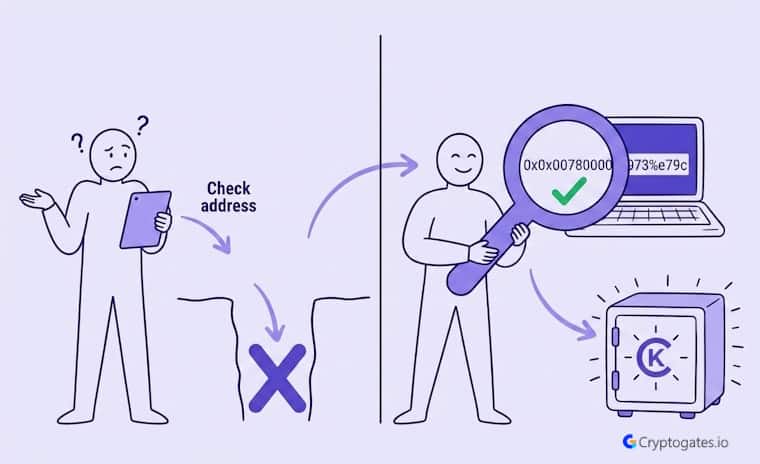
Most people treat a crypto address like an email address.
Type it in, hit send, done. But here’s the thing — email has an “undeliverable” bounce. Crypto doesn’t.
If you send funds to the wrong address, even by one character, they’re gone. No refund. No support ticket. No recovery.
Roughly $1 billion in crypto is lost annually due to user errors, including wrong addresses. Chainalysis
And yet most beginners never actually learn what a crypto address is. They just copy, paste, and hope.
This changes that.
Let’s start with the basics.
- The Problem:Most beginners copy-paste crypto addresses without understanding what they are or how to verify them.
- The Solution:Learn what a crypto address is, how to read it, and how to use it safely.
- The Incentive: One small mistake with an address can mean permanent loss of funds.
- The Risk:Skipping the verification habit puts every future transaction at unnecessary risk.
What a Crypto Address Actually Is
A crypto address is a unique string of letters and numbers that acts as your location on a blockchain.
Think of it like a bank account number — except there’s no bank behind it, no one to call, and no way to reverse a wrong transfer.
When someone wants to send you crypto, they need your address. When you want to receive it, you share your address.
That’s it on the surface. But understanding what’s underneath changes how carefully you handle it.
Stop Guessing.
Stress Test Your Edge.
The market doesn't care about your backtest. Our engine simulates 1,000+ "what-if" scenarios to ensure your strategy is built for survival.
Run Crypto Strategy Engine →Where Does a Crypto Address Come From?
A crypto address isn’t assigned by any company or platform. It’s generated mathematically from your private key through a cryptographic process.
No two addresses are the same. No central authority creates or controls them.
Here’s the interesting part. That process is one-way.
You can generate an address from a private key, but you can’t reverse-engineer the private key from the address. That’s the security model. The address is public. The key is not.

ZAHEER, CEO CryptoGates
How to Read a Crypto Address
An address isn’t meant to be memorized. It’s meant to be copied exactly. But that doesn’t mean you should treat it like a black box. Knowing how to read one helps you catch errors before they become losses.
Most addresses have three things you can check visually: the prefix, the length, and the character set. Each network uses its own format, and those formats aren’t interchangeable.
Research Insight
Crypto’s irreversibility problem isn’t unique to addresses — it shows up in trading systems too, and the data on how disciplined execution limits damage is instructive. When ETH fell 32% over 46 days, a rules-based DCA bot lost just 1.81%, compared to a 354.61% wider loss for a static buy-and-hold position over the same window. The bot didn’t avoid the crash. It avoided compounding the crash with poor timing decisions.
The parallel to address handling is direct: most catastrophic outcomes in crypto aren’t caused by bad luck, they’re caused by skipping a verification step under the assumption that “it’s probably fine.” A disciplined, rules-based process — whether verifying six characters or following a fixed DCA schedule — closes the gap between what could go wrong and what actually does.
Why Addresses Look Different Across Networks
A Bitcoin address starting with “1” is a Legacy address. Starting with “bc1” means it’s a newer SegWit format. Ethereum addresses always start with “0x” and are 42 characters long, a format ethereum.org’s own developer docs define precisely.
Solana addresses look completely different — longer, no prefix pattern, case-sensitive.
Battle-Test Your Strategy
Before the Market Does.
Eliminate guesswork with institutional-grade backtesting for DCA, Grid, and Rebalance bots. Real historical data. Real-world results.
Around 20% of all crypto support queries involve incorrect-network transfers, many of which are unrecoverable. Binance Support Data
What Happens If You Send to the Wrong Network?
Honestly, most of the time?
The funds disappear into an address that exists on one network but not the other. In some cases, exchanges can recover them — but it’s expensive, slow, and not guaranteed. Most small transfers are lost.
The network doesn’t know you made a mistake. It just processes the instruction you gave it.

No. The number of possible crypto addresses is astronomically large — mathematically, the odds of two people generating the same address are effectively zero. Each address is unique to its private key.
How to Use a Crypto Address Safely
Using a crypto address correctly isn’t complicated. But it does require a habit most beginners skip entirely — verification.
Copy-pasting feels safe. It isn’t always. Malware exists specifically to swap addresses in your clipboard without you noticing.
The smart move is to treat every address like it’s the first time you’ve used it. Even if you’ve sent to that address before.
Reality Check
Common belief: A safety process either works or it doesn’t — if losses still happen, the process failed.
What CryptoGates research found: When BNB dropped 33% after its all-time high, a grid bot generated $163.94 in real trading profit, yet still closed the period at a −21.64% ROI. The system worked exactly as designed. It reduced exposure to bad execution. It did not eliminate the underlying market risk.
Why it matters: The same logic applies to address verification. Checking an address carefully doesn’t guarantee a transaction was the right one to make — it only guarantees you didn’t lose funds to a preventable error. Confusing “a safeguard reduced risk” with “a safeguard prevents all loss” is exactly the kind of overconfidence that leads people to skip verification once they feel experienced.
Always Verify Before You Send
Before hitting send on any transaction, check at least the first six and last six characters of the address manually. Don’t just glance. Actually, compare them character by character.
Here’s what actually matters. Most address-swapping malware only changes the middle portion, knowing people skim the start and end. That quick manual check catches it.
Pre-Trade Strategy Audit
- Copy the address from the source
- Paste it into the send field
- Manually compare first 6 and last 6 characters
- Confirm the network matches your destination
- Start with a small test transaction before sending large amounts
Common Mistakes Beginners Make With Crypto Addresses
Wait. Before you feel confident, there’s a layer most beginners never hear about.
Getting the address right is step one. But there are mistakes people make even when they think they’re being careful.
The biggest one isn’t typos. It’s trust. Trusting that what’s on their screen is what they actually copied.
Address Poisoning — The Attack You Haven't Heard Of
Address poisoning is a specific scam where an attacker sends you a tiny transaction from an address that looks almost identical to one you’ve used before.
The goal is simple — get you to copy their address from your transaction history instead of the real one.
Here’s the issue. Most crypto wallets display truncated addresses. You see the first few characters and the last few. The middle is hidden. Attackers craft addresses that match both ends exactly.
Address poisoning attacks led to tens of millions in losses in a single recent wave across multiple blockchains. Etherscan Blog
| Mistake | Why It Happens | How to Avoid It |
|---|---|---|
| Wrong network send | The address looks identical across chains | Always confirm the network before sending |
| Clipboard swap | Malware replaces copied address | Compare first and last 6 characters manually |
| Address poisoning | Copying from transaction history | Always copy from original, verified source |
| Trusting truncated display | Wallets hide middle characters | Use full address view when available |
| Skipping test transaction | Feels unnecessary on small amounts | Always test first regardless of amount |
Read It. Verify It. Then Send.
A crypto address is more than a string of characters.
It’s the entry point to an irreversible system. Understanding what it is, where it comes from, and how to verify it before every transaction isn’t optional — it’s the foundation of safe crypto use.
Most losses aren’t caused by hacks. They’re caused by habits. The habit of skipping verification. The habit of trusting a clipboard. The habit of assuming the address on screen is the right one.
Build the verify-first habit now, before a mistake teaches it to you the hard way. If you’re still figuring out which exchange to use for your first transaction, CryptoGates’ Exchange Picker can help you find a platform that matches your experience level and needs — without the guesswork.