

 Bitcoin
  Ethereum
  Solana
  TRON
TRON  Zcash
Zcash  Hyperliquid
  Dogecoin
  Monero
  Chainlink
  Cardano
  Stellar
  Uniswap
  Sui
Sui  Hedera
  Bittensor
  Shiba Inu
  Ripple USD
  Polkadot
  Aster
Aster  World Liberty Financial
  Render
  Artificial Superintelligence Alliance
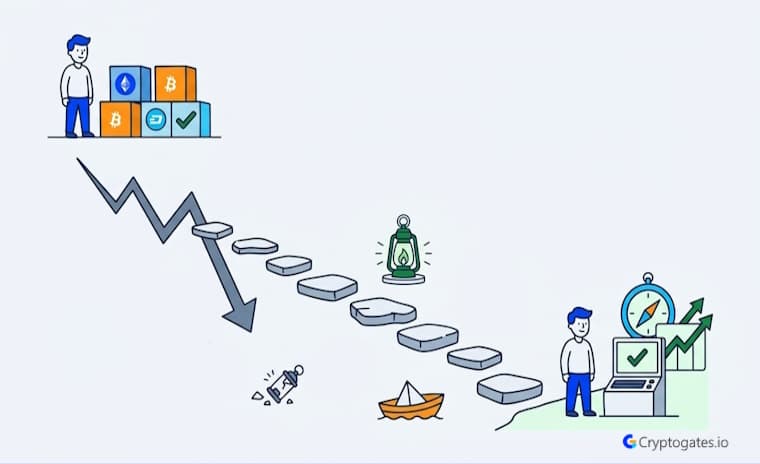
You pick your DCA step size in about ten seconds.
Type a number, hit run, move on. Then a real crash shows up, and that tiny setting decides whether you’re buying the bottom or staring at an empty ladder.
Most traders treat the step like a cosmetic choice.
It isn’t.
It controls how fast your orders get spent, and that matters more than most coin picks.

Source: Blockworks
Think about your last bad dip.
Did your bot have ammo left when the price hit its lowest point?
Let’s break this down.
- The Problem: Traders set the DCA step by feel, then burn through every order early when a crash hits.
- The Solution: Match the step to a realistic drawdown depth, then backtest it before going live.
- The Incentive: You keep orders in reserve for the cheapest prices and stay in position for the bounce.
- The Risk: A wider step can sit idle in choppy markets, and no setting guarantees profit. Not financial advice.
What DCA Step Size Controls (and Why Most Traders Just Guess It)
The step is the price gap between each DCA order.
Price drops by that much, the bot buys again.
Simple on paper, messy in a real crash.
Real Backtest Example
Strategy: DCA bot (3% step, 10 orders, 1.2× multiplier)
Coin: DOGE/USDT
Market Condition: A 34% decline over 60 days, driven by whale-led capitulation.
Objective: Stay funded through a prolonged drop instead of exhausting the ladder early.
Key Result: 13 of 14 sessions closed in profit, for +$924.23 in total. One session used all 10 orders, deployed $10,491 and still returned $298.54.
Expert Interpretation: Step size and order count together set how much of a fall the ladder can absorb. A 3% spacing across 10 orders gave the bot enough depth to keep buying as price slid and still close the session in profit.
DOGE Crashed 34% in 60 Days: Our DCA Bot Made +$924.23 Anyway
Most traders never question it.
They copy a number from a forum, or guess their DCA settings by whatever “feels” active.
That’s a coin flip, not a plan.
1. Step Size and Order Count: The Link Nobody Checks
Picture a ladder.
In any DCA strategy, max DCA orders are the rungs, and the step is the spacing between them.
Pack the rungs close together and the whole ladder covers a short fall.
Spread them out and it reaches much deeper.
| Step Style | How Fast Orders Get Used | Reserve in a Deep Drop |
|---|---|---|
| Tight | Very fast | Often empty |
| Medium | Steady | Partly intact |
| Wide | Slow | Mostly intact |
Here’s the part people miss.
Your order count and your step work as a pair, and changing one without the other quietly changes how much of a drop you’re actually protected against.
2. Why Tight Steps Feel Safe but Burn Your Orders
A tight step buys all the time.
Green dots everywhere, bot looks busy, and it feels like you’re defending your position.
Look, I get it.
Activity feels like control.
Reality Check
Strategy: DCA bot
Coin: ETH/USDT
Market Condition: An 18.5% decline over 45 days (January–February 2025) with no meaningful bounce.
Common Belief: A DCA ladder works out as long as price eventually recovers.
Key Result: 9 of 9 closed sessions finished in profit. One of them deployed the full $1,100 and returned $28.48 while ETH was still falling. One session stayed open at the end of the test.
Expert Interpretation: Closed sessions only show the cycles that got their bounce. The open session shows what happens when the bounce is delayed: capital is fully deployed, the average entry sits well above the market, and the position has to wait. Reserve orders matter most in this scenario, and the step setting decides how much reserve is left.
ETH Crashed 18.5% in 45 Days: Our DCA Bot Still Closed 9/10 Sessions Green
But busy isn’t the same as protected.
Every extra buy near the top is an order you won’t have near the bottom, and that’s where the cheap fills live.
How a Tight DCA Step Gets Trapped in a Crash
Crashes don’t politely drop a little and wait.
They bleed, bounce, bleed again, and nuke through levels you thought were “deep enough.“
A tight step treats the first stretch of that fall like the main event.
By the time the real flush arrives, the ladder is finished.
1. Orders Spent Early, Nothing Left at the Bottom
Now imagine a trader watching price slide through a downtrend like the one in our DOT falling knife DCA test.
The bot buys, buys, buys, and then goes quiet while the chart keeps falling.
No ammo.
Just a heavy bag and a lot of copium.
Source: Presto Research
Deep drops can also arrive fast, which leaves little time to react by hand.
2. Why a Sharp Recovery Doesn't Always Rescue You
So the bounce comes. Great, right?
Wait, not so fast.
A position built mostly near the top has a high average cost, and the price needs to climb a long way before the bot can close anything in profit.

Crypto isn't a fair game, and the market doesn't care how busy your bot looks. I'd rather see a trader survive a bad drop with orders left than feel active and end up rekt. Verify first. Risk later. Scale slowly. - Zaheer
Meanwhile, a position that kept reserve for the lows has a cheaper average and a shorter road back, as these DCA bot backtest case studies show.
Same coin, same crash, very different outcome.
Wide DCA Step Size Trade-Offs: Survival vs Activity
Wider spacing isn’t a free lunch.
It keeps your ladder alive in a deep drop, but it changes how the bot behaves day to day.
You’re trading activity for staying power.
Think of it like a fuel tank on a long trip.
A bigger tank means the needle barely moves early on, and that’s the whole point.
1. Fewer Buys, More Reserve Capital
With a wide step, the bot waits.
Price has to fall further before the next order fires, so fewer orders get used in the early part of a drop.
More ammo sits untouched for the lows.
Confused about
market outlook?
Trading without a plan is just gambling. Our strategy architect analyzes your risk tolerance and capital to match you with a proven algorithmic framework.
That’s survival logic.
The cheapest prices usually show up late and fast, and a trader with orders left gets to use them.
A wide step protects you, well, mostly.
If price falls past the end of your ladder, you’re still stuck waiting, just later and with a lower average.
2. What You Give Up in Choppy, Sideways Markets
In chop, a wide step can feel dead.
Price wiggles inside a small range, never travels far enough to trigger a buy, and the bot just sits there.
No fills. No action.
| Market Type | Tight Step | Wide Step |
|---|---|---|
| Deep crash | Orders run out early | Reserve lasts longer |
| Sideways chop | More frequent fills | Often idle |
| Sharp rebound | Heavy, late-built bag | Lower average entry |
Honestly, that boredom is where traders start tweaking settings at the worst possible time.
Every strategy has trade-offs, and this is the main one here.
Confused about
market outlook?
Trading without a plan is just gambling. Our strategy architect analyzes your risk tolerance and capital to match you with a proven algorithmic framework.
Neither style wins everywhere.
The right pick depends on how deep the drop can go.
How to Match Your DCA Step Size to Expected Drawdown Depth
The goal is simple.
Make your whole ladder cover a drop that’s realistically possible, not one that’s comfortable to imagine.
So ask what this coin has done before, then build for that.
1. Reading Past Drawdowns Before You Set the Step
Pull up the chart and zoom way out.
Look at the deepest falls from past tops. Alts tend to fall harder than people remember, because memory is kind to bagholders.
In one large study of liquid tokens, the median token lost 97% from its qualifying price.
Source: Blockworks Research
Use that as a gut check.
Multiply your step by your max orders and see where the ladder actually ends.
And if it ends way above where price has bottomed before?
Well.
2. Backtest Three Step Sizes Before Going Live
Change only the step. Keep the base order, DCA order, max orders, and take profit the same.
Run a tight, a medium, and a wide version through the same crash window in the CryptoGates DCA Backtest Bot, then compare how many orders each one still had at the lows.
That takes five minutes, maybe ten.
DCA Step Strategy Audit
- Does my full ladder reach a drop this coin has actually seen before?
- Did I change only the step between test runs?
- How many orders were left when price hit its lowest point?
- Can my wallet handle the max capital if every order fills?
- Am I okay with a bot that sits idle in chop?
Let the data do the talking. Trust the numbers, not the vibes.
Set the Step for the Drop, Not the Comfort
Your DCA step size decides how long your capital lasts when the market turns ugly. Tight steps feel active and safe, but they tend to spend every order early.
Wider steps keep ammo for the lows, though they can sit quiet in chop.
So build the ladder around a drop that’s realistic, not one that’s comfortable, and let a DCA strategy backtest show you the difference before real money is on the line.
Battle-Test Your Strategy
Before the Market Does.
Eliminate guesswork with institutional-grade backtesting for DCA, Grid, and Rebalance bots. Real historical data. Real-world results.
If you want to see this play out on real crash data, the full figures live in our ARB DCA Step Playbook.
Then run your own parameters in the CryptoGates DCA Backtest Bot and see what the data shows.
No signup. No credit card. Just build → cryptogates.iO
Not financial advice.
FAQs
How do I choose the right DCA step size for my capital?
Start with how deep the coin has fallen in the past, then pick a step so your full ladder reaches that depth. Backtest a few options before you go live.
How many DCA orders should I set with my chosen step?
Enough that step times orders covers a realistic worst-case drop, without needing more capital than you’re willing to commit. Test a few combos together, since they work as a pair.
Can a DCA bot still lose money if the step is set well?
Yes. A good step improves survival, but price can fall past your ladder, and a position can stay underwater for a long time. No setting removes risk.