

 Bitcoin
  Ethereum
  Solana
  TRON
TRON  Zcash
Zcash  Hyperliquid
  Dogecoin
  Monero
  Chainlink
  Cardano
  Stellar
  Uniswap
  Sui
Sui  Hedera
  Bittensor
  Shiba Inu
  Ripple USD
  Polkadot
  Aster
Aster  World Liberty Financial
  Render
  Artificial Superintelligence Alliance
Most people guess whether a DCA bot actually works.
They watch a clip, read a thread, and decide based on vibes.
Real DCA bot backtest results don’t work that way.
They come from actual price candles, fixed settings, and sessions that either close in profit or don’t.
A Vanguard research paper on dollar-cost averaging found that, across U.S. historical data, lump-sum investing beat DCA about two out of three times in rising markets.
Vanguard, “Dollar-cost averaging just means taking risk later
We pulled two real backtests from the CG Strategy Lab to show you exactly what that looks like.
One where the bot turned a falling coin into profit.
One where it simply lost less than doing nothing.
Here’s what the numbers actually say.
- The Problem: Most traders trust hype or gut feeling instead of real tested data before running a DCA bot.
- The Solution: Two real CG Strategy Lab backtests show what a DCA bot actually does in a brutal bear run and in a slow, grinding decline.
- The Incentive: You get exact settings and outcomes instead of a sales pitch, so you can judge a strategy before risking a single dollar.
- The Risk: A well built DCA bot can still lose money, and a past backtest never guarantees what happens next.
What Counts as a Real DCA Bot Backtest Result?
A lot of “results” floating around crypto spaces aren’t results at all.
They’re screenshots with no settings shown, no losing trades mentioned, and no real timeframe attached.
A real result means the strategy ran against actual price candles, used fixed settings the whole way through, and reported every session, win or lose, not just the good ones.

Mark Douglas, Trading Psychology Author
That line matters here.
A backtest doesn’t predict the future.
It shows you how one specific setup behaved against one specific stretch of real price action.
That’s the whole value of it, and it’s also the limit of it.
Battle-Test Your Strategy
Before the Market Does.
Eliminate guesswork with institutional-grade backtesting for DCA, Grid, and Rebalance bots. Real historical data. Real-world results.
How CG Strategy Lab Tests These Bots
Every playbook in the CG Strategy Lab runs on real 1-minute exchange data, not simplified daily averages.
That level of detail matters because a coin can swing 3% and recover within hours, and a daily candle would miss that completely.
The bot tracks every order, every session close, and every fee paid down to the cent.
Nothing gets rounded up to look better.
Case Study One - A DCA Bot That Profited Through a 64% PEPE Crash
Here’s the thing about this one: it’s not a cherry-picked bull market win.
PEPE lost 64% of its value over 112 days of steady selling.
No crash, no panic, just a slow, grinding bleed where every small bounce got sold into.
A DCA bot ran through the entire thing.
The Setup and Strategy Parameters
The bot wasn’t trying to predict a bottom.
It was built to buy small dips and sell small bounces, over and over, regardless of where the bigger trend was heading.
PEPE DCA Backtest - Core Settings
| Setting | Value | Why It Mattered |
|---|---|---|
| Base & DCA Order Size | $300 each | Kept early exposure low |
| DCA Step | 3% | Matched PEPE's bounce rhythm |
| Take Profit | 2.5% | Loose enough to catch mini-pumps |
| Max DCA Orders | 14 | Covered deep, extended drawdowns |
The Results vs Buy and Hold
Out of 100 sessions, 99 closed in profit.
Call it 99 wins out of 100, in a coin that was losing value the entire time.
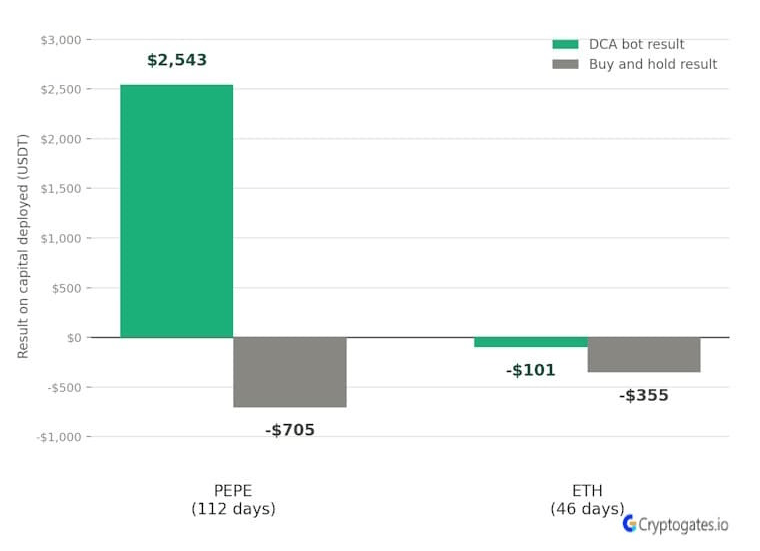
The bot closed with $2,542.73 in realized profit.
A spot holder who bought and just held the same capital lost $704.79 over that same stretch.
That’s a gap of over $3,200 between the two outcomes, on the same asset, in the same window.
Continue Your Research
PEPE and ETH show the two extremes — a deep memecoin bleed that produced profit, and a steady ETH decline that still lost money. For a fuller picture of how the same DCA logic behaves across different assets and crash types, two more CG Strategy Lab backtests are worth reviewing:
- A 56% Polkadot downtrend spread across 7 months, where 79 of 80 sessions closed in profit despite the extended timeframe: https://cryptogates.io/playbooks/how-a-dca-bot-made-381-while-polkadot-lost-56/

Yes, if the asset still produces small bounces along the way down. The bot profits from those bounces, not from the overall trend direction.
The catch is real, too.
Max drawdown on individual sessions hit over 93%, which means at points the bot was deep underwater before a bounce finally triggered the exit.
Anyone running this would’ve needed the full budget liquid and untouched the whole time.
Tools like the DCA Backtest Bot exist specifically so you can see that drawdown curve before you commit real money to it, not after.
Stop Guessing.
Stress Test Your Edge.
The market doesn't care about your backtest. Our engine simulates 1,000+ "what-if" scenarios to ensure your strategy is built for survival.
Run Crypto Strategy Engine →Case Study Two - A DCA Bot That Lost Less Than Doing Nothing on ETH
Not every backtest ends in green, and that’s exactly why this one belongs here.
No recovery, no bounce back to even.
The bot lost money.
But here’s what actually matters: how much it lost compared to just holding.
H3: The Digital Ledger Revolution
This wasn’t a memecoin freefall.
It was a slow, grinding decline with lower highs and lower lows, the kind that wears down a spot holder’s patience one red candle at a time.
ETH DCA Backtest - Core Settings
| Setting | Value | Why It Mattered |
|---|---|---|
| Base & DCA Order Size | $100 each | Smaller stack for a steady grind |
| DCA Step | 2% | Tighter spacing for shallower dips |
| Take Profit | 3% | Gave each session real exit margin |
| Max DCA Orders | 10 | Buffer for a multi-leg decline |
The Results vs Buy and Hold
14 of 15 sessions closed in profit. Sounds strong, right?
But the math still landed negative overall, at -$101.49.
Honestly, that’s the part most people miss when they only look at win rate.
One session opened near the top, deployed the full order stack averaging down, and that single session dragged the whole result into the red.

ZAHEER, CEO CryptoGates
Here’s where it gets interesting, though.
A spot holder with the same $1,100 lost $354.61 over the same 46 days.
The bot’s loss was real, but it was $253 smaller.
That’s not a win. It’s damage control, and in a falling market, damage control is sometimes the actual goal.
What These Two Backtests Teach You About DCA Bots
Put both backtests side by side, plus a third DCA bot playbook where a bot banked $898 through a 45% crash, and a pattern shows up fast.
PEPE: 99% session win rate, big profit.
ETH: 93% session win rate, still a loss.
Almost the same win rate, completely different outcome.
So what actually decided it?
Interactive Checklist: Before You Trust Any DCA Bot Result
- Was the backtest run on real exchange data, not simulated estimates
- Does it report every session, including the losing ones
- Is the max drawdown disclosed, not just the final profit number
- Was the result compared against simple buy and hold
- Were the exact settings (step %, take profit %, order size) shown
Research Snapshot
The PEPE and ETH cases aren’t isolated outcomes. Across other CG Strategy Lab DCA backtests run on sharply declining coins, the same pattern repeats: a high session win rate on its own tells you very little about the final P&L.
In a 7-month, 56% DOT downtrend, 79 of 80 sessions closed in profit, and the bot still finished ahead of spot holders by nearly $1,000.
In a volatile TAO round trip that ultimately left spot holders down 17%, 139 of 140 sessions closed green, delivering +$1,677.
The recurring lesson: win rate measures consistency, not magnitude. What decides the outcome is how few sessions open badly — and how large those specific losses are relative to everything else. That’s the number worth checking before trusting any DCA result at face value.
Full breakdowns: DOT DCA Bot Backtest | TAO DCA Bot Backtest
Why a High Win Rate Doesn't Always Mean Profit
The real difference wasn’t the bot’s skill.
It was where each new session opened.
In the PEPE case, the price kept oscillating enough that each session, even a losing one, had room to recover into a small profit.

Nic Carter, crypto analyst and Castle Island Ventures co-founder
In the ETH case, one session opened high and averaged all the way down, and that single session’s loss outweighed several smaller wins combined.
Because one session opened at a high price and used the full order stack averaging down, and that single loss outweighed the smaller wins from the other sessions.
That’s basically the lesson in numbers.
Patience and a tested setup beat reacting to whatever the last candle did.
The Real Lesson from These Two Backtests
Two backtests, two different markets, two different outcomes.
One turned a 64% crash into real profit.
The other lost money, just less of it than doing nothing would have.
Neither result came from a guess.
Both came from real settings tested against real price data, win or lose, fully disclosed.
Confused about
market outlook?
Trading without a plan is just gambling. Our strategy architect analyzes your risk tolerance and capital to match you with a proven algorithmic framework.
That’s really the whole point of backtesting.
Not to promise a win every time, but to know what you’re actually signing up for before you commit real capital to it.
If you want to see how a setup like this would have performed on a coin and timeframe of your choosing, the CG DCA Strategy Validator lets you run that test yourself, free, before risking anything.
FAQs
Does a DCA bot always make a profit?
No. The ETH case study here lost money. It performed better than buy and hold, but it still wasn’t profitable on its own.
What is a good win rate for a DCA bot backtest?
Win rate alone doesn’t tell the full story. A 93% win rate still lost money in one case, while a 99% win rate produced a large profit in another.
How is a DCA bot backtest different from real trading?
A backtest uses real historical data but assumes you have the full capital liquid and available the entire time. Real trading adds emotion, hesitation, and the temptation to intervene.