

 Bitcoin
 Ethereum
 Solana
 TRON
 Zcash
 Hyperliquid
 Dogecoin
 Monero
 Chainlink
 Cardano
 Stellar
 Uniswap
 Sui
 Hedera
 Shiba Inu
 Bittensor
 Ripple USD
 Aster
 Polkadot
 World Liberty Financial
 Render
 Artificial Superintelligence Alliance

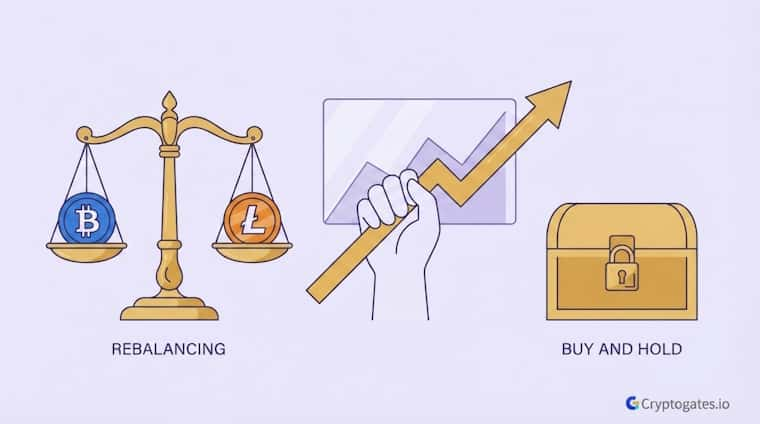
You back-tested your DCA bot last month.
Solid numbers.
But now you’re staring at two very different playbooks for the same portfolio, and this isn’t the only fork in the road, as this full breakdown of DCA, Grid, and Rebalance strategies makes clear.
That’s the real question behind rebalancing vs buy and hold: not which strategy sounds smarter, but which one actually holds up when you run the numbers across real market cycles.
Here’s the thing — most of this debate happens in theory. Few people actually pull the historical data and check.
A Shrimpy study covering thousands of simulated portfolios found the median performance improvement from rebalancing was 64% compared to plain holding, and 92% of rebalanced portfolios still beat HODL even after tax drag.
(Source: Shrimpy)
This guide runs both approaches through actual backtests — bull, bear, and sideways — so you can see where each one earns its keep.
No hype. Just data and a playbook you can use.
- The Problem: Traders assume one strategy always wins, then get blindsided when it fails in a different market regime.
- The Solution: Historical backtesting across multiple market conditions to see how rebalancing vs buy and hold actually performs, not how it's assumed to perform.
- The Incentive: A clear playbook for matching strategy to market condition instead of guessing.
- The Risk: Past backtest results don't guarantee future performance, and every strategy carries drawdown risk.
What Is Buy & Hold?
Buy and hold means exactly what it sounds like. You buy an asset, and you leave it alone.
No trimming, no rebalancing, no reacting to every red candle. It’s the closest thing crypto has to “set it and forget it,” and its entire performance rides on one thing: timing and trend.

Larry Fink Source: BlackRock Chairman's Letter
1. How Buy & Hold Actually Works
There’s no active trading involved. You pick an asset, size your position, and let conviction do the work.
This is why buy-and-hold performs best when the underlying asset is in a strong, sustained uptrend — and why it can quietly bleed you out during a prolonged chop or drawdown.
It’s a passive investing approach that depends entirely on picking the right asset and having the patience to sit through the noise — the same “low stress, high conviction” logic behind our Spot Buy & Hold strategy playbook.
What Is Rebalancing?
Rebalancing works differently.
Instead of letting winners run unchecked, it restores your portfolio to its original target weights on a schedule or a trigger.
If BTC rips and becomes 80% of a portfolio that was supposed to be 60%, rebalancing sells some BTC and buys the underperformer to bring things back in line.
1. How Rebalancing Keeps Risk Aligned
Look, this isn’t about predicting the market. It’s a rules-based process that corrects portfolio drift — the natural pull toward whatever asset just pumped the hardest.
By managing asset allocation this way, rebalancing keeps your risk exposure closer to what you actually planned for, not whatever the market happened to push you into.

It depends on the market. Rebalancing tends to win on risk-adjusted return and drawdown control, while buy and hold often wins on raw returns during strong bull runs.
Why Backtesting Matters
Backtesting shows how both strategies would have actually performed in the past — not how they’re supposed to perform in theory.
That gap matters more than most traders admit. Historical testing takes emotional assumptions out of the equation and replaces them with something closer to evidence.

1. The Same Strategy Looks Different in Every Market
Here’s what most beginners miss.
A strategy that looks brilliant in a bull run can look reckless in a bear market, and the same setup that feels boring during a chop can quietly outperform everything else.
Wait — that’s kind of the whole point of this article. Bull, bear, and sideways conditions each reward a different structure, and no single approach wins across all three — a pattern that holds up across our breakdown of the best strategies for every market phase.
Performance comparison only means something when it’s tested across regimes, not cherry-picked from one.
The Backtesting Framework
A fair comparison needs identical inputs. Same starting capital. Same assets.
Same time period.
Fees included, every time — skipping that step is one of the fastest ways to fake a result that looks better than it is.
1. Key Metrics That Matter
It’s not just about who ends with more money. A real comparison looks at:
| Metric | What It Shows |
|---|---|
| Final Portfolio Value | Raw ending outcome |
| Max Drawdown | Worst peak-to-trough loss |
| Risk-Adjusted Return | Return relative to risk taken |
Final value and ROI tell you who “won” on paper.
Max drawdown and volatility tell you what it actually felt like to hold that strategy through the worst stretch. Risk-adjusted return and capital efficiency tie it together — because a strategy that returns 40% with a 70% drawdown isn’t automatically better than one that returns 25% with a 20% drawdown.
Honestly, most retail comparisons skip this part entirely.
Historical Backtest Scenario 1 — Bull Market
In a sustained bull run, buy and hold usually wins the raw returns game. No contest. Letting BTC or ETH ride without interruption means you capture the full move — every leg up, every parabolic candle, all of it.
Over a rolling three-year window, an unrebalanced Bitcoin allocation returned 178% compared to 75% for a portfolio with no Bitcoin at all, and yearly rebalancing came in around 143%.
Cointelegraph Research
But there’s a problem.
Rebalancing during a strong uptrend means trimming your biggest winner just as it’s doing the heavy lifting.
That’s the tradeoff — you’re capping upside in exchange for controlled risk. Still, rebalancing earns its place if the portfolio gets dangerously concentrated.
A position that grows from 20% to 70% of your book isn’t a win anymore; it’s concentration risk wearing a win’s clothing.

Mark Douglas Source: Trading in the Zone
1. What the Bull Market Backtest Shows
Momentum rewards patience. But concentration quietly builds in the background, even while the chart looks beautiful.
2. Playbook
Use buy-and-hold if you have real conviction in a small number of major assets. Use rebalancing if you want to stay in the upside while keeping risk in check.
Best for: BTC, ETH, and core long-term holdings — the names you’d actually want to hold through a full cycle.
Reality Check
Common belief: Rebalancing always caps your upside – if you’re trimming your winner, you’re leaving money on the table.
What CryptoGates research found: A 51-day backtest tracking a lopsided XRP/BTC pair told a different story. XRP surged nearly 27% while BTC added just 2.5% — exactly the kind of divergence that should have punished a rebalancing bot for selling into strength. Instead, the bot ran 22 swaps, locked in $184.24 in profit, and finished 1.64 percentage points ahead of simply holding both assets.
Why it matters: Trimming a winner isn’t the same as missing the move. When one asset is doing all the work, periodic rebalancing captures gains along the way instead of waiting for a single exit point — which is exactly why the “rebalancing = lower returns” assumption doesn’t hold up once you actually test it.
🔗 Playbook: https://cryptogates.io/playbooks/xrp-exploded-27-in-51-days/
Historical Backtest Scenario 2 — Bear Market
Bear markets flip the script fast. If your portfolio is heavily loaded into whatever’s falling the hardest, buy and hold just watches the damage happen.
No mechanism to slow the bleeding.
Rebalancing works differently here — it forces you to trim exposure to the worst performers along the way and keep the structure you originally planned for, the same dynamic that let a SOL/ETH rebalance bot beat HODL during a real 2026 drawdown.
The raw returns might still be ugly. Everyone loses something in a real bear market. But the risk-adjusted picture tends to look meaningfully better, since the drawdown gets managed instead of just absorbed.
1. What the Bear Market Backtest Shows
Rebalancing tends to improve risk-adjusted results even when the headline number is still modest.
It’s not glamorous.
It’s capital preservation, and in a bear market, that’s basically the whole game.
2. Playbook
Rebalancing suits investors who want to gradually protect capital and stay aligned with a target mix. Holding only makes sense with very high conviction and a genuinely long time horizon — not “I’ll hold until it recovers,” but an actual multi-year outlook.
Best for: diversified portfolios and anyone who wants lower volatility over raw upside.
Real Backtest Example
Strategy: Rebalance
Assets: SOL / ETH
Market Condition: Severe bear market (Oct 20 – Dec 15, 2025)
Objective: Test whether rebalancing between two collapsing assets helps or hurts
Key Result: SOL dropped nearly 32% and ETH collapsed 48% in the same window. A passive $1,000 holder would have taken a −28.73% hit. The rebalance bot still lost money — down $287 — but that loss was smaller than doing nothing, proving the “risk-adjusted, not risk-free” argument with real numbers instead of theory.
Expert Interpretation: This is the honest version of a bear-market backtest — nobody wins outright. But the gap between −28.73% and the bot’s actual result is the whole case for rebalancing during a drawdown: it doesn’t stop the bleeding, it slows it.
🔗 View Complete Playbook: https://cryptogates.io/playbooks/sol-crashed-32-eth-crashed-48-did-rebalancing-help/
On risk-adjusted metrics, usually yes. Rebalancing tends to limit downside exposure, though raw returns can still be negative in a deep bear market.
Historical Backtest Scenario 3 — Sideways Market
Sideways markets are brutal for pure buy-and-hold. No trend means no upside to capture — which is exactly why one grid bot returned 27.74% on XRP while buy-and-hold made 0.24% over the same flat 90 days.
Well, nothing happens on the surface. Underneath, individual assets are still drifting apart from each other, and that’s exactly the kind of movement rebalancing is built to harvest.
Rebalancing can sometimes outperform in this environment by selling the asset that popped and buying the one that dipped, over and over, capturing small gains from allocation drift.
Discipline matters more here than in any other regime — actually, discipline might be the entire strategy in a range-bound market. There’s no momentum to ride, so the process has to carry the weight instead.
1. What the Sideways Market Backtest Shows
Consolidation punishes patience-as-a-strategy. Allocation drift, on the other hand, quietly rewards the mechanical discipline of rebalancing — even when nothing looks like it’s “happening” on a price chart.
Rebalancing vs Buy & Hold by Asset Type
Not every asset behaves the same way in a backtest.
BTC, ETH, and smaller altcoins each respond to these two strategies differently, and lumping them together is where a lot of comparisons go wrong.
1. Bitcoin
BTC tends to work reasonably well under both approaches, which isn’t surprising given that Bitcoin still commands over half of the entire crypto market cap.
Buy-and-hold shines hardest during strong, sustained trend periods — the kind of multi-month runs BTC is known for.
Rebalancing helps control concentration when BTC starts eating up more and more of a portfolio’s weight.
2. Ethereum
ETH tends to run hotter than BTC across most market periods — more volatile, sharper swings, bigger drawdowns.
That extra volatility is exactly where rebalancing’s risk control starts to earn its keep. It’s not that ETH is a bad hold, it’s just a rougher one.
3. High-Volatility Altcoins
This is where buy-and-hold gets genuinely risky. A single altcoin can go from hero to zero fast, and there’s no mechanism catching that fall.
Rebalancing can soften some of that damage, but only if the asset stays liquid enough to actually trade out of — an illiquid altcoin can trap you regardless of strategy.
Common Mistakes in the Comparison
Most rebalancing vs buy and hold comparisons online are, ngl, kind of broken. Not maliciously — just built on lazy assumptions that quietly tilt the result toward whichever strategy the writer already liked.
Pre-Trade Strategy Audit
- Comparing different assets without adjusting for risk
- Ignoring fees entirely, which flatters whichever strategy trades less
- Testing across only one market period instead of a full cycle
- Assuming past backtest results guarantee future performance
- Confusing "simpler" with "better," which isn't the same thing
Here’s the issue.
A backtest that only covers a bull run will always make buy-and-hold look like the obvious winner. Run the same comparison across a bear market and sideways chop, and the story usually gets a lot more nuanced.
This kind of testing bias is everywhere, and honestly, it’s the main reason this debate feels so unresolved online — people are arguing from cherry-picked evidence and calling it a conclusion, which tracks with the fact that only 1 in 67 active retail traders stays consistently profitable across full market cycles.
Which Strategy Should You Choose?
Buy and hold works best when you have a strong conviction and want something simple that you don’t have to babysit.
Rebalancing works best when structure, discipline, and risk control matter more to you than squeezing out every last percent of upside.

This is really where a tool like the Rebalance Simulator earns its place — instead of guessing which approach fits your portfolio, you can actually see how allocation drift and rebalancing frequency would've played out on your specific mix.

ZAHEER, CEO CryptoGates
Rebalancing and Buy & Hold Both Work — Just Not at the Same Time
Here’s the honest takeaway.
Neither strategy is universally better — the backtests make that pretty clear.
Buy-and-hold wins on raw returns when a trend is strong and you have real conviction. Rebalancing wins on risk-adjusted performance and drawdown control almost everywhere else.
What actually separates a good outcome from a bad one isn’t which strategy you pick in the abstract.
It’s whether the strategy matches the market regime you’re actually in, and whether you stick with it.
If you want to see how your own mix behaves under both approaches, the Rebalance Simulator lets you test allocation drift and rebalancing frequency against your actual portfolio before you touch a live account.
Run the numbers. Twenty or thirty backtests across different regimes will tell you more than any opinion piece — including this one. Systems over speculation. That’s really the whole point.
FAQs
Is rebalancing safer than buy and hold?
Generally, yes, on a risk-adjusted basis, since it limits concentration and controls drawdown. Raw returns can still favor buy-and-hold in strong bull markets.
How often should a crypto portfolio be rebalanced?
Quarterly rebalancing is a common starting point for most portfolios. More frequent rebalancing controls risk further but adds fees and tax events.
Can buy and hold beat rebalancing over the long term?
It can, especially with strong conviction in a small number of major assets during sustained bull trends. Backtesting your specific assets is the only way to know.