

 Bitcoin
  Ethereum
  Solana
  TRON
TRON  Zcash
Zcash  Hyperliquid
  Dogecoin
  Monero
  Chainlink
  Cardano
  Stellar
  Uniswap
  Sui
Sui  Hedera
  Bittensor
  Shiba Inu
  Ripple USD
  Polkadot
  Aster
Aster  World Liberty Financial
  Render
  Artificial Superintelligence Alliance
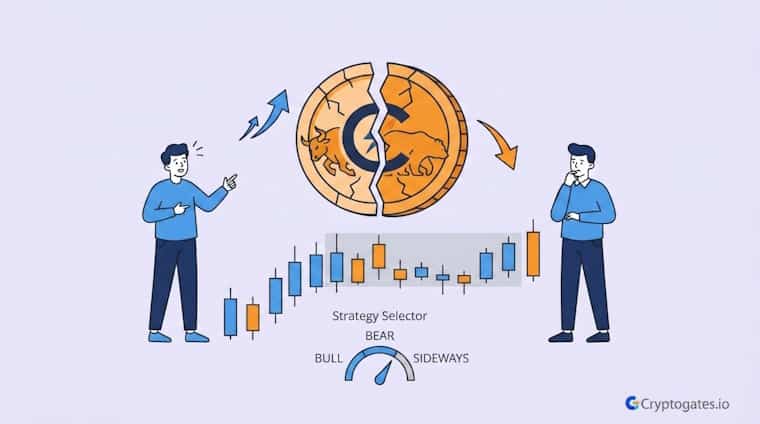
You bought the dip.
Then it dipped again. Then again. Sound familiar?
Here’s the thing.
Most traders don’t lose because they picked a bad coin.
They lose because they used a bullish strategy in a bearish market, or tried to grid trade a trend that never stopped running.
The best crypto trading strategies aren’t universal, they’re situational.
What works when BTC is ripping will get you rekt in a chop zone.
A 2025 NFTEvening survey of 1,005 retail crypto traders found 84% lose money and fail within their first year, and 58% lose almost all their money in that first year.
NFTEvening survey, Nov 2025 – nftevening.com
Honestly, that’s the part nobody tells beginners.
The market doesn’t punish you for being wrong about direction.
It punishes you for using the wrong playbook for the conditions you’re actually in.
- The Problem: Traders apply one strategy across every market phase, then wonder why it stops working the moment conditions shift from trend to chop.
- The Solution: Match your strategy type, trend-following, defensive, or range-based, to the actual market structure you're trading in right now.
- The Incentive: Fewer blown accounts, more consistent execution, and a repeatable process you can actually backtest before risking capital.
- The Risk: Crypto markets shift fast. A strategy that fits today's regime can become a liability within weeks if you don't reassess. This isn't financial advice, it's a framework to test yourself.
Understanding Crypto Market Conditions
Every crypto cycle repeats the same three phases.
Bull, bear, chop. Most traders can name them.
Fewer can actually spot which one they’re in right now, and that gap is where money gets lost.
Coin Bureau
Here’s the thing.
Price action alone won’t tell you the full story.
You need volume, momentum, and structure working together before you can call a market condition with any confidence.
How to Spot a Bull Market
Higher highs, higher lows, buyers stepping in on every dip.
That’s bullish structure in its simplest form.
Volume expands on green candles and shrinks on red ones.
Bulls are defending hard, and every pullback gets bought fast.
Battle-Test Your Strategy
Before the Market Does.
Eliminate guesswork with institutional-grade backtesting for DCA, Grid, and Rebalance bots. Real historical data. Real-world results.
RSI holding above the midline for extended stretches is another tell.
So is price staying glued above key moving averages.
When breakouts hold instead of faking out, that’s your confirmation.
Ser, that’s when the bullish crypto strategy playbook comes out.
How to Spot a Bear Market
Flip it.
Lower highs, lower lows, selling pressure that doesn’t let up.
Support levels break instead of holding.
Bounces feel weak, and they get sold into almost immediately.
Momentum indicators stay pinned below neutral.
Sentiment turns negative fast, and rallies start looking like exit liquidity for anyone still holding on hope.
This is where a bearish crypto strategy earns its keep, not the one you used three weeks ago during the pump.
How to Spot a Sideways Market
Chop.
No other word for it.
Price bounces inside a range, testing the same support and resistance zones over and over without committing to a direction.
Bollinger Bands tighten. Volatility drops.
Breakout attempts fail and snap right back into the range.
Honestly, this phase frustrates trend traders the most, but it’s exactly where a sideways crypto strategy, built around range logic instead of direction, starts to shine.
Best Crypto Trading Strategies for Bull Markets
When BTC starts printing green candles back to back, the whole vibe on CT shifts.
Everyone’s suddenly a trading genius.
But here’s the thing, bull market strategies actually have structure behind them, not just vibes and “send it” energy.
Trend-following and breakout setups work here because momentum is doing the heavy lifting for you.
Proven Setups &
Expert Breakdowns.
We don't just show you the data; we engineer and validate high-performance strategies, providing the "Alpha" behind the numbers.
1. Trend Following Crypto Strategy
This one’s simple in theory, brutal in execution.
You ride the trend using moving averages as your guide, entering when price stays above key averages and momentum confirms strength.
The best crypto trading strategy in a strong uptrend isn’t complicated. It’s disciplined.
“Trend followers don’t predict tops. They just refuse to fight the direction until structure breaks,”
CG Research Analyst
Ser, the hard part isn’t spotting the trend.
It’s staying in it without panic selling on every 5% pullback.
Weak hands get shaken out constantly during real bull runs.
Diamond hands who trust their system tend to capture the bigger moves.
2. Breakout Trading Strategy Crypto
Breakouts look exciting on a chart.
Price coils near resistance, volume builds, then it rips through.
But not every breakout is real. Fakeouts happen constantly, especially when retail gets baited into buying the top of a liquidity sweep.
Volume confirmation matters here more than people admit.
A breakout without volume is probably nothing.
A breakout with expanding volume and a clean candlestick close above resistance?
That’s giga bullish, and worth testing before you size in.
3. Pullback Buying Strategy
Not every entry needs to be at the breakout.
Sometimes the smarter move is waiting for the dip on support, using Fibonacci retracement zones and RSI oversold signals to time it.
This is basically structured BTFD, minus the emotional chaos.

Trend-following and breakout strategies tend to perform best in bull markets, since momentum and volume confirmation work in your favor. Pullback buying can add better entries within that trend.
Look, buying dips without a plan is gambling.
Buying dips at confirmed retracement zones with RSI confluence is a strategy.
The difference matters more than people think.
You can actually stress test these bull market setups yourself using the CryptoGates Strategy Engine before deploying real capital.
Verify first. Risk later.
Best Crypto Trading Strategies for Bear Markets
Nobody wants to talk about bear markets.
It’s the part of the cycle where CT goes quiet and the moonboys disappear.
But here’s the thing, bear markets are where disciplined traders actually separate from the herd.
The whole game shifts from chasing gains to protecting what you’ve got.
Crypto trading strategies for bear market conditions aren’t about calling the bottom.
They’re about risk managed crypto trading, full stop.
Capital preservation becomes the actual goal, not an afterthought.
Confused about
market outlook?
Trading without a plan is just gambling. Our strategy architect analyzes your risk tolerance and capital to match you with a proven algorithmic framework.
1. Defensive Portfolio Strategy
When the charts turn red for weeks straight, rotating into stablecoins isn’t cowardice.
It’s strategy.
A solid crypto portfolio strategy during downtrends means reducing exposure to high-beta alts and parking capital where it won’t bleed out with every red candle.
Ngl, this feels boring compared to bull market ape-ins.
But boring is exactly what keeps your account alive long enough to buy the next cycle’s opportunities.
2. Short Selling and Advanced Crypto Trading Strategies
This one’s not for beginners.
Advanced crypto trading strategies like shorting require tight stop losses, careful position sizing, and a real understanding of trend continuation.
One bad liquidation cascade against you and it’s game over fast.
Coinrule, "Free Backtesting Platform" data page, Feb 2026
Honestly, most retail traders shouldn’t be shorting at all.
But for those who understand the mechanics, it’s one more tool in a bear market playbook that stablecoin-only strategies can’t offer.
3. DCA Strategy in Strong Assets
Here’s where patience actually pays.
Dollar cost averaging into fundamentally strong assets during a downtrend lowers your average entry without requiring you to time the exact bottom, which, let’s be real, nobody consistently does.
Stop Guessing.
Stress Test Your Edge.
The market doesn't care about your backtest. Our engine simulates 1,000+ "what-if" scenarios to ensure your strategy is built for survival.
Run Crypto Strategy Engine →This is one of the more profitable crypto trading strategies precisely because it removes the emotional guesswork.
You’re not trying to be a hero.
You’re just showing up consistently while everyone else is busy panic selling or coping about their bags.
You can actually simulate this yourself using the CryptoGates DCA Simulator before committing real capital to a downtrend accumulation plan.
Real Backtest Example
Strategy: DCA
Coin: DOT/USDT
Market Condition: 7-month downtrend, 56% decline
Objective: Lower average entry into a fundamentally strong asset during sustained weakness
Key Result: 79 of 80 DCA sessions closed in profit, returning +$380.99, while a spot holder on the same capital sat on a −$617 loss, a $998 gap in outcomes.
Expert Interpretation: The data here separates disciplined accumulation from panic-driven exits. A trader manually trying to time DOT’s bottom across seven months of grinding downside would likely have capitulated somewhere along the way.
The bot didn’t need to call the bottom, it just kept buying at defined intervals, letting the averaging mechanism absorb the volatility. This is the practical case for DCA-into-strength during bear conditions: it removes the emotional decision of “is this the bottom” entirely.
View Complete Playbook: https://cryptogates.io/playbooks/how-a-dca-bot-made-381-while-polkadot-lost-56/
Best Crypto Trading Strategies for Sideways Markets
Chop is brutal for trend traders.
Price goes nowhere for weeks, breakouts fail, and anyone trading like it’s a bull run gets chewed up.
Crypto trading strategies for sideways market conditions need a completely different mindset.
Range-based and mean-reversion approaches take over here.
1. Range Trading Strategy
Buy near support, sell near resistance, repeat.
It sounds almost too simple, but that’s the point.
Range trading works because it respects market structure instead of fighting it.
Look, the tricky part is patience.
You’re waiting for price to hit the edges of the range again and again, resisting the urge to chase moves in the middle where the risk to reward just isn’t there.
2. Grid Trading Strategy
This is where automation earns its keep.
Grid trading captures small, repeated profits inside a defined range without needing to predict direction at all.
The bot just does its job, buying low and selling high within the grid, over and over.
Backtested grid strategies during extended consolidation phases have historically outperformed manual range trading in execution consistency.
That consistency is the whole appeal.
No emotional interference, no missed entries because you stepped away from the charts.
Real Backtest Example
Strategy: Grid
Coin: SOL/USDT
Market Condition: 60-day sideways drift, post-crash range between $80–$97
Objective: Extract repeated profit from range-bound price action without predicting direction
Key Result: Over the 60-day window, the grid bot executed 146 trades and generated $462.95 in net profit, outperforming a buy-and-hold position by 10.88%.
Expert Interpretation: This backtest illustrates why grid trading is structurally suited to chop. SOL didn’t trend in either direction during the test window, conditions that typically punish trend-followers, but the range itself became the source of profit.
Each swing between support and resistance triggered a buy-sell cycle, compounding gains that a static holder simply couldn’t access. The result reinforces a core principle of range trading: in sideways markets, volatility is the opportunity, not the risk.
View Complete Playbook: https://cryptogates.io/playbooks/sol-usdt-grid-bot-backtest-mar-apr-2026/
3. Mean Reversion Strategy
Overbought and oversold zones are the bread and butter here.
When RSI spikes into extreme territory and Bollinger Bands stretch wide, mean reversion traders are watching for that snap back toward the average.
Range trading and grid trading tend to work best in sideways markets since they profit from repeated price movement instead of a clear trend. Mean reversion adds another layer for catching extremes.
This isn’t about catching every move.
It’s about picking off high-probability reversals with confirmation, not just guessing that “it’s gone too far” and hoping.
You can stress test any of these range-based setups using the CryptoGates Grid Simulator to see how they would’ve performed across real historical chop.
Which Strategy Fits Which Market?
Here’s the truth nobody likes admitting.
The best crypto strategy isn’t a fixed answer.
It’s a moving target that depends entirely on what phase the market’s actually in. Ser, that’s it. That’s the whole secret.
Bull market?
Trend following, breakout trading, pullback buying. Bear market?
Capital preservation, DCA into strength, careful short setups for those who actually know what they’re doing.
Sideways market?
Range trading, grid trading, mean reversion. Match the tool to the condition, not the other way around.
Quick Match Table
| Market Condition | Best Strategy Types | Core Focus |
|---|---|---|
| Bull Market | Trend Following, Breakout, Pullback | Ride Momentum |
| Bear Market | Defensive, DCA, Short (Advanced) | Preserve Capital |
| Sideways Market | Range, Grid, Mean Reversion | Capture Volatility |
Look, this isn’t about memorizing a chart.
It’s about training yourself to ask “what condition am I actually in” before you ask “what trade should I take.”
Most traders skip straight to the second question.
That’s kinda where things go wrong.
Risk Management in Crypto Strategies
You can have the best crypto trading strategy on the planet and still blow your account.
How?
No stop loss. No position sizing. No plan for when things go against you, which, let’s be honest, they eventually will.

ZAHEER, CEO CryptoGates
Risk management isn’t the boring part of trading.
It’s the actual alpha. Anyone can pick a direction.
Surviving long enough to compound gains over time, that’s the hard part.
Why Emotional Discipline Beats Technical Skill
Here’s what actually matters more than your indicator setup.
Can you follow your own rules when the chart moves against you?
Most traders can’t. Fear kicks in, they exit early.
Greed kicks in, they hold too long.
Market volatility doesn’t cause most losses.
Emotional reaction to volatility does.
An academic study on retail trading behavior found a wide majority of retail traders lose money, with figures ranging between 68% and 97% across markets in Europe, the UK, Australia, India, and the US, largely tied to overtrading and emotional decisions.
Yieldfund research summary, May 2026
That’s kind of the whole point of backtesting before you go live.
You’re not just testing whether a strategy works.
You’re testing whether you can actually sit through the drawdowns without touching the panic button.
Common Mistakes to Avoid
Ngl, most of these mistakes aren’t complicated. They’re just repeated.
Over and over. Cycle after cycle.
Using a bullish crypto strategy in a bear market is probably the biggest one.
Traders get comfortable with what worked last quarter and keep running it even after the structure flips.
Bulls are defending nothing anymore, but the trader’s still buying every dip like it’s still send-it season.
Neutralize Volatility.
Own the Growth.
Access systematic playbooks designed to eliminate emotional bias. From Spot HODL frameworks to advanced Grid simulators.
Ignoring crypto market trends is another classic.
Price action tells you what phase you’re in if you actually look. Skip that step and you’re basically trading blind, hoping instead of reading.
Overtrading during a consolidation phase burns accounts quietly.
Chop doesn’t reward activity.
It rewards patience.
But sitting still feels boring, so traders force entries in the middle of the range where risk to reward is garbage.
Trading Without Backtesting or Optimization
Here’s the uncomfortable part.
Deploying a strategy without testing it first isn’t trading.
It’s gambling with extra steps.
You wouldn’t invest in a business without checking if it’s ever made money, right? Same logic applies here.
“Industry backtesting audits show a large portion of unadjusted backtests contain hidden bias or leakage, causing live results to fall far below reported figures.”
Blockchain Council, “Backtesting AI Crypto Trading Strategies,” April 2026
Look, the fix is simple even if it feels tedious.
Run your setup against historical data first.
See how it holds up across different regimes, not just the one that made it look good in your head.
How to Build an Adaptive Crypto Strategy
The traders who actually survive multiple cycles aren’t the ones with the flashiest setup.
They’re the ones who adapt.
An adaptive crypto strategy isn’t one strategy.
It’s a process for switching between strategies based on what the market’s actually doing.
That means testing constantly.
Journaling every trade, win or loss, and being honest about why it worked or didn’t.
Most traders skip this part because it’s unglamorous. But it’s kinda the whole game.
Combining Technical Indicators with Sentiment and Trend Analysis
Technical indicators alone miss half the picture.
Combine RSI and moving averages with sentiment data, funding rates, and broader macro trend, and suddenly your read on the market gets sharper.
Here’s the thing.
None of this needs to be perfect.
It just needs to be tested, repeatable, and honest about what actually happened last time you ran it.
You can build and stress test your own version of this process using the CryptoGates Strategy Engine before touching real capital.
Match the Strategy, Not Just the Market
Here’s the simple truth.
There’s no such thing as the one strategy that wins every cycle.
Bulls reward trend following.
Bears reward patience and defense.
Chop rewards range logic. That’s it.
That’s the whole framework.
The Truth in Numbers.
Designed for the 10% who require absolute clarity. We strip away the hype to reveal the structural reality of the crypto markets.
Look, most traders don’t fail because they’re bad at crypto.
They fail because they keep running yesterday’s playbook in today’s market.
The traders who actually survive multiple cycles are the ones who ask “what condition am I in” before they ask “what should I buy.”
CryptoGates built its Strategy Picker exactly for this problem, matching your risk profile and market outlook to a strategy type instead of leaving you to guess.
Test this setup yourself → cryptogates.io.
FAQs
What's the best crypto trading strategy for beginners?
Start with DCA or spot buy and hold. Both remove emotional timing decisions and let you build conviction slowly while you learn to read market structure.
Can one strategy work in every market condition?
Not really. Trend following works in bulls, defensive strategies fit bears, and range or grid strategies suit chop. Matching the strategy to the condition is what matters most.
Why is backtesting important before using a crypto trading strategy?
Backtesting shows you how a strategy performed across real historical data, including drawdowns and losses, before you risk actual capital on it.