

 Bitcoin
 Ethereum
 Solana
 TRON
 Hyperliquid
 Zcash
 Dogecoin
 Monero
 Chainlink
 Cardano
 Stellar
 Uniswap
 Sui
 Hedera
 Shiba Inu
 Bittensor
 Ripple USD
 Aster
 Polkadot
 World Liberty Financial
 Render
 Artificial Superintelligence Alliance

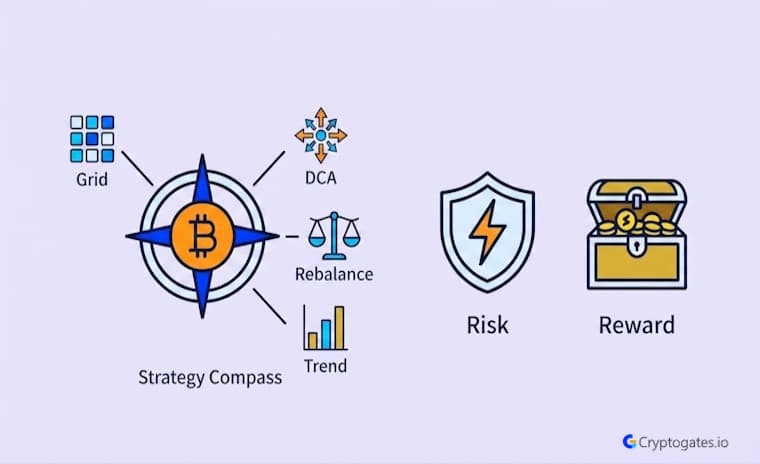
You’ve probably asked yourself this at 2 am while staring at a red candle: Which crypto trading strategy actually works?
Ser, you’re not alone.
Most traders bounce between DCA, Grid, Rebalance, and five other setups without ever running a real crypto trading strategy comparison first.
They just copy whatever CT is hyping that week. Here’s the thing, though.
The strategy that printed for some anon on Twitter might be the exact one that gets you rekt, because your risk tolerance, your capital, and your time aren’t the same as theirs.
A survey of 1,005 retail crypto traders published by NFTEvening found that 84% lost money in their first year, and day trading alone caused 54% of those losses.
That’s not a market problem.
That’s a strategy-fit problem.
Especially when 97% of day traders lose money before reaching their second year because they relied on luck over a structured framework.
This guide breaks down eight major strategies, side by side, so you can finally see which one matches your personality, your capital, and the market you’re actually trading in right now, helping you escape the statistics where 21% of crypto owners report net losses on their holdings.
- The Problem: Most traders pick a strategy because it's trending on CT, not because it fits their risk profile or the current market.
- The Solution: A direct, side-by-side crypto trading strategy comparison across DCA, Grid, Rebalance, Buy & Hold, Swing, Trend, Mean Reversion, and Breakout.
- The Incentive: Clarity means fewer emotional decisions, fewer wasted trades, and a system built for survival instead of guesswork.
- The Risk: Even the "right" strategy on paper can fail if it's never been tested against real historical data first.
How to Compare Crypto Trading Strategies
Look, before we jump into DCA vs Grid vs everything else, you need one thing first: a fair way to judge them.
Ngl, most comparison content skips this part completely. They just tell you Grid is “better” without explaining better for whom, or under what conditions.
Here’s the framework we’ll use for every single pairing in this crypto trading strategy comparison.
Six factors. Same six, every time, so you’re not comparing apples to candles.
Interactive Checklist: Before Picking Any Strategy
- What's my real risk tolerance, not my hoped-for one?
- How much capital am I actually willing to commit?
- How many hours a week can I realistically give this?
- What's the current market structure: trending, ranging, or chaotic?
- Have I tested this on historical data, or am I just vibing?
Risk level. How much can this strategy actually lose you, and how fast?
Capital requirement. Some setups need a real size to work well.
Others run fine on lunch money.
Complexity.
Is this something you set once, or something you babysit?
Time commitment. Daily attention or weekly glance?
Execution style. Manual, semi-automated, or fully bot-driven?
Market fit.
Does this thing even work in the market condition you’re in right now?
Battle-Test Your Strategy
Before the Market Does.
Eliminate guesswork with institutional-grade backtesting for DCA, Grid, and Rebalance bots. Real historical data. Real-world results.
Trade Frequency, Time Commitment & Emotional Pressure
Some strategies want your attention every hour.
Others run quietly in the background for weeks.
Honestly, this is the factor most beginners ignore, and it’s the one that burns them out fastest.
Trading psychology matters here just as much as the setup itself.
Emotional discipline, passive versus active trading, and execution style all tie back to how much pressure a strategy puts on your head, not just your wallet.
DCA vs Grid Trading - Which Accumulation Strategy Wins?
DCA builds a position slowly, patiently, over time.
Grid trading profits from price bouncing inside a range. Different tools.
Different jobs.
Let’s break both down before we compare them.
1. What Is Dollar-Cost Averaging (DCA)?
Dollar cost averaging is a systematic accumulation strategy.
You buy at fixed intervals, regardless of price, which spreads your entries and lowers your average cost over time.

Mark Douglas, author of Trading in the Zone
No timing skill required.
That’s kind of the point.
A DCA bot automates this so you’re not manually clicking buy every week like it’s a chore.
2. What Is Grid Trading?
Grid trading sets a price range, splits it into levels, and automates buy-low-sell-high orders inside that band.
It thrives on volatility and sideways chop.
When price oscillates without a clear trend, a grid bot just keeps farming those small moves over and over.
3. DCA vs Grid - Key Differences
DCA Strategy
• Works across time with scheduled, recurring investments.
• Simple and mostly passive, focused on long-term accumulation.
Grid Strategy
• Works across price using predefined buy and sell levels.
• More active, aiming to capture repeated profits inside a trading range.
4. Best Use Cases for DCA and Grid Bots
DCA fits long-term conviction plays. If you believe in an asset for over a year or more and don’t want to time entries, DCA smooths that out.
Grid fits choppy, sideways, high-volatility markets where price refuses to commit to a direction, as demonstrated when XRP went sideways for three months while our grid bot accumulated handsomely.
Wrong tool, wrong market, and you’ll end up frustrated watching a grid bot sit idle during a strong trend, or watching a DCA plan bleed through a prolonged downtrend with no bottom in sight—though past results show how we successfully DCA’d into Polkadot’s worst downtrend to turn a falling knife into a winning position.
Proven Setups &
Expert Breakdowns.
We don't just show you the data; we engineer and validate high-performance strategies, providing the "Alpha" behind the numbers.

DCA tends to hold up better in a sustained downtrend since it keeps lowering your average cost. Grid bots can struggle if price breaks below the set range entirely.
5. Real-World Example: DCA vs Grid in Action
Picture a 40% drawdown.
One trader keeps adding a fixed amount every week regardless of the red candles, lowering their average cost as the price falls.
Another trader, running a grid bot in the same coin, profits off every bounce between support and resistance during that same stretch.
Same market.
Two completely different outcomes, both valid, depending on the trader’s goal.
Real Backtest Example
Strategy: DCA
Coin: ETH
Market Condition: 46-day, 32% drawdown
Objective: measure whether spreading entries over time actually softens a fast, sustained decline
When ETH shed roughly $1,400 in under seven weeks, a fixed-interval DCA approach lost 1.81% against a straight buy-and-hold loss north of 6% on the same capital. The bot didn’t call the bottom, and it didn’t need to — every scheduled buy simply lowered the average cost basis as price kept falling.
Expert Interpretation: The gap isn’t proof DCA “wins” in every crash. It’s proof that removing timing decisions from a bad market caps the damage rather than eliminating it. That distinction matters more than the headline number.
View Complete Playbook: ETH Crashed 32% in 46 Days – Our DCA Bot Lost Only 1.81%
You can actually run both of these scenarios yourself using the DCA Backtest Bot on CryptoGates before deciding which fits your situation better.
Grid vs Rebalance - Tactical Trading vs Portfolio Discipline
Grid trades price movement inside bands.
Rebalancing manages exposure across your entire portfolio. Ngl, people mix these up a lot because both sound “automated” and “systematic.”
But they’re solving completely different problems.
1. What Is Portfolio Rebalancing?
Rebalancing means resetting your portfolio back to its target asset allocation once it drifts.
Say you set 60% BTC, 40% stables.
If BTC pumps hard, that ratio can quietly shift to something way riskier than you signed up for.
A 60/40 portfolio left untouched for roughly a decade can drift to nearly 80/20 as one asset class keeps outperforming the other.
Vanguard Research
Here’s the issue.
Most people don’t notice this drift until a crash hits and they’re holding way more risk than they thought.

ZAHEER, CEO CryptoGates
2. Grid vs Rebalance - Key Differences
Grid Strategy
• Trade-execution heavy, placing frequent buy and sell orders inside a defined price range.
• Profits from repeated price swings, making it a tactical, short-term trading strategy.
Rebalance Strategy
• Portfolio-allocation focused, adjusting asset weights to maintain your target allocation.
• Manages long-term portfolio exposure, making it a strategic approach rather than an active trading system.
3. Best Use Cases for Grid and Rebalance Strategies
Grid fits range-bound markets where you’re actively managing a single asset’s chop.
Rebalance fits diversified portfolios where you care more about long-term structure than catching every swing.
4. Real-World Example: Grid vs Rebalance
One trader runs a grid bot on a volatile altcoin, farming the range all week.
A different investor holds BTC, ETH, and stables, and rebalances back to target weights after BTC makes a big move.
Two totally different games, both disciplined, both data-driven instead of emotional.
Real Backtest Example
Strategy: Rebalance
Assets: SOL / ETH
Market Condition: simultaneous two-asset collapse (SOL −32%, ETH −48%) over roughly two months
Objective: test whether rebalancing between two falling assets helps or just adds transaction cost to a loss
A passive 50/50 holder of this pair would have absorbed close to a 29% portfolio loss. The rebalance bot, cycling capital between the two as their ratio drifted, ended down about $287 less – beating the do-nothing outcome without ever going net positive.
Expert Interpretation: This is the honest version of what rebalancing actually promises. It’s not a hedge against a shared downturn, and it won’t turn two losing assets into a gain.
What it does is keep exposure closer to target instead of letting the worse-performing asset’s decline quietly define the whole portfolio.
View Complete Playbook: SOL −32%. ETH −48%. Our Rebalance Bot Lost $287 — and Still Beat Doing Nothing
You can model both scenarios using the Grid Backtest Bot and the Rebalance Backtest Bot on CryptoGates before committing real capital.
Stop Guessing.
Stress Test Your Edge.
The market doesn't care about your backtest. Our engine simulates 1,000+ "what-if" scenarios to ensure your strategy is built for survival.
Run Crypto Strategy Engine →DCA vs Buy & Hold - Timing Risk vs Simplicity
DCA reduces timing risk by spreading entries out.
Buy and hold is simpler, but honestly, it leaves you way more exposed to when you actually pull the trigger.
1. What Does Buy & Hold Mean in Crypto?
Buy and hold means you enter once, then just… hold.
No rebalancing, no re-entry, just conviction and patience.
Diamond hands, basically, through the pumps and the dumps alike.
2. DCA vs Buy & Hold - Key Differences
DCA Strategy
• Spreads entries across time instead of investing all at once.
• Reduces market timing risk by averaging the purchase price over multiple buys.
Buy & Hold Strategy
• Typically enters the market with a single purchase and holds long term.
• Simpler to manage but fully exposed to the entry price and any immediate drawdown.
3. Best Use Cases for DCA and Buy & Hold
DCA fits situations where you’re unsure about entry timing, which, let’s be real, is most of the time for most people.
Buy and hold fits strong long-term conviction plays where you don’t want to actively manage anything.
DCA tends to feel safer for beginners since it removes the pressure of picking one perfect entry point. Buy and hold works better once you already have strong conviction.
4. Real-World Example: DCA vs Buy & Hold
One user buys BTC every month regardless of price.
Another buys once and holds for years.
Same asset, same time horizon, even, but completely different ride along the way.
Swing Trading vs Trend Following - Timing vs Discipline
Swing trading chases the next meaningful move.
Trend following just rides whatever wave is already happening, for as long as it lasts.
Honestly, these two get lumped together a lot, but the mindset behind them is pretty different.
1. What Is Swing Trading?
Swing trading means capturing medium-term price moves using technical levels and momentum.
You’re not holding for months.
You’re not scalping minute candles either.
It’s the middle ground, patient enough to wait for a setup, active enough to actually manage it.
2. What Is Trend Following?
Trend following means riding the main directional move for as long as it keeps going.
No predicting the top.
No predicting the bottom.
Just staying in while the trend holds and getting out when the structure breaks.
Research across multiple asset classes published by the EFMA found that trend following cuts portfolio volatility by roughly 40 to 50% compared to equally weighted portfolios.
EFMA trend following research
3. Swing vs Trend - Key Differences
Swing Trading
• Focuses on capturing the next meaningful price move.
• Requires precise entries and exits with strong market timing.
Trend Following
• Stays in winning trades for as long as the trend remains intact.
• Demands patience and discipline to ignore normal pullbacks.
4. Best Use Cases for Swing and Trend Strategies
Swing fits traders who can actually monitor price action regularly.
Trend following fits traders chasing the big macro moves, the ones who’d rather miss the first 10% of a move than fake-out their way into ten failed entries.
5. Real-World Example: Swing vs Trend
A swing trader enters after a pullback, targets the next resistance, and closes out.
A trend follower stays in through multiple higher highs, ignoring the noise in between.
Same asset. Same trend even. Wildly different holding periods.
Mean Reversion vs Breakout Trading - Snapback vs Continuation
Mean reversion bets that price snaps back to average.
Breakout trading bets the opposite, that price keeps going once it escapes a level.
Wait, that sounds contradictory, but both can be right, just in different market conditions.
1. What Is Mean Reversion Trading?
Mean reversion assumes price often returns to its average after stretching too far in one direction.
It works well when a market is range-bound or clearly overextended, kind of like a rubber band that’s been pulled too tight.
2. What Is Breakout Trading?
Breakout trading enters when price escapes a key level, usually with rising volume behind it.
It thrives when volatility expands and momentum actually follows through instead of fading.
3. Mean Reversion vs Breakout — Key Differences
Mean Reversion
• Trades price moves back toward the average within a range.
• Performs best in sideways or range-bound market conditions.
Breakout
• Trades the move after price breaks out of a key range or pattern.
• Works best during strong expansion phases and trending markets.
4. Best Use Cases for Mean Reversion and Breakout
Mean reversion fits sideways markets and overextended moves.
Breakout fits strong momentum and real volume expansion, not just a wick that fades in ten minutes.
5. Real-World Example: Mean Reversion vs Breakout
A coin keeps bouncing between the same support and resistance for weeks.
A different coin finally breaks resistance on strong volume and just keeps climbing.
Same chart pattern at first. Two completely different endings.
You can stress test which of these fits your read on the market using the Strategy Engine on CryptoGates, which runs thousands of scenario simulations before you risk anything real.
Which Crypto Trading Strategy Fits Which Trader Personality?
Honestly, this is the part most guides skip completely.
They’ll tell you Grid trading is great, but never ask if you’re even wired for active management.
Strategy fit depends on temperament just as much as market conditions.

Larry Fink, BlackRock CEO
Low risk, patient traders usually gravitate toward DCA, Buy & Hold, and Rebalance.
These are the “set it and check in occasionally” crowd.
Active traders lean toward Grid, Swing, and Breakout, the ones who don’t mind watching charts and adjusting on the fly.
Analytical traders, the ones who love rules and backtests more than gut feel, tend to land on Trend Following and Mean Reversion.
Confused about
market outlook?
Trading without a plan is just gambling. Our strategy architect analyzes your risk tolerance and capital to match you with a proven algorithmic framework.
That single line explains a lot of bad strategy switching, actually.
People abandon a perfectly good system after one losing streak, not because the system broke, but because the loss felt heavier than the wins ever did.
Wait, that’s kind of the whole point of this section.
Trader personality, not just market condition, decides whether a strategy sticks or gets abandoned in month two.
Which Crypto Strategy Fits Which Market Condition?
Here’s the thing. Matching a strategy to your personality only gets you halfway there.
You also need to match it to whatever market regime is actually happening right now.
1. Which Trading Strategies Perform Best in Different Market Conditions?
In a bull market, DCA, Buy & Hold, Trend Following, and Breakout tend to shine, since price is generally cooperating with you.
In a bear market, DCA, Rebalance, and cautious Mean Reversion setups tend to hold up better, especially DCA since it keeps lowering your average cost through the pain.
Sideways or chop-heavy markets favor Grid, Mean Reversion, and Rebalance, strategies that don’t need a clean trend to function.
Research Highlight
A pattern worth noting from CryptoGates’ Grid Playbooks: the strategy’s edge tends to widen, not narrow, the flatter the market gets. In one 90-day window where XRP opened and closed within a single cent of itself – effectively a dead flat, a grid bot still fired 875 trades and returned 27.74%, against a buy-and-hold result of 0.24% on identical capital.
This isn’t a case of the bot predicting direction. There was no direction to predict. The return came entirely from harvesting the small, repeated oscillations that a static hold position simply can’t monetize. It’s a useful data point for anyone assuming a “boring” chart means a “boring” strategy result.
View Complete Playbook: XRP Went Nowhere for 3 Months
High volatility markets favor Grid, Breakout, and selective Swing setups that can actually capitalize on the bigger swings.
And in a trendless market, Grid and Mean Reversion usually perform better than anything trying to catch a directional move that just isn’t there.
2. Why Strategy Performance Depends on Market Regime, Not Hype
The simple truth is, no single strategy survives every regime equally well.
That’s exactly why testing across different market conditions before going live matters more than picking the “best” strategy off some CT thread.
Risk, Capital & Complexity Comparison Across All Strategies
Let’s break this down plainly, because complexity and capital needs swing hard across these eight strategies.
1. Low-Complexity Strategies: DCA & Buy and Hold
DCA and Buy & Hold sit at the simple end.
Low complexity, low starting capital, and honestly, not much that can go wrong operationally.
You set it, you forget it, mostly.
2. Medium to High-Complexity Strategies: Grid, Rebalance, Swing & Breakout
Grid and Rebalance sit in the middle.
They need real structure.
A grid bot needs sensible range boundaries or it just sits idle or gets steamrolled by a strong trend.
Rebalancing needs a clear target allocation, or you’re just guessing when to trim and add.
Swing and Breakout demand more skill and more active management.
You’re reading charts, reacting to volume, managing entries in real time.
This isn’t a “set it and walk away” category.
Not sure which
exchange fits you?
Bypass the marketing hype. Our matrix cross-references your profile against 50+ institutional metrics—including Proof-of-Reserves and Slippage Models.
3. Why the Best Strategy Is the One You Can Execute Consistently
Trend Following and Mean Reversion are rule-based systems, but ngl, they only work if you actually follow the rules.
The math behind them is solid.
The discipline to execute it without second-guessing every pullback is the hard part.
The simple truth is, complexity isn’t automatically bad and simplicity isn’t automatically safe.
It’s about matching the system to what you can actually sustain.
Practical Selection Framework for Crypto Trading Strategy Comparison
Okay, so how do you actually pick, instead of just reading eight strategy breakdowns and still feeling stuck?
1. Start With Your Risk, Capital, and Available Time
Start with your risk tolerance first, before anything else.
Then check how much capital you can realistically commit without it affecting your sleep.
After that, figure out your available time and attention, because a strategy that needs daily monitoring is useless to someone with a nine to five.
2. Choose a Strategy That Matches Your Trading Personality
Match your personality with the strategy style you just read about.
And here’s the step almost everyone skips: conduct a thorough DCA strategy backtesting setup or a portfolio simulation to validate your rules before investing real capital.
3. Validate Your Strategy Before Risking Real Capital
This is where a lot of traders get cooked, not because the strategy was bad, but because they never chose to backtest a DCA bot or run grid simulations against historical data first.
Strategy tools exist for exactly this reason, to help you check your choice before your capital is on the line.
CryptoGates Tools That Simplify Strategy Selection and Testing
Look, everything above is useless if you can’t actually validate it against real data.
That’s the whole gap between “I think this strategy works” and “I tested this strategy and here’s what actually happened.”
1. Find the Right Strategy With CG Strategy Picker
This is where CG Strategy Picker comes in.
It’s a quick profile match, ten questions on your risk tolerance, capital, experience, and goals, and it points you toward a strategy framework that actually fits instead of whatever’s trending on CT this week.
Confused about
market outlook?
Trading without a plan is just gambling. Our strategy architect analyzes your risk tolerance and capital to match you with a proven algorithmic framework.
2. Validate Every Strategy With CG Strategy Engine
Once you’ve got a direction, CG Strategy Engine takes over.
It runs thousands of Monte Carlo simulations against your setup, checking robustness, risk of ruin, and drawdown probability before you ever risk a single dollar.
Honestly, this is the part most traders skip entirely.
They backtest once, get a good result, and go live.
One good run means nothing if the strategy falls apart the moment market conditions shift slightly.
Together, these tools move you from “which strategy should I use?” to “how do I actually validate it properly?”
That’s the real question anyway.
Common Mistakes in Crypto Strategy Selection
Most bad strategy choices don’t come from bad math.
They come from bad psychology.
1. The Most Common Strategy Selection Mistakes
Choosing a strategy because it’s popular on CT is probably the biggest one.
Just because some anon posted a 300% chart doesn’t mean that setup fits your capital or your risk tolerance.
Using a strategy that doesn’t match your available time is another.
A swing strategy is useless to someone who can’t check charts during work hours.
Ignoring market regime gets people too.
Running a grid bot through a strong trend, or trend following through a chop-heavy range, and wondering why it’s not working.
2. Why Discipline Matters More Than Chasing the Next Winning Strategy
Then there’s overestimating capital needs, or worse, ignoring fees entirely until they’ve quietly eaten a chunk of the gains.
And switching strategies too often without enough data is maybe the sneakiest one.
One bad week doesn’t mean the system is broken.
It might just mean the sample size is too small to judge anything yet.
The simple truth is, discipline beats cleverness here almost every time.
Final Crypto Strategy Comparison Table
Here’s the whole guide compressed into one quick-glance view.
Useful if you just want the summary without rereading eight sections.
| Strategy Pair | Best For | Best Market | Risk Level | Complexity |
|---|---|---|---|---|
| DCA vs Grid | Long-term accumulation vs range profits | Downtrend/dip vs sideways chop | Low vs Medium | Low vs Medium |
| Grid vs Rebalance | Active range trading vs portfolio discipline | Sideways vs diversified holdings | Medium vs Low | Medium vs Medium |
| DCA vs Buy & Hold | Uncertain timing vs strong conviction | Any market vs bull trend | Low vs Low | Low vs Low |
| Swing vs Trend | Medium-term timing vs riding the wave | Volatile swings vs strong trends | Medium vs Medium | Medium vs Medium |
| Mean Reversion vs Breakout | Range snapback vs momentum continuation | Range-bound vs expansion phase | Medium vs High | Medium vs High |
There's No Universal Best Crypto Trading Strategy
The simple truth is, there’s no single winner in this crypto trading strategy comparison.
The right pick depends on your capital, your risk tolerance, your available time, and whatever market regime you’re actually trading in right now. DCA reduces timing stress.
Grid farms range-bound chop. Rebalance keeps your portfolio honest.
Buy and hold rewards patience.
Swing and trend both chase moves, just on different timelines.
Mean reversion and breakout play opposite sides of the same price action.
Stop Guessing.
Stress Test Your Edge.
The market doesn't care about your backtest. Our engine simulates 1,000+ "what-if" scenarios to ensure your strategy is built for survival.
Run Crypto Strategy Engine →Here’s the thing, though. Reading about a strategy isn’t the same as testing it.
Before you commit real capital, run your idea through the CG Strategy Picker to check the fit, then stress test it with the CG Strategy Engine.
Verify first. Risk later. Scale slowly.
FAQs
What is the safest crypto trading strategy for beginners?
DCA is usually the safest starting point since it removes the pressure of timing entries.
It spreads risk over time instead of betting everything on one price point.
Can I combine DCA, Grid, and Rebalance strategies together?
Yes, many traders run DCA for long-term accumulation, Grid for range-bound assets, and Rebalance to keep overall portfolio risk in check. Each one serves a different job.
Which crypto strategy works best in a sideways market?
Grid trading tends to perform best in sideways, range-bound conditions since it profits from repeated price oscillation. Mean reversion and Rebalance also hold up well here.