

 Bitcoin
  Ethereum
  Solana
  TRON
TRON  Zcash
Zcash  Hyperliquid
  Dogecoin
  Monero
  Chainlink
  Cardano
  Stellar
  Uniswap
  Sui
Sui  Hedera
  Bittensor
  Shiba Inu
  Ripple USD
  Polkadot
  Aster
Aster  World Liberty Financial
  Render
  Artificial Superintelligence Alliance
Ser, be honest with yourself for a second.
How many crypto tools have you paid for that you used exactly once?
Most beginners think they need a premium subscription to trade smart.\
They don’t, as this comparison of free vs paid crypto backtesting software shows exactly where free tools hold up.
The truth is, a handful of free crypto tools for beginners already cover everything from strategy matching to backtesting to risk stress testing, and most people never even open them.

(Source: Industry Research)
This isn’t about grinding through paid courses or chasing a signal group on Telegram.
It’s about knowing which free tools actually do the heavy lifting and using them before you ape into anything.
- The Problem: Beginners either skip tools entirely or pay for ones that don't fix the real issue, which is trading without verification.
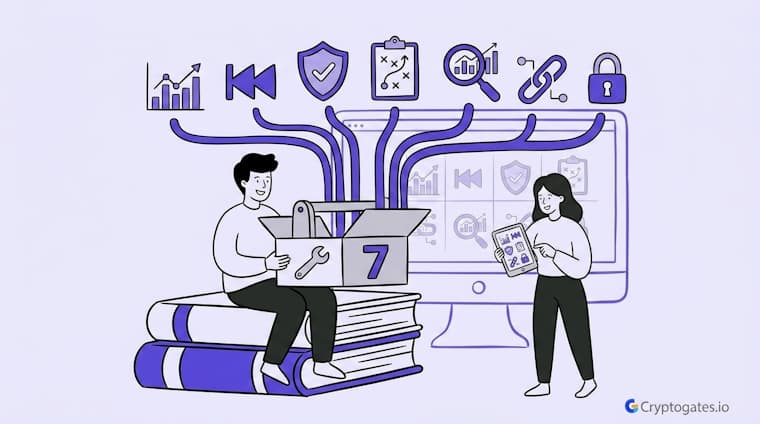
- The Solution: Seven free CryptoGates tools cover strategy matching, backtesting, stress testing, and quick calculations, all in one workflow.
- The Incentive: You test everything before a single dollar touches the market.
- The Risk: Even free tools won't save you if you skip the process and jump straight to execution.
Why Free Tools Beat Guesswork Every Time
Here’s the thing. Most people don’t lose money because the market is unfair.
They lose money because they never tested the idea in the first place. They saw a chart, felt FOMO, and ape’d in.
Free tools remove that excuse. When something costs nothing to try, there’s no reason to skip it.
And when a tool is built specifically to test strategies against real historical data, skipping it isn’t saving time. It’s just gambling with extra steps.
Battle-Test Your Strategy
Before the Market Does.
Eliminate guesswork with institutional-grade backtesting for DCA, Grid, and Rebalance bots. Real historical data. Real-world results.
Look, the market doesn’t care how confident you feel about a trade idea. It cares whether the idea actually holds up.
That’s the entire reason backtesting and simulation tools exist.
Verify first. Risk later. Scale slowly.
The Cost of Trading Without a Toolkit
Most losses don’t come from bad luck.
They come from skipping a step that a free tool would’ve caught in under two minutes.
Reality Check
Common belief: Grid bots print money regardless of market direction, since they’re just buying low and selling high inside a range.
What CryptoGates research found:
Strategy: Grid Bot
Coin: BTC/USDT
Market Condition: Trending bull run (BTC +10.4% for the month)
Objective: Measure grid performance when price breaks trend instead of staying range-bound
Key Result: The bot returned +7.74% on just $3.26 in fees — a real, profitable outcome — but buy-and-hold still outpaced it over the same stretch.
Expert Interpretation: A grid bot isn’t malfunctioning in a trending market; it’s working against its own design. The strategy is built to harvest oscillation inside a range, not a sustained directional move — which is the exact mismatch described just above, where a grid position entered a trending market instead of a ranging one.
Why it matters: Matching the strategy to the market condition, not picking whichever bot sounds appealing that week, is what separates a working setup from a mismatched one.
Full breakdown: BTC Pumped +10% in May — Our Grid Bot Made +7.74%
Think about it this way.
A trader enters a grid trading strategy during a strong trending market instead of a ranging one.”
A quick check with a simulator would’ve flagged that mismatch before any capital moved. Instead, it turned into a bagholder situation nobody saw coming, mostly because nobody checked.
That’s not bad luck. That’s a missing toolkit.
The Strategy Picker (Find Your Fit First)
Before you touch any bot, you need to know which strategy actually fits you. Not the one that’s trending on CT this week.
The one that matches your risk tolerance, capital, and time.
The Strategy Picker on CryptoGates does exactly that. It’s a simple 10-question tool covering your market outlook, risk tolerance, capital size, experience level, and a few other factors.
Answer honestly, and it will point you toward DCA, Grid, or Rebalance, whichever fits your actual profile instead of whatever’s pumping on Twitter that day.
Stop Guessing.
Stress Test Your Edge.
The market doesn't care about your backtest. Our engine simulates 1,000+ "what-if" scenarios to ensure your strategy is built for survival.
Run Crypto Strategy Engine →Here’s what most beginners miss.
They pick a strategy because it sounds exciting, not because it fits their situation.
A degen with a high risk tolerance and small capital might genuinely be fine running an aggressive grid.
A busy professional with a steady income and low monitoring time probably isn’t.
Who This Tool Is Really For
Honestly, this tool is built for two types of people.
Beginners who don’t know where to start, and busy professionals who want exposure without babysitting charts all day.

A strategy matching tool that assesses risk tolerance and goals before recommending an approach works best. It stops beginners from picking a strategy blind.
If you’re new to bot trading, the questions alone will teach you things.
You’ll start thinking in terms of drawdown limits and monitoring time instead of just “will this pump.”
The Backtest Bots (DCA, Grid, Rebalance)
Now let’s get into the part that actually separates disciplined traders from everyone else. Backtesting.
CryptoGates runs three backtest bots, one each for DCA, Grid, and Rebalance strategies.
Each one lets you run your exact parameters against real historical market data before you commit a single dollar.
Want to know how a DCA strategy would’ve performed during a 40% drawdown? Run it. Curious if a grid setup survives a choppy, range-bound market?
Test it first.
Real Backtest Example
Strategy: DCA Bot
Coin: DOT/USDT
Market Condition: Severe multi-month downtrend (−56% over 7 months)
Objective: Test whether disciplined step-buying holds up through a prolonged, unrelenting decline rather than a single sharp dip
Key Result: 79 of 80 sessions closed in profit. The bot returned +$380.99 while spot holders sat on a −$617 loss on the same starting capital — a $998 gap in outcomes.
Expert Interpretation: The edge here didn’t come from timing the bottom. It came from spreading entries across the entire decline instead of committing capital at one price point — exactly the kind of scenario a backtest bot lets you check before real money is on the line.
Full breakdown: DOT Crashed 56% in 7 Months — The Falling Knife Test
This is where the “verify first” part of our philosophy actually gets practical.
It’s not a slogan. It’s a literal button you can press before risking capital.
Why Backtesting Beats Backtesting Claims You Read Online
Here’s the issue with most strategy claims floating around CT.
Someone posts a screenshot of a 40% gain and calls it a system.
No context, no timeframe, no proof it wasn’t a lucky sequence.
Confused about
market outlook?
Trading without a plan is just gambling. Our strategy architect analyzes your risk tolerance and capital to match you with a proven algorithmic framework.
A backtest bot doesn’t care about vibes.
It runs your parameters against actual price data and shows you the real result, like this BTC DCA Bot Backtest: The Honest Truth, wins and losses included.
That’s the difference between a claim and evidence.
The Strategy Engine and Exchange Picker
Once you’ve backtested a strategy and it looks solid, don’t just assume it’ll hold up forever. Markets shift.
What worked in a trending market might fall apart in a choppy one.
This is where the Strategy Engine comes in. It runs Monte Carlo simulations, basically thousands of “what if” scenarios using different trade sequences, to see if your strategy’s performance was actually structural or just a lucky run.
Click “Run” once, and you’ll get a Robustness Score. Click it again and get a different result each time, because the market never repeats itself exactly either.
| Tool | What It Solves |
|---|---|
| Strategy Picker | Matches your profile to a strategy |
| Backtest Bots | Proves the strategy on real data |
| Strategy Engine | Stress-tests for luck vs structure |
| Exchange Picker | Finds where to execute it |
| Converter + Simulators | Quick math before committing funds |
Once your strategy passes that stress test, the Exchange Picker helps you find where to actually execute it.
It’s another quick questionnaire covering things like fees, security requirements, leverage needs, and payment methods, matching you to an exchange from partners like Binance, OKX, KuCoin, and a few others instead of you guessing based on which one your favorite YouTuber uses.
Robustness Over Luck
A strategy that survives 1,000 random simulations and keeps a stable score is fundamentally different from one that only worked once in backtesting.
Run it through a stress test tool using Monte Carlo simulation. If the results stay consistent across thousands of random trade sequences, the edge is likely structural instead of lucky.
If your Robustness Score swings wildly every time you hit run, that’s not randomness being unfair to you.
It’s the strategy telling you it depends too much on one specific sequence of trades to work.
A Risk of Ruin above 1% is generally considered high risk in professional trading circles.
Crypto Converter and Simulators (Rounding Out the Toolkit)
The last two tools are simple, but they matter more than people give them credit for.
The Crypto Converter handles quick swaps and rate checks across 500+ pairs, with no hidden fees, no digging through five different exchange apps just to figure out what your position is actually worth right now.

Zaheer puts it simply. Every strategy deserves proof before it deserves capital. That's not a tagline. It's the whole reason these tools exist.
The Simulators, Spot, DCA, Grid, and Rebalance let you preview outcomes before you commit.
Want to see how a DCA entry plays out during a 40% drawdown, or how a grid bot performs across a defined price range?
Run the numbers first. It takes a couple of minutes and beats finding out the hard way with real capital on the line.
Proven Setups &
Expert Breakdowns.
We don't just show you the data; we engineer and validate high-performance strategies, providing the "Alpha" behind the numbers.
Building a Simple Weekly Routine With These Tools
Here’s a routine worth stealing.
Once a week, run your active strategy through the backtest bot again with any new data.
Check your Robustness Score if anything feels off. Use the converter when you’re rebalancing between pairs.
Your Weekly Free Tools Routine
- Run active strategy through backtest bot with fresh data
- Check Robustness Score if anything feels off
- Confirm Risk of Ruin is still under your comfort line
- Use Converter when rebalancing between pairs
- Re-run Strategy Picker if your risk profile or capital changed
That’s it.
Fifteen minutes, maybe less once you’re used to it.
It’s not exciting, but neither is losing capital because you skipped a step that takes less time than scrolling CT.
Bookmark These Before You Trade Another Coin
Seven tools. Zero cost. One shared purpose: test everything before you risk anything.
The Strategy Picker tells you what fits.
The backtest bots prove whether it works. The Strategy Engine checks if it survives beyond one lucky run.
The Exchange Picker, Converter, and Simulators round out the rest. None of it requires guesswork, and none of it requires capital to get started.
Test this setup yourself before you risk a single dollar on the next trade.
FAQs
Are CryptoGates tools really free to use?
Yes. No signup, no credit card, and no capital required to test strategies using the backtest bots, simulators, and Strategy Picker.
Do I need trading experience to use these tools?
No. The Strategy Picker and Exchange Picker are built for beginners, walking you through simple questions instead of requiring prior knowledge.
Which tool should I use first as a beginner?
Start with the Strategy Picker to find your fit, then run that strategy through the matching backtest bot before doing anything else.