

 Bitcoin
  Ethereum
  Solana
  TRON
TRON  Zcash
Zcash  Hyperliquid
  Dogecoin
  Monero
  Chainlink
  Cardano
  Stellar
  Uniswap
  Sui
Sui  Hedera
  Bittensor
  Shiba Inu
  Ripple USD
  Polkadot
  Aster
Aster  World Liberty Financial
  Render
  Artificial Superintelligence Alliance
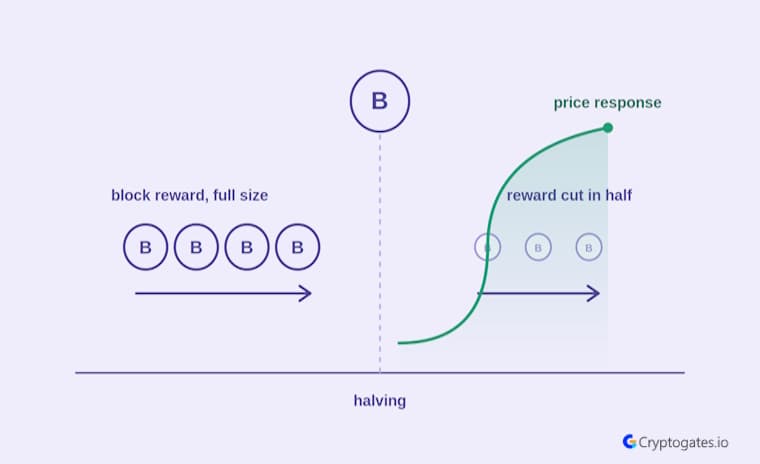
Every four years, something happens deep inside Bitcoin’s code that most people don’t notice until months later.
The block reward gets cut in half. No headlines flash “Bitcoin Just Changed” on the day it happens.
No siren goes off.
But the supply of new coins entering the market just dropped by 50%, and that quiet shift has preceded some of the biggest price moves in crypto history.
Here’s the thing.
A lot of traders treat the bitcoin halving explained on some random blog as a green light to ape in. That’s not how markets work.

(Source: market cycle research, verify before publishing)
If you’re wondering whether this time plays out the same way, you’re asking the right question.
Let’s break it down properly instead of trusting a hype thread.
- The Problem: Most traders assume halving equals an automatic price pump, and they position on hope instead of data.
- The Solution: Understand the actual mechanism, look at what happened in past cycles, and test your assumptions before risking capital.
- The Incentive: Traders who verify the pattern first tend to avoid getting rekt chasing a narrative that's already priced in.
- The Risk: Past halving rallies are not a guarantee. Macro conditions, market size, and existing supply expectations can change the outcome completely.
What Is Bitcoin Halving, Really?
Look, the name makes it sound complicated, but the mechanism is pretty simple once you strip away the noise.
Bitcoin halving is a coded event, not a decision anyone makes.
What Actually Changes During a Halving
- Block reward paid to miners drops by 50%
- New coin supply entering circulation slows immediately
- Mining profitability shifts overnight for anyone running on thin margins
- Network difficulty adjusts afterward to match the new hash rate
- Nothing about existing holders' coins changes at all
It’s not a marketing stunt.
It’s not a company announcement.
It’s a rule written into Bitcoin’s protocol from the very start, and it fires automatically whether anyone is paying attention or not.
1. How the Halving Mechanism Works
Bitcoin’s protocol pays miners a reward for confirming blocks.
Roughly every four years, or after a set number of blocks are mined, that reward gets cut in half automatically.
Miners who were earning a certain number of coins per block suddenly earn half – a mechanic covered in full in how Bitcoin actually works, from wallets to mining.
This has happened multiple times already, moving from an initial reward of 50 BTC per block all the way down through several halvings to a small fraction of that original number.
Real Backtest Example
If a shrinking percentage gain per cycle sounds abstract, a real bot run through a genuine BTC bull leg makes the point concrete. In June–July 2025, BTC climbed nearly 15% — the kind of move halving hype threads love to point to. A DCA bot running through that exact window tells a different story than “buy the halving and hold.”
Strategy: DCA Bot
Coin: BTC/USDT
Market Condition: Strong uptrend (+14.5%)
Objective: Capture gains through systematic dip-buying during a rally
Key Result: 8 of 9 sessions closed in profit, but the bot finished $119.81 behind simple buy-and-hold
Expert Interpretation: Strategy choice matters as much as market direction. A rising market doesn’t automatically reward every approach equally — which is exactly why “the pattern says price goes up” isn’t the same as “any strategy captures that upside.”
Honestly, the elegance of it is that nobody can change it. Not Zaheer, not a whale, not an exchange.
It’s baked into the code.
2. Why Satoshi Built It This Way
Here’s the interesting part.
This wasn’t an accident or an afterthought.
The entire design exists to create predictable, shrinking scarcity. Instead of a central bank deciding when to print more money, Bitcoin’s supply schedule was fixed from day one, capped at 21 million coins total.
Battle-Test Your Strategy
Before the Market Does.
Eliminate guesswork with institutional-grade backtesting for DCA, Grid, and Rebalance bots. Real historical data. Real-world results.
That’s exactly why people call it digital gold.
Except unlike gold, you can verify the entire supply schedule down to the exact block.
No guessing, no trusting an institution. Just code, and everyone can check it themselves.
Does Halving Actually Move Price?
Now let’s look at the part everyone actually cares about. Does cutting the supply in half actually push the price up?
The honest answer is: it’s complicated, and anyone giving you a confident “yes, guaranteed” is selling something.
(Source: crypto cycle data, verify before publishing)
That’s a massive number.
But here’s the catch.
Percentage returns shrinking each cycle isn’t a coincidence. It’s math. A market with more capital in it needs proportionally more money to move the same percentage. Few people talk about that part.
1. What Happened After Past Halvings
In every completed cycle so far, the price didn’t explode on the day of the halving itself. It took months.
Sometimes over a year.
The pattern looks something like this: quiet accumulation, a slow grind, then a delayed rally that peaked somewhere between 12 and 18 months later.
Chasing the exact halving date for a quick flip has, historically, not been the move.
The real move happened later, after the narrative built and new demand caught up to reduced supply.
Reality Check
Common belief: Once a halving narrative kicks in, any strategy running through the rally will perform similarly — it’s just a matter of being in the market.
What CryptoGates research found: Backtesting a BTC DCA bot through a sharp macro-driven crash — the April 2025 tariff-fear selloff that took BTC from $87K to $74K — showed the opposite of what most traders assume happens in a downturn. Rather than bleeding out, 16 of 17 sessions closed via take-profit, and the bot finished $349.61 in the green while spot holders were sitting on paper losses.
Why it matters: Macro shocks and halving cycles don’t move in isolation — tariffs, rate decisions, and liquidity conditions can override the “supply just got cut” narrative entirely. The bot’s edge came from a tested, rules-based response to volatility, not from correctly predicting the news cycle.
The Tariff Trap Playbook — How a DCA Bot Turned BTC’s Worst April Into +$349 Profit
2. Why This Time Could Look Different
Realistically, every cycle has its own macro backdrop.
Bigger institutional participation, different regulatory posture, and different levels of leverage are sitting in the system.
Bitcoin’s market is also just bigger now, meaning more capital is required to produce the same percentage move.

No. Price moves have historically lagged the event by months, sometimes over a year, and each cycle's gains have shrunk compared to the one before it.
Don’t fade the pattern completely. But don’t treat it as gospel either.
Verify first. Risk later.
Scale slowly isn’t just a slogan, it’s the entire point of backtesting this stuff instead of guessing.
What Halving Means for Miners and Network Security
But there’s a problem most beginners never think about. Halving doesn’t just affect price speculation.
It hits miners directly, and that has knock-on effects for the entire network.

Zaheer puts it simply: "Every halving separates miners running a real business from miners running on hope. The network gets stronger because the weak links get squeezed out. That's not a flaw. That's the system working as designed."
When the reward miners earn gets cut in half overnight, their revenue gets cut in half too, assuming the price doesn’t immediately compensate for it.
That’s a brutal math problem for anyone running old, inefficient equipment or paying high electricity costs.
The Miner Capitulation Risk
Some miners simply can’t survive the cut. Their costs stay the same, but their revenue just got sliced in two.
So they shut off their machines. This is called miner capitulation, and it’s happened after previous halvings.
Stop Guessing.
Stress Test Your Edge.
The market doesn't care about your backtest. Our engine simulates 1,000+ "what-if" scenarios to ensure your strategy is built for survival.
Run Crypto Strategy Engine →When enough miners drop out, the hash rate falls temporarily.
The network then adjusts mining difficulty downward to compensate, which eventually restores profitability for the miners who stayed. It’s a self-correcting system, but it can get messy in the short term.
Weaker hands get flushed out. Stronger, better-capitalized operations usually end up controlling more of the network afterward.
How Traders Should Actually Approach a Halving
So what should you actually do with all of this?
Here’s the simple truth: positioning based on a halving narrative you read on CT isn’t a strategy. It’s a bet dressed up as analysis.
Confused about
market outlook?
Trading without a plan is just gambling. Our strategy architect analyzes your risk tolerance and capital to match you with a proven algorithmic framework.
Most people think they need to predict exactly when price will move. They don’t.
What they actually need is a tested plan for multiple scenarios, because nobody, including us, knows exactly how this cycle plays out.
Verify the Narrative Before You Act
This is where CryptoGates’ DCA Strategy Backtest Bot becomes genuinely useful instead of just another tool sitting unused.
Rather than trusting a hype thread claiming “halvings always send BTC to the moon,” you can actually run historical data through a backtest and see how a dollar-cost averaging approach would have performed across every previous halving cycle, drawdowns included.
There's no data suggesting the exact halving date is a reliable entry point. Historical rallies happened months after, not on the day itself, so timing purely around the event carries real risk.
That’s the difference between conviction built on data and conviction built on vibes.
One survives a red candle. The other doesn’t.
The Bottom Line on Bitcoin Halving
Halving changes the math behind Bitcoin’s supply, not the outcome of your trade.
Every four years, new coin issuance gets cut in half, and history shows price often responds, just not on a fixed schedule and never with a guaranteed size.
Treating a halving date as a buy signal on its own is gambling with extra steps.
Testing how a strategy would’ve performed across every past cycle, drawdowns and all, is how you actually build conviction instead of borrowing someone else’s.
Proven Setups &
Expert Breakdowns.
We don't just show you the data; we engineer and validate high-performance strategies, providing the "Alpha" behind the numbers.
Backtest before risking capital.
Run the DCA Backtest Bot against every completed halving cycle and see the real numbers for yourself.
FAQs
When is the next Bitcoin halving?
The next halving is expected roughly four years after the last one, once the network reaches the next scheduled block milestone. Exact timing shifts slightly based on block production speed.
Does Bitcoin always go up after a halving?
Every completed cycle so far has seen a rally within 12 to 18 months, but the size of the gains has shrunk each time. It’s a pattern, not a promise.
How does halving affect Bitcoin mining profitability?
Miner revenue per block drops by 50% overnight, squeezing out less efficient operations until network difficulty adjusts and profitability stabilizes for those who remain.