

 Bitcoin
  Ethereum
  Solana
  TRON
TRON  Zcash
Zcash  Hyperliquid
  Dogecoin
  Monero
  Chainlink
  Cardano
  Stellar
  Uniswap
  Sui
Sui  Hedera
  Bittensor
  Shiba Inu
  Ripple USD
  Polkadot
  Aster
Aster  World Liberty Financial
  Render
  Artificial Superintelligence Alliance
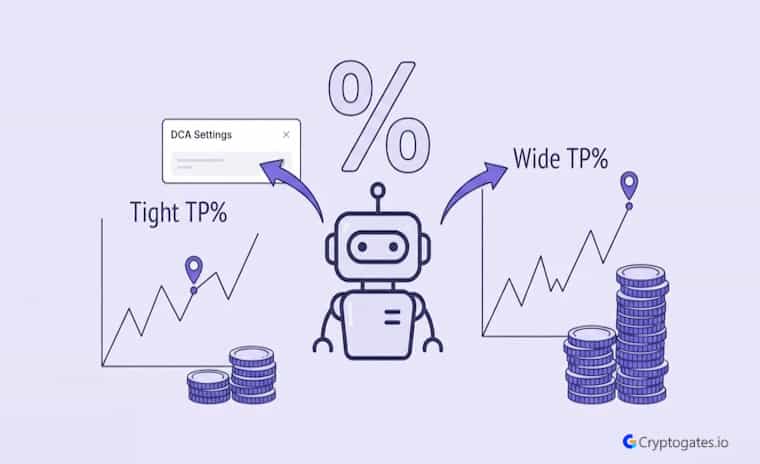
Ser, you set your take profit at 5% once, felt good about it, and never looked back.
Fair enough. But here’s the thing.
Your dollar-cost averaging (DCA) take-profit percentage is quietly deciding a lot more than “when the bot sells.”
It’s deciding how much of a bounce you actually keep versus how much you leave sitting on the table, waiting for a candle that might not come back around.

Source: Kraken Investor Survey
Most beginners treat TP% like a formality.
It’s not.
It’s one of the few levers you fully control in a market that controls everything else.
- The Problem: Traders set a DCA take profit percentage once, then never test whether it actually fits the market condition they're trading in.
- The Solution: Treat TP% as a variable you test against different regimes, not a fixed setting you install and forget.
- The Incentive: A TP% that matches the current regime can mean the difference between banking a solid win and watching a good entry turn into a mediocre one.
- The Risk: A wider TP% can look great in a fast bounce but give back the same gains if the market stalls or reverses before hitting target.
What Take Profit Percentage Actually Controls In A DCA Bot
Let’s get one thing straight.
Your DCA take-profit percentage doesn’t decide if your strategy works.
It decides when a single session closes and how much profit gets locked in before the bot resets and waits for the next dip — the same mechanic that let our BTC DCA bot backtest hit take-profit ten times in a single stretch.
That’s it.

"Verify first. Risk later. Scale slowly. Your TP% should reflect what the backtest actually shows for the market condition you're testing, not a number that felt right last week."
Nothing more, nothing less.
But that “nothing more” ends up mattering a whole lot when the price keeps moving after your bot has already exited.
Why A Small Number Has An Outsized Effect
Here’s what most guides miss.
A 2% TP and a 5% TP don’t just change your profit target.
They change how often your sessions close, how much capital gets freed up for the next entry, and how exposed you stay to a reversal – the same kind of outsized effect a DCA bot’s step percentage setting has on entries.

Not exactly. A lower TP% tends to close sessions faster and more often, which can reduce exposure time. It doesn't reduce risk on any single trade, just how long you're sitting in it.
Small percentage, big downstream effect.
That’s the part beginners skip past.
Tight TP% vs Wide TP%: The Real Tradeoff
Look, there’s no universally “correct” TP%. There’s only the one that fits what the market is doing right now.
A tight TP% grabs small wins fast and often.
Research Insight
Traders often treat a percentage-point tweak to a bot setting as a rounding error – not something worth testing carefully. CryptoGates internal backtesting suggests the opposite: the number itself doesn’t need to be dramatic for the downstream result to shift meaningfully.
Strategy: DCA
Coin: TRX/USDT
Market Condition: 105-day post-ATH slow-bleed correction, no clean bounce
Objective: Compare step-multiplier variants under identical entry logic
Key Result: A 1.15× multiplier variant outperformed the next-best variant tested by $192 – the single largest gap recorded among the settings run, inside a session set that closed 27 of 28 sessions in profit overall.
Expert Interpretation: The multiplier here isn’t the take-profit percentage, but the lesson carries over directly – a setting that reads like a footnote on paper can be the actual gap between an average outcome and the best one on the table.
A wide TP% asks the price to keep moving in your favor before it lets go.
Neither is wrong.
They just behave completely differently depending on the setup you’re in.
1. What Happens During A Fast Recovery Leg
Picture this.
Price crashes hard, panic spreads across CT, then things start easing, and the chart begins climbing back.
In that kind of V-shaped bounce, a tighter TP% tends to close sessions early, sometimes right as the real move is getting started.
Real Backtest Example
Strategy: DCA
Coin: ETH/USDT
Market Condition: 45-day, 18.5% decline (Jan–Feb 2025 bear leg)
Objective: Observe how a fixed take-profit threshold performs as sessions close versus staying open
Key Result: 9 of 9 closed sessions finished in profit – including one that deployed the full $1,100 and returned $28.48 while ETH was actively falling. The session still open at the end of the test window tells the sharper story: with no bounce back to the TP level, that capital simply sat exposed.
Expert Interpretation: This is the regime dependency the take-profit setting can’t escape – a TP% that performs cleanly through a bounce-heavy stretch can leave a position stranded the moment price stops bouncing at all.
ETH DCA Bot Backtest: January-February 2025 Bear Market Results
A wider TP% gives the recovery room to actually develop before the bot books profit.
During a genuine bounce, patience on TP% often pays for itself.
Often. Not always.
2. What Happens During A Choppy Or Slow Grind
Now flip the market condition.
In a range-bound, directionless chop, a wider TP% can sit there for a long time, waiting for a move that never fully commits.
| Market Condition | Tight TP% | Wide TP% |
|---|---|---|
| Fast recovery (V-shape) | Exits early, smaller win | Captures more of the bounce |
| Choppy / sideways | Closes sessions faster, cycles capital | Sits waiting, can stall |
| Strong reversal risk | Locks in profit sooner | Risk giving back gains |
A tighter TP%, in that same environment, tends to close sessions more frequently and keep capital cycling instead of parked.
Same bot. Same DCA logic.
Completely different outcome, just because the regime changed underneath it.
Not really. What works in a fast recovery often underperforms in a choppy range, and vice versa. Testing TP% against the actual regime beats picking one number and reusing it everywhere.
Here’s the honestly annoying truth about this: the “right” TP% for a fast recovery can be the wrong TP% for a slow grind, and the market doesn’t announce which one you’re in.
Finding Your TP% Without Guessing
At the end of the day, your DCA take-profit percentage isn’t a set-it-and-forget-it number.
It’s a variable that behaves differently depending on whether the market is bouncing hard or grinding sideways, and the only real way to know which setting fits your pair right now is to test it rather than guess it.
Battle-Test Your Strategy
Before the Market Does.
Eliminate guesswork with institutional-grade backtesting for DCA, Grid, and Rebalance bots. Real historical data. Real-world results.
Run your own parameters through the DCA Strategy Backtest Bot and see how tight versus wide TP% actually plays out on real historical data before you risk capital on a hunch.
FAQs
What take profit percentage should I use for a DCA bot?
There’s no fixed number that works everywhere. It depends on whether you’re trading a fast recovery or a slow, range-bound market, so testing both against your pair is the safer approach.
Does a higher take profit percentage always mean higher profit?
Not always. A wider TP% can capture more of a strong move, but it also risks giving back gains if the market reverses before hitting the target.
How often should I change my DCA take profit setting?
Whenever the market regime shifts. A setting built for a bounce won’t necessarily hold up once the market turns choppy or starts trending the other way.