

 Bitcoin
 Ethereum
 Solana
 TRON
 Hyperliquid
 Zcash
 Dogecoin
 Monero
 Chainlink
 Cardano
 Stellar
 Uniswap
 Sui
 Hedera
 Shiba Inu
 Bittensor
 Ripple USD
 Aster
 Polkadot
 World Liberty Financial
 Render
 Artificial Superintelligence Alliance

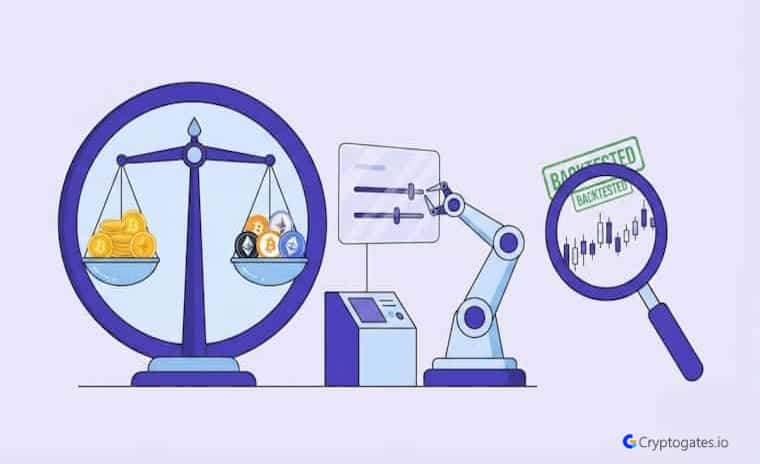
Ser, if you’ve ever opened your portfolio and thought “wait, how did my altcoins take over 40% of this thing?“,
You already know why a crypto rebalancing bot exists.
Crypto doesn’t sit still. One asset pumps, another bleeds, and suddenly your carefully planned 50/30/20 split looks nothing like what you built.
A crypto rebalancing bot fixes that automatically. It watches your target weights, checks your current ones, and trades just enough to bring things back in line.
No emotional decisions, no forgetting to check the app for three weeks straight.
This guide walks through how these bots work, how to set them up properly, and why backtesting one before going live isn’t optional if you actually want it to hold up.
Portfolio Theory Studies
- The Problem: Crypto prices move fast, so your portfolio drifts from its target allocation before you even notice.
- The Solution: A crypto rebalancing bot automatically sells overweight assets and buys underweight ones to keep your allocation on track.
- The Incentive: You get discipline without babysitting charts, plus a system that removes emotional decision-making from the process.
- The Risk: Poor settings, like a threshold that's too tight or ignoring fees, can turn automation into overtrading that quietly eats your returns.
What Is a Crypto Rebalancing Bot?
Here’s the thing.
A crypto rebalancing bot is just software doing a job you’d otherwise have to do manually, and probably inconsistently.
It tracks your portfolio’s target weights, say 40% BTC, 30% ETH, 30% stablecoins, and it watches for drift. When one asset grows past its target because it has pumped, the bot sells a portion of it. When another falls behind because it dipped, the bot buys more. That’s portfolio automation in its simplest form.
Honestly, the value isn’t just the trading itself. It’s what the bot removes. It removes the moment where you’re staring at a green candle thinking, “Maybe I should just let this ride a little longer.“
It removes the hesitation during a red day when selling feels wrong, even though your allocation says it’s time to buy.
Target weights stay target weights. Allocation management becomes a rule, not a mood.
Michael Kitces, financial planning researcher
Why Use a Rebalancing Bot?
Crypto doesn’t move like traditional markets.
A 15% swing in a single day isn’t rare; it’s kind of just Tuesday. That means your allocation can drift hard and fast.
Without something watching it, you might not notice until your “balanced” portfolio is quietly 70% one coin.
Speed, Discipline & Risk Control
A bot saves you the time of checking manually, sure. But the bigger win is discipline. It follows the rules you set instead of reacting to whatever CT is panicking about that day.
That’s real risk management, not just a buzzword. Automated rebalancing means portfolio control isn’t dependent on your mood, your sleep schedule, or whether you happened to glance at your phone during the dip.

No. It manages allocation and risk, not market direction. It can't prevent losses if the whole market drops.
How a Rebalancing Bot Works
The mechanics are simpler than people expect. You set target percentages for each asset in your portfolio; that’s your baseline.
Then you define what triggers action, either a threshold (a percentage drift limit) or a schedule (check every day, week, whatever). From there, the bot just does its job quietly in the background.
The Core Mechanics
The process runs in a loop.
First, the bot checks your current weights against your targets.
If something’s drifted past the trigger point, it executes trades, selling the overweight asset and buying the underweight one, to bring things back to plan.
This can happen continuously, in near real-time, or at set intervals depending on how you configure it.
Wait, here’s what actually matters though:
The trigger you choose changes everything about how the bot behaves. A tight trigger means constant small trades. A loose one means bigger, less frequent moves. Neither is “correct.”
It depends on your goals, which we’ll get into under settings.
CG’s Strategy Engine lets you stress-test how these triggers hold up across thousands of simulated scenarios before you commit real capital to any specific setup.
Manual vs Rebalancing Bot
Manual rebalancing gives you full control. You decide when to trade, how much, and under what conditions. Sounds good on paper. But here’s the issue:
It takes real time, real attention, and real discipline that’s hard to maintain when the market gets emotional.
A bot trades speed and consistency for that control. It doesn’t get tired. It doesn’t skip a rebalance because it’s a Sunday and you’d rather not look at charts. It doesn’t talk itself into “just one more week” when an asset’s clearly overweight.
| Factor | Manual | Bot |
|---|---|---|
| Time Required | High | Low |
| Emotional Risk | High | Low |
| Consistency | Depends on you | Rule-based |
Best Settings for a Rebalancing Bot
Settings are where a rebalancing bot goes from “neat idea” to “actual strategy tool.” Get them wrong, and you’re either overtrading into fee city or barely rebalancing at all.
Target Allocation
Start with your percentages for BTC, ETH, stablecoins, and altcoins.
This isn’t a random guess.
It should reflect your actual risk tolerance and your conviction in each asset. Someone who’s mostly here for stability leans stablecoin-heavy.
Someone with a strong conviction on ETH might run it higher. There’s no universal split, just one that matches you.
Rebalancing Threshold
The threshold is the percentage drift that triggers a rebalance.
Say you set BTC at 40% with a 5% threshold.
Once BTC hits 45% or drops to 35%, the bot acts. Smaller thresholds mean more frequent trades and tighter tracking. Larger thresholds mean fewer trades but more drift allowed before correction.
Rebalance Frequency
This is the difference between threshold-based automation (act when drift happens) and periodic automation (act on a schedule, like every Monday).
Daily, weekly, or monthly checks each affect turnover and fees differently. More frequent checks mean tighter alignment but potentially more trading costs.
Trade Size and Capital Allocation
Here’s something beginners miss constantly.
A bot shouldn’t be rebalancing tiny balances where fees eat the entire trade. Capital efficiency matters.
If your portfolio’s small, a 2% drift correction might cost more in fees than it’s worth. Trade cost and execution quality need to justify the move, not just the math on paper.
It depends on your threshold and frequency settings. Tighter thresholds and shorter intervals mean more trades, which also means more fees.
Threshold Rebalancing Strategy
Here’s the interesting part.
Threshold rebalancing only acts once an asset moves beyond a set range, not on a fixed calendar.
That means the bot stays quiet during calm periods and springs into action when things actually shift. It’s useful for volatile portfolios where prices can swing hard without warning.
This kind of drift control means you’re not paying for trades you don’t need. The bot watches allocation deviation constantly, but it only pulls the trigger when the deviation crosses your line.
Rule-based execution like this cuts down on the “am I overtrading or undertrading” guesswork entirely.
Research Highlight
One pattern shows up repeatedly across CryptoGates’ rebalance backtests: the bots that perform best aren’t the ones trading the most.
In one 33-day ADA test, a bot ran just 6 total swaps — reacting only when drift crossed its threshold — and still beat a pure buy-and-hold outcome by 2.74%, worth roughly $137 on the tested capital.
The edge didn’t come from being clever about timing; it came from mechanically stepping aside during the crash phase and letting the threshold trigger the next entry, without emotional second-guessing.
This lines up with a distinction worth remembering: fewer, well-timed trades often outperform frequent ones. It’s less about how often the bot fires and more about whether it fires at the right drift point.
View Complete Playbook: https://cryptogates.io/playbooks/ada-rebalanced-against-usdc-for-33-days-the-bot-outperformed-holding-by-2-74/
Periodic Rebalancing Strategy
Periodic rebalancing takes a different approach. Instead of watching for drift, it just runs on a schedule, weekly, monthly, quarterly, whatever you set.
It’s simple. Predictable. Easy to follow even if you’re new to this.
Scheduled rebalancing works well for people who want structure without needing to think about thresholds and percentages constantly. It’s less reactive than threshold-based rebalancing, but that’s kind of the point. Discipline through routine.
Portfolio maintenance becomes a habit, not a decision you make every time the market moves.
Best Portfolio Types for a Rebalancing Bot
Not every portfolio benefits equally here. Balanced BTC/ETH/stablecoin setups tend to work great, since there’s enough price movement between assets to create real drift worth correcting.
Long-term crypto baskets with clearly defined target weights are another strong fit. Same with multi-asset portfolios that have strong liquidity, since trades execute cleanly without slippage eating your returns.
Honestly,
The common thread is this: the bot works best where price movements actually create meaningful drift. If your portfolio barely moves relative to its targets, you’re paying for a system that has nothing to correct.
Is Your Portfolio a Good Fit for a Rebalancing Bot?
- Contains at least 3 liquid assets
- Has clearly defined target weights
- Sees meaningful price divergence between assets
- Is large enough that fees don't dominate trade size
- Isn't tied to a short-term, hands-on thesis
Backtesting a Rebalancing Bot
But there’s a problem most beginners skip right past. They set up a bot with target weights and a threshold, hit go, and hope for the best. That’s not a strategy; that’s a guess with extra steps.
Backtesting matters because it shows how your bot would’ve behaved across real historical conditions, bull runs, chop, brutal drawdowns, all of it. Verify first, risk later isn’t just a slogan here; it’s the actual process. Historical testing gives you performance validation before a single dollar is on the line.
CryptoGates’ Rebalance Backtest Bot lets you run your exact allocation, threshold, and frequency settings against real historical data before you commit real capital.
You can compare a 5% threshold against a 10% one, or weekly checks against monthly ones, and actually see the difference in outcomes instead of guessing which sounds better.

ZAHEER, CEO CryptoGates
What to Measure in Backtests
Look, raw profit alone tells you almost nothing. A backtest that shows a nice green number could still be hiding a portfolio that got wrecked by a 60% drawdown halfway through.
Key Metrics Checklist
Here’s what actually matters when you’re reading backtest results:
- Final portfolio value
- Maximum drawdown
- Number of rebalances triggered
- Fee impact across the full period
- Turnover rate
- Risk-adjusted return, not just raw return
Quant trading research
A strategy that turns $10,000 into $14,000 but drops 45% at some point along the way has a very different risk profile than one that reaches the same number with a 12% max drawdown.
Numbers alone don’t tell you which one you could’ve actually stomached holding.
Real Backtest Example
Strategy: Rebalance (SOL/ETH pair)
Market Condition: Sharp simultaneous downtrend — SOL fell nearly 32%, ETH collapsed 48% over roughly two months
Objective: Test whether active rebalancing helps or hurts when both assets in a pair are falling together
Key Result: A $1,000 portfolio ended down 28.73% under buy-and-hold. The rebalance bot’s loss came in lower, around $287, because it kept shifting capital toward the relatively less-damaged asset rather than staying frozen in a fixed split.
Expert Interpretation: This is exactly the kind of scenario the metrics checklist above is warning about.
A backtest showing “the bot lost money” looks bad in isolation — but max drawdown and relative performance against the passive baseline tell the real story.
Here, rebalancing didn’t prevent the loss; it reduced it, which is a different (and more useful) thing to measure than raw P&L alone.
View Complete Playbook: https://cryptogates.io/playbooks/sol-crashed-32-eth-crashed-48-did-rebalancing-help/
Common Mistakes With Rebalancing Bots
Honestly, most rebalancing bot problems come down to settings, not the concept itself. A few things trip people up constantly.
Setting the threshold too tightly is probably the biggest one. It sounds disciplined on paper: “I want tight control,” but in practice, it just means constant small trades that quietly bleed fees. Ignoring trading fees entirely is another.
A 2% correction on a small balance can cost more in fees than the drift was worth in the first place.
Using unrealistic target allocations is sneakier. Setting BTC at 80% because you’re bullish, then acting surprised when the bot barely rebalances anything because there’s nothing else to buy into, isn’t a bot problem.
That’s a planning problem. Overcomplicating the portfolio with ten different assets when three would’ve done the job just adds noise and slippage risk.
And then there’s the one that undoes everything else: not testing before going live. Poor settings, run without a single backtest, can quietly turn what should be disciplined automation into overtrading that eats your returns one small fee at a time.
Best Practices for Rebalancing Bot Users
The simple truth is this works best when you keep it simple.
Use liquid assets so trades execute cleanly.
Keep the portfolio itself lean; you don’t need ten coins to build a disciplined system. Choose a threshold that actually fits your asset’s volatility and the fees you’re paying, not just a number that sounds tight and responsible.
Backtest before deployment. Every time. Then review results regularly instead of setting it and forgetting it completely; markets change, and your assumptions should get checked against that.
Adjust allocations if your goals or conviction shift; the bot should serve your strategy, not lock you into an old one.
Rebalancing Bot Best Practices
- Stick to liquid, established assets
- Keep target allocations simple (3–5 assets max)
- Match threshold to volatility and fee costs
- Backtest every setting combination before going live
- Review performance on a regular schedule
When Not to Use a Rebalancing Bot
Now let’s look at when this isn’t actually the right move, because automation isn’t a universal fix.
If fees are too high relative to your portfolio size, a bot can quietly cost you more than it saves.
If your assets are illiquid, trades might slip badly enough that “rebalancing” ends up doing more damage than the drift it was meant to fix. If your portfolio’s just too small, honestly, automation doesn’t have much to work with; the trades themselves might not even clear minimum size requirements cleanly.
And if you’re running a short-term thesis that needs full manual control, like actively trading around a specific catalyst, a rebalancing bot’s rules-based nature will actually work against you. Automation is a tool. It’s not always the tool.
Automation Should Support Strategy, Not Replace It
A crypto rebalancing bot is a genuinely practical way to keep your portfolio on track without checking it five times a day.
But the bot itself isn’t the strategy.
The strategy is your target allocation, your threshold, your frequency, and whether you actually tested those choices before trusting them with real capital.
Get the settings right, backtest them properly, and the automation just does its job quietly in the background.
Test this setup yourself using CryptoGates’ Rebalance Simulator before running it live.
FAQs
What is a good rebalancing threshold for crypto?
It depends on volatility and fees, but 5–10% is a common starting range. Backtest a few options before committing to one.
Is a rebalancing bot the same as a trading bot?
Not quite. A rebalancing bot maintains target allocation, while a trading bot tries to actively predict price moves.
Can a rebalancing bot lose money?
Yes. It manages allocation and risk, not market direction. It can’t prevent losses in a broad market downturn.