

 Bitcoin
  Ethereum
  Solana
  TRON
TRON  Zcash
Zcash  Hyperliquid
  Dogecoin
  Monero
  Chainlink
  Cardano
  Stellar
  Uniswap
  Sui
Sui  Hedera
  Bittensor
  Shiba Inu
  Ripple USD
  Polkadot
  Aster
Aster  World Liberty Financial
  Render
  Artificial Superintelligence Alliance
Ever bought crypto, watched it dump the next day, then bought again at an even worse price?
Yeah, most beginners have been there. A DCA bot exists for exactly that problem – it buys on a fixed schedule, no matter what your gut is screaming at you.
No checking charts every hour.
No “should I buy now or wait” anxiety.
Just a simple, repeatable system running in the background while you go live your life.
Over 70% of retail crypto traders lose money chasing short-term price moves.
Resonanz Capital research on retail trading behavior
Honestly, that alone changes how people experience crypto, because the stress of timing every single entry just disappears.
- The Problem: Beginners buy based on emotion, timing the market badly and locking in losses.
- The Solution: A DCA bot automates fixed-interval buying, removing guesswork and emotional timing.
- The Incentive: Smoother average entry price over time, even through volatile swings.
- The Risk: A DCA bot doesn't guarantee profit - bad settings or a one-way falling market can still hurt returns.
What Is a DCA Bot, Exactly?
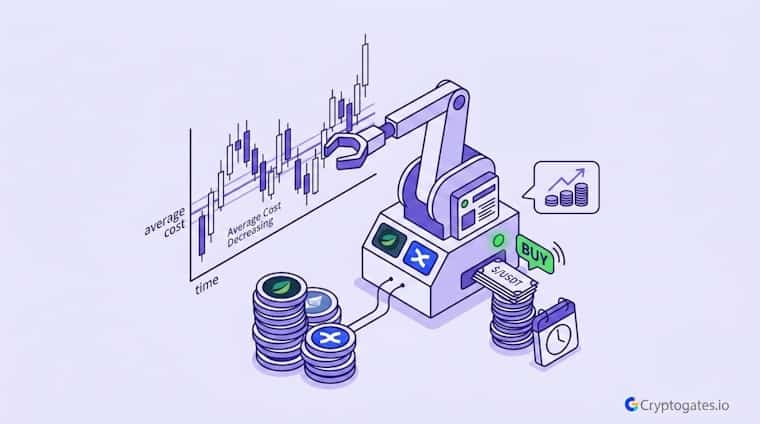
A DCA bot is software that buys a fixed amount of crypto at set intervals, regardless of price.
Daily, weekly, whatever you choose. It doesn’t try to predict tops or bottoms. Honestly, that’s the whole point – it’s built to ignore the noise.
Here’s the thing.
Most people think successful trading means picking the perfect entry.
But a DCA bot works on a different idea entirely: consistency beats precision.
You’re not trying to be right once. You’re trying to be steady, again and again, until the average works in your favor.
Consistent, scheduled buying reduces the impact of short-term volatility on overall returns.
Vanguard research on systematic investing
Think about it this way.
If you tried to manually time twelve buys over a year, you’d need to be right twelve separate times.
That’s exhausting, and honestly, nobody is that good at predicting short-term price moves – not even professionals with years of experience.
A DCA bot sidesteps the whole problem.
It just buys. Same amount, same schedule, no debate involved.
Where the Term "DCA" Comes From
Dollar-Cost Averaging isn’t new – it’s a strategy traditional investors have used for decades in stock markets, long before crypto existed.
The basic idea was always simple: instead of investing one lump sum at one moment, you spread it out.
CryptoGates and other platforms simply automated this for digital assets, where prices move a lot faster and a lot harder than they ever did in traditional markets.
What took a human trader manual discipline to do in stocks now runs on autopilot for crypto.
How Does a DCA Bot Actually Work?
Set it up once, and it just runs.
You pick the asset, the amount per order, and how often to buy.
That’s basically it. No constant babysitting, no opening the app five times a day to check if “now” is the right moment.
Wait, that sounds too simple, right?
It kind of is.
The complexity isn’t in the buying – it’s in choosing settings that actually fit your budget and your goals.
A bot buying too aggressively can drain a budget fast.
One buying too cautiously might barely build a position before the year ends.
Battle-Test Your Strategy
Before the Market Does.
Eliminate guesswork with institutional-grade backtesting for DCA, Grid, and Rebalance bots. Real historical data. Real-world results.
The Three Settings That Control Everything
Three levers decide how a DCA bot behaves: the interval, the amount per order, and the total budget.
The interval decides how often the bot buys – daily, weekly, or even monthly.
Shorter intervals mean smaller, more frequent purchases, which smooths the average price even further.
Longer intervals mean fewer transactions, which some traders prefer for simplicity.
Confused about
market outlook?
Trading without a plan is just gambling. Our strategy architect analyzes your risk tolerance and capital to match you with a proven algorithmic framework.
The amount per order is exactly what it sounds like – how much gets spent each time the bot executes.
This should match what someone can comfortably commit without disrupting daily life or savings goals.
The total budget defines when the bot stops or when it starts a new cycle.
Without this, a strategy can run indefinitely without a clear endpoint, which makes performance harder to evaluate.
Get these three wrong, and even a solid strategy underperforms.
Get them right, and the bot just quietly does its job in the background.
A Simple Example
Say someone buys $50 of an asset every week for a year.
Some weeks the price is high, some weeks it’s low.

Yes. It removes the hardest part of trading - deciding when to buy - and replaces it with a fixed, repeatable schedule that doesn't depend on experience or market timing skill.
Over time, those highs and lows blend into one average cost – usually smoother than trying to time a handful of “perfect” entries.
By the end of the year, that trader has built a position without ever needing to predict a single price swing.
Why Do Traders Use DCA Bots Instead of Manual Buying?
Manual buying sounds fine in theory.
In practice, it falls apart fast.
You get busy, you forget, or worse – you panic and buy at the exact wrong moment because the price just pumped 8% and FOMO took over.

ZAHEER, CEO CryptoGates
A DCA bot doesn’t have that problem.
It doesn’t get scared during a red day.
It doesn’t get greedy during a green one.
It just executes the plan, every single time, exactly as set.
There’s something almost boring about that consistency.
But boring, in trading, is usually a good sign.
Reality Check
A common assumption is that a DCA bot will eventually turn any falling market into a profit – it won’t.
What it does reliably do is reduce the damage compared to a lump-sum or panic-driven entry.
In a CryptoGates backtest on ETH during a 46-day, 32% price decline, a DCA bot closed the window down just 1.81%, while a simple buy-and-hold position on the same capital was down considerably more over the same stretch. The bot didn’t turn a loss into a win — it never claimed to.
What it demonstrated is that scheduled, unemotional buying narrows the gap between “doing nothing” and “getting it right,” even in a market that never recovers within the test window.
This is the honest version of what DCA can and can’t do: It manages downside exposure, it doesn’t manufacture upside that isn’t there.
Full Playbook: https://cryptogates.io/playbooks/eth-crashed-32-in-46-days-our-dca-bot-lost-only-1-81/
The Emotion Problem DCA Bots Solve
Fear and greed wreck more portfolios than bad strategy ever does.
A trader who’s calm on paper often isn’t calm when their money’s actually on the line.
That’s not a character flaw – it’s just human.
Watching a chart move red for three days in a row triggers a very real, very physical stress response, and that stress is exactly what leads to bad decisions.
A DCA bot simply removes the moment where emotion could even step in.
There’s no decision to make in real time, which means there’s no moment for panic to take over.
The plan was already set, calmly, before the market got volatile.
Is a DCA Bot Right for Every Market Condition?
Short answer?
No. And anyone who tells you a DCA bot works perfectly in every market is selling something.

Mark Douglas, Author, Trading in the Zone
DCA bots tend to do well in choppy, sideways, or uncertain markets – the kind where nobody really knows what’s coming next.
They’re less suited to short, sharp trading windows where speed matters more than consistency, or to markets that fall continuously without ever recovering.
Stop Guessing.
Stress Test Your Edge.
The market doesn't care about your backtest. Our engine simulates 1,000+ "what-if" scenarios to ensure your strategy is built for survival.
Run Crypto Strategy Engine →When DCA Bots Are Most Useful
Markets that grind sideways for weeks or months are where DCA really earns its place.
Instead of trying to guess a breakout direction, the bot just keeps accumulating at a steady average, ready for whichever way the market eventually moves.
It can soften the damage by lowering your average buy price, but it won't make you profitable in a market that only goes down. The trend still matters.
The same logic applies during uncertain or news-driven periods, where prices swing on headlines rather than fundamentals.
Nobody can consistently predict those swings, so steady accumulation becomes the more reliable approach.
Real Backtest Example
Strategy: DCA
Coin: BTC/USDT
Market Condition: Sideways-to-bearish (a slow 2% grind down over the month)
Objective: Test whether small, scheduled buys can stay profitable when a market isn’t trending in either direction
Key Result: Across 8 total sessions, 7 closed in profit, and the bot finished the month up +1.93% even as BTC itself was in the red.
Expert Interpretation: This is the market condition where DCA bots tend to be most useful in practice — not sharp crashes, not strong rallies, but the slow, directionless chop that makes manual timing almost impossible to get right. The one losing session in the data is arguably more instructive than the wins: it shows that even in a favorable setup, not every cycle closes green, which is why testing a strategy against real historical data before going live matters more than picking numbers by feel.
Full Playbook: https://cryptogates.io/playbooks/btc-fell-2-in-march-our-dca-bot-made-1-93-anyway/
How to Test a DCA Bot Strategy Before Using Real Money
Here’s what most beginners miss.
They set up a DCA bot, pick random numbers for the interval and amount, and just hope it works.
That’s not a strategy – that’s a guess with extra steps.
| Market Type | What a DCA Bot Typically Shows | Why It Matters |
|---|---|---|
| Falling Market | Lower average entry over time | Reduces damage from buying too early |
| Sideways Market | Steady accumulation, no major loss | Builds position without guessing direction |
| Rising Market | Slightly higher average cost than lump sum | Trade-off for reduced risk earlier on |
Look, the smarter approach is to test the setup against real historical data first.
See how it would’ve performed during a crash, a sideways grind, and a bull run – before a single dollar of real capital touches it.
That’s the whole “verify first, risk later” idea in practice, not just a slogan.
What CryptoGates' Backtest Tool Shows You
CryptoGates runs DCA strategies against real 1-minute OHLCV data across major exchanges – not rounded, simplified candles.
This means the backtest reflects how the bot would’ve actually behaved, not a smoothed-out approximation.
Systematic, rules-based strategies consistently reduce behavioral timing errors compared to discretionary entries.
Newfound Research
You can adjust the interval, amount, and asset, then immediately see how that exact setup performed across different time periods.
No spreadsheets. No manual math.
Just a clear picture before any money moves.
Interactive Checklist: Before Running a DCA Bot With Real Money
- Backtest the exact interval and amount across at least two market conditions
- Confirm the total budget fits comfortably without affecting other savings
- Check how the strategy performed during a falling market specifically
- Review the average entry price compared to a lump sum approach
- Set a clear stop or pause condition before going live
And honestly, this step is the part most beginners skip – which is exactly why so many of them end up disappointed with results that a few minutes of testing could’ve predicted.
Start Small, Test First, Automate Later
A DCA bot isn’t magic.
It won’t fix a bad strategy or guarantee profit in a market that only goes one direction.
But here’s the thing – it does remove the single biggest reason beginners lose money: emotional, badly-timed decisions.
The real value isn’t the automation itself. It’s testing the setup first, seeing how it actually performs, and only then trusting it with real capital.
That’s the difference between gambling and building something repeatable.
Start with the CG DCA Backtest Tool, run a few scenarios, and adjust before going live.
FAQs
Do DCA bots guarantee profit?
No. They reduce timing risk and emotional decisions, but they can’t protect against a market that keeps falling without recovery.
How much money do I need to start a DCA bot?
There’s no fixed minimum. Most traders start small – even $10 to $50 per interval – and scale up once the strategy proves itself in testing.