
 Bitcoin
  Ethereum
  Solana
  TRON
TRON  Zcash
Zcash  Hyperliquid
  Dogecoin
  Monero
  Chainlink
  Cardano
  Stellar
  Uniswap
  Hedera
  Sui
Sui  Bittensor
  Shiba Inu
  Ripple USD
  Polkadot
  Aster
Aster  World Liberty Financial
  Render
  Artificial Superintelligence Alliance
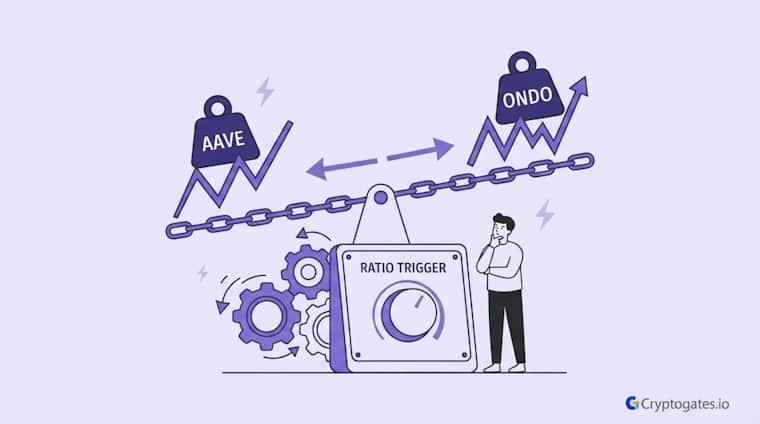
Ever paired a stable-ish blue chip with a coin riding a hot narrative, then watched your rebalance bot fumble the exit timing?
That’s basically what happened with AAVE and ONDO.
One asset chopped sideways for months.
The other broke out hard on the RWA narrative.
And the only thing standing between solid gains and leaving money on the table was one number: the coin ratio trigger.

Source: Cointelegraph (Binance Research)
This is exactly why testing a crypto rebalancing strategy for volatile altcoins matters more than picking the “right” coins, ser.
The coins aren’t the real variable here.
The trigger is.
- The Problem: A "safe" stable-plus-breakout pair still bleeds if the trigger setting is wrong.
- The Solution: Testing AAVE/ONDO at 1%, 2%, and 5% triggers shows how trigger width trades fees for trend capture.
- The Incentive: The loosest trigger delivered the highest return using a tenth of the trades.
- The Risk: Too loose a trigger can mean rebalancing late if the trend suddenly reverses.
Why AAVE and ONDO Make a Perfect Divergence Test
Look, most rebalance backtests use two coins that move together, unlike our BTC/ETH divergence autopsy.
That’s kind of pointless if you’re trying to learn something.
This one’s different.
AAVE spent the test window basically going nowhere in a wide range, while ONDO caught a real narrative wave and broke out hard.
| Asset | Role in Test | Price Behavior |
|---|---|---|
| AAVE | Ballast (stability anchor) | Range-bound, chopped between roughly 135 and 250 |
| ONDO | Breakout leg (RWA narrative) | Climbed steadily off a low base before fading late |
| Portfolio | 50/50 starting split | Rebalanced automatically as the gap between the two widened |
That gap between a “ballast” asset and a “runner” asset is exactly what makes a crypto rebalancing strategy for volatile altcoins worth studying in the first place, because it forces the bot to make real decisions instead of just following two correlated charts up and down together.
1. What "Ballast" Means in a Rebalance Portfolio
Think of AAVE here like ballast in a ship.
It doesn’t do much on its own, but it keeps the whole thing from tipping over when ONDO starts moving fast.
Real Backtest Example
The AAVE/ONDO test isn’t the only divergence pair in CryptoGates’ internal research.
A separate backtest ran ETH against XRP over four months, where ETH quietly compounded a 14% gain while XRP essentially went nowhere. The setup mirrors the ballast-versus-runner structure above, just with the roles reversed: XRP played the flat anchor, ETH did the climbing.
The rebalance bot didn’t need to predict which asset would move. It only needed a trigger wide enough to let ETH’s gain build before locking part of it into the flat leg. That test closed ahead of passive holding by capturing the value of the gap between the two assets — the same mechanic driving the AAVE/ONDO result above, just on a different pair and timeframe.
The consistency across pairs suggests trigger sizing, not coin selection, is the transferable lesson.
Every time ONDO’s value pulled ahead of the 50/50 split, the bot sold a slice of it and topped up AAVE, locking in gains along the way instead of hoping the breakout lasts forever.
2. The Single Variable Being Tested
Everything else in this test stayed frozen. Same pair, same 3,500 USDT starting size, same Binance fee, same time window.

It's the percentage a coin's weight has to drift from its target allocation before the bot automatically buys or sells to bring it back in line. A tighter percentage means more frequent, smaller rebalances.
The only thing that changed across the three runs was the Coin Ratio Trigger, set at 1%, 2%, and 5%.
That’s it.
One dial, three positions.
What Tightening or Loosening the Trigger Actually Does
Here’s the interesting part.
All three tests used the exact same coins, same 3,500 USDT, same fee structure.
The only dial that moved was the Coin Ratio Trigger, and it dragged everything else along with it, trade count, fee drag, and final return.
Source: HackerNoon (Sia)
Test A ran a 1% trigger and fired 50 rebalances.
Test B ran a 2% trigger and fired 17.
Test C, the loosest at 5%, only fired 5 times.
And here’s the part that trips people up: more trades didn’t buy more profit. It bought more fee drag, plain and simple.
1. Test A vs Test B vs Test C — Reading the Trade-Off
Test A closed at a 48.68% ROI with 1,703.87 USDT in profit.
Test B landed at 49.06% ROI with 1,717.06 USDT.
Test C, running the loosest trigger, closed at 49.60% ROI and 1,735.85 USDT, using just 5 trades to get there.
Interactive Checklist
- Is one of your assets range-bound and the other trending hard, or are they moving together?
- Can your exchange fee tier absorb frequent small rebalances without eating your edge?
- Are you optimizing for hands-off automation or for tight risk control?
- Have you run the same pair through the Rebalance Strategy Backtest Bot at more than one trigger width?
- Does your risk tolerance actually match a looser trigger, or does that make you nervous?
Same starting capital. Same coins.
Different outcome purely because of trigger width.
Research Insight
It’s tempting to assume a tighter trigger is always the “safer” or more responsive choice. Another internal test challenges that assumption. When XRP surged 44.6% over four months while BNB delivered a quieter 7.4%, the bot needed only three rebalances to beat passive holding — not because the trigger was loose by accident, but because fewer, well-timed rebalances let the outperforming leg keep compounding before capital got pulled back to the anchor.
That result lines up with what the AAVE/ONDO test found: the loosest trigger, not the most active one, produced the strongest outcome.
Across both pairs, the bot’s edge came from resisting the urge to rebalance every small drift, and instead waiting for the divergence to become meaningful before acting.
This is worth remembering before defaulting to a tight trigger “just to be safe” — over-rebalancing has a cost, and that cost is often invisible until you look at the trade count next to the return.
XRP Surged 45% in 4 Months — Did Rebalancing Beat Passive Holding? →
2. Where the Hero Setup Pulled Ahead
The 5% trigger basically let ONDO run further between each rebalance, which meant it captured more of the breakout leg before locking gains back into AAVE.

"A tighter trigger feels safer because it 'does something' more often. But the data says the loosest trigger let ONDO's breakout actually compound instead of getting clipped every time it moved. Verify first, don't assume."
Ngl, that’s the whole story of this test in one sentence.
What This Divergence Test Teaches About Trigger Sizing
So here’s the bottom line.
Running the same AAVE/ONDO pair through three trigger widths didn’t just produce three numbers, it showed that a crypto rebalancing strategy for volatile altcoins lives or dies on how you size the trigger, not on picking a “perfect” coin.
A 5% threshold on a crypto portfolio typically triggers somewhere between 8 and 15 rebalances a year, while a 10% threshold cuts that down to 3 to 6, trading responsiveness for lower costs.
Source: Spark Money
The tightest setting felt the most active, but it also bled the most into fees.
The loosest setting looked almost lazy, five trades over the whole window, yet it let the winning leg actually compound before locking gains.
That’s not luck.
Not really. A tighter trigger locks in gains more often, but it also racks up more trades and more fees, which can eat into the edge it's trying to protect.
That’s math working in your favor when you stop overtrading your own edge, exactly the discipline gap behind why so few retail traders stay consistently profitable across full market cycles.
Battle-Test Your Strategy
Before the Market Does.
Eliminate guesswork with institutional-grade backtesting for DCA, Grid, and Rebalance bots. Real historical data. Real-world results.
Before you copy Test C’s 5% trigger onto your own pair, run it yourself.
Correlation, volatility, and how “breakout-y” your second asset is will all shift the ideal number.
Test this setup yourself using the Rebalance Strategy Backtest Bot on CryptoGates, no signup, no credit card, just build and see what your own parameters say.
FAQs
What is a good coin ratio trigger for a volatile altcoin pair?
It depends on your fee tier and risk comfort, but this test shows wider triggers around 5% captured more of a breakout with far fewer trades and less fee drag.
Does a stable coin and a breakout coin make a safe rebalance pair?
Not automatically. The pairing only worked well here because the trigger width let the breakout leg run before locking in gains, so the trigger setting mattered as much as the pair itself.
How many trades should I expect from a 1% versus 5% rebalance trigger?
In this test, a 1% trigger produced 50 trades over the window, while a 5% trigger produced only 5, a big difference in cumulative fees.