

 Bitcoin
  Ethereum
  Solana
  TRON
TRON  Zcash
Zcash  Hyperliquid
  Dogecoin
  Monero
  Chainlink
  Cardano
  Stellar
  Uniswap
  Sui
Sui  Hedera
  Bittensor
  Shiba Inu
  Ripple USD
  Polkadot
  Aster
Aster  World Liberty Financial
  Render
  Artificial Superintelligence Alliance
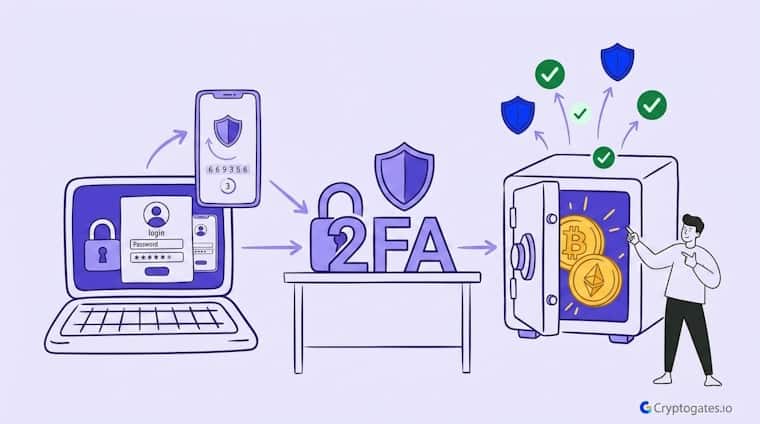
Ser, one text message.
That’s sometimes all it takes for someone to walk into your exchange account and walk out with everything.
Sounds dramatic?
It’s not. SIM swaps happen. Phishing links get clicked. Passwords leak in breaches you never even hear about. And once your crypto moves, ngl, it’s gone. No bank to call. No chargeback.
That’s why 2fa for crypto isn’t a nice-to-have anymore. It’s the one habit standing between “my funds are safe” and “wait, where did my portfolio go.”
- The Problem: Passwords alone can't protect crypto accounts anymore, and weak login security is behind most account takeovers.
- The Solution: 2FA for crypto adds a second verification layer, using an app, a key, or a code, so a stolen password isn't enough to break in.
- The Incentive: Setup takes minutes and closes off the most common way traders lose access to their funds.
- The Risk: Not all 2FA methods offer equal protection, and setup mistakes like skipping backup codes can still leave you locked out or exposed.
What Is 2FA and Why Crypto Accounts Need It
Your password got leaked.
Again.
Maybe not yours specifically, but somewhere in a database sitting on the dark web right now, there’s a good chance a password you’ve used before is sitting there too.
That’s why 2fa for crypto isn’t optional anymore. It’s the second lock on a door that thieves already know how to pick.
Here’s the thing.
A password alone proves you know something. 2FA proves you also have something, like your phone, an app, or a physical key.
Attackers can steal a password from a data breach in seconds. Stealing a physical device or a live authentication code?
Way harder.

(Source: Chainalysis, placeholder pending verification)
Look, this matters more for crypto than almost anything else you do online. Your Netflix account getting hacked is annoying.
Your exchange account getting hacked can mean your funds are gone in minutes, no chargeback, no bank to call, no undo button.
1. How 2FA Actually Works
Put simply, two-factor authentication asks for two things before letting you in. Something you know, like your password.
And something you have, like a code from an app or a tap on a hardware key.
Battle-Test Your Strategy
Before the Market Does.
Eliminate guesswork with institutional-grade backtesting for DCA, Grid, and Rebalance bots. Real historical data. Real-world results.
When you log in, the platform checks your password first.
Then it asks for that second factor. If someone stole your password but doesn’t have your phone or your key, they’re stuck at the door.
It sounds simple because it is. That’s kind of the point.
2. Why Crypto Accounts Are Bigger Targets Than Regular Accounts
Think about it this way. If someone breaks into your email, you can usually reset things, lock accounts, and recover most of what matters. Crypto doesn’t work like that.
Transactions on the blockchain are final.
Ser, there’s no undo.
No fraud department reversing a transfer at 2am. Once funds move, they’re gone, and chasing them across wallets and exchanges is close to impossible for most victims.
Expert Observation
Automation only pays off if the account running it is actually secure – and that’s easy to forget once a bot is quietly executing trades in the background. Reviewing CryptoGates’ own Grid Bot data makes the point clearly: these systems run unattended for weeks, placing dozens or hundreds of trades without a human checking in.
That’s the entire value proposition – and also exactly why account-level protection matters more here than on a typical login you check once a day.
Strategy: Grid Bot
Coin: XRP/USDT
Market Condition: Flat, range-bound (90 days, near-zero net price movement)
Objective: Extract profit from sideways price action without manual intervention
Key Result: 875 trades executed autonomously, generating a 27.74% return while buy-and-hold returned just 0.24%
Expert Interpretation: The bot’s edge came entirely from unattended, continuous execution — the same characteristic that makes account security non-negotiable before switching automation on. A compromised login doesn’t just risk funds sitting idle; it risks funds actively being moved by a system running 24/7.
XRP Went Nowhere for 3 Months — Our Grid Bot Made +27.74% Anyway:
https://cryptogates.io/playbooks/xrp-grid-bot-returned-27-74-in-90-days-while-buy-hold-made-0-24/
That’s exactly why crypto accounts, already the fastest-growing target for individual wallet compromises, sit higher on every hacker’s target list than a random shopping account ever will.
Whales get targeted because the payoff is bigger. Shrimp get targeted because there are a lot more of them, and plenty still skip 2FA entirely, hoping they won’t be the unlucky one.
CryptoGates doesn’t provide custody or wallet security tools directly, but before automating anything through Backtest Bots or connecting exchange accounts, having your login security locked down is step zero.
Types of 2FA You Can Use for Crypto
Not all 2FA is created equal. Ngl, this trips up a lot of traders who think they’re protected just because they turned something on.
There’s a real gap between the weakest option and the strongest one, and that gap matters a lot when your funds are on the line.
1. SMS-Based 2FA
SMS codes are the most common starting point. You get a text, you type in the code, you’re in. Easy.
But there’s a problem. SIM swap attacks. An attacker convinces your phone carrier to move your number to their device, and suddenly your “secure” text codes are landing in their hands, not yours.
It’s still better than no 2FA at all. Realistically, though, if you’re holding any meaningful amount, SMS shouldn’t be your only line of defense.
2. Authenticator Apps (TOTP)
Authenticator apps generate a fresh code every 30 seconds or so, right on your device. No carrier involved. No SIM to swap.
This is where most experienced traders land. It’s a solid middle ground between convenience and actual protection, and it works offline once it’s set up.
The code lives on your phone, not floating through a text message that can be intercepted. That alone closes off a big attack path.
3. Hardware Security Keys
Now imagine this. A small physical device, something like a YubiKey, that you plug in or tap to confirm a login. No code to type. No app to open.
This is about as close to bulletproof as consumer 2FA gets right now. An attacker would need your actual physical key in their hand, which, honestly, changes the entire threat model.

It's better than nothing, but SIM swap attacks make it the weakest option. For any real holdings, an authenticator app or hardware key offers stronger protection.
OGs and larger holders tend to gravitate here. It’s a bit more setup, sure.
But for anyone treating crypto as a long-term position rather than a quick trade, it’s worth the extra five minutes.
| 2FA Method | Security Level | Best For |
|---|---|---|
| SMS-Based | Weakest, vulnerable to SIM swaps | Better than nothing, not ideal for real holdings |
| Authenticator App | Strong, offline protection | Most traders, solid daily use |
| Hardware Key | Highest, requires physical device | Long-term holders, larger balances |
Setting Up 2FA on Exchanges and Wallets
Okay, so you know which method you want.
Now what?
Setting it up is usually faster than people expect, once you know where to look.
1. Enabling 2FA on Major Exchanges
Most exchanges follow a similar pattern. You’ll find 2FA settings under security or account settings, usually with a clear “enable” button sitting right there.
From there, you scan a QR code with your authenticator app, or register your hardware key, and confirm with a test code. Takes maybe two minutes.
2FA Setup Checklist
- Enable 2FA on login, not just account access
- Enable 2FA on withdrawals separately, check this setting exists
- Save backup codes somewhere physical, not a screenshot
- Avoid linking the same phone number across exchange, email, and recovery
- Test your 2FA method once before relying on it fully
Here’s what most beginners miss.
Some platforms let you enable 2FA for login only, while withdrawals stay unprotected unless you turn on a separate setting.
Check both. Seriously, check both, because that gap is exactly where a lot of losses happen even after someone thinks they’re covered.
2. Backup Codes and Recovery Planning
Every authenticator setup gives you backup codes. A list of one-time codes meant for exactly one situation, you lose access to your phone or your authenticator app.
Write them down.
Not a screenshot buried in your camera roll. Somewhere physical, somewhere separate from your phone.
Here’s the issue.
People treat backup codes as optional busywork during setup, click past them, and then panic six months later when they get a new phone and can’t log in anywhere. It happens more than you’d think.
Common 2FA Mistakes That Still Get Traders Hacked
2FA isn’t a magic shield.
Honestly, it’s one layer, and layers only work if every part of them holds up.
1. Reusing Phone Numbers Across Accounts
Here’s the interesting part.
A lot of traders link the same phone number to their exchange, their email, and their authenticator recovery, not realizing that one SIM swap now threatens all three at once.
That’s a single point of failure dressed up as convenience. One breach, three accounts exposed, sometimes more.
Stop Guessing.
Stress Test Your Edge.
The market doesn't care about your backtest. Our engine simulates 1,000+ "what-if" scenarios to ensure your strategy is built for survival.
Run Crypto Strategy Engine →Rotation matters here too, in a different sense.
Spreading recovery methods across different channels, email, hardware key, backup codes, means one compromised piece doesn’t take down everything else with it.
2. Ignoring Backup Codes
We’ve all been there, rushing through setup screens, clicking past the part that says “save your backup codes.”
It’s the kind of mistake that feels harmless until it isn’t.
If you saved backup codes, you can use one to regain access. Without them, you'll need to go through the exchange's account recovery process, which can take time.
No backup plan means that if your phone breaks, gets stolen, or just gets replaced, you could be locked out of an account holding real money.
Support tickets for exchange account recovery can take days, sometimes weeks, especially during high-volume periods when everyone else is having the same problem.
Lock Down Your Crypto the Right Way
Look, 2fa for crypto isn’t complicated, and it isn’t optional. It’s a five-minute setup that closes off the most common way traders lose access to their funds in the first place.
Pick an authenticator app at a minimum.
Add a hardware key if you’re holding anything long-term. Save your backup codes somewhere real. That’s it. That’s the whole system.
Confused about
market outlook?
Trading without a plan is just gambling. Our strategy architect analyzes your risk tolerance and capital to match you with a proven algorithmic framework.
Verify first. Risk later. Scale slowly applies here too, not just to strategy.
Before you connect an exchange account to test a setup in the Strategy Engine, make sure the account itself is locked down properly.
Security is step zero; testing comes after.
FAQs
What is the safest type of 2FA for crypto accounts?
Hardware security keys offer the strongest protection since they require a physical device. Authenticator apps are a solid second choice for most traders.
Can I use 2FA and still get hacked?
Yes, if you reuse phone numbers across accounts or skip saving backup codes. 2FA reduces risk significantly but doesn’t remove it entirely.
What should I do if I lose my phone with my authenticator app?
Use your saved backup codes to regain access immediately. Without them, you’ll need to go through the exchange’s recovery process, which can take time.