

 Bitcoin
  Ethereum
  Solana
  TRON
TRON  Zcash
Zcash  Hyperliquid
  Dogecoin
  Monero
  Chainlink
  Cardano
  Stellar
  Uniswap
  Sui
Sui  Hedera
  Bittensor
  Shiba Inu
  Ripple USD
  Polkadot
  Aster
Aster  World Liberty Financial
  Render
  Artificial Superintelligence Alliance
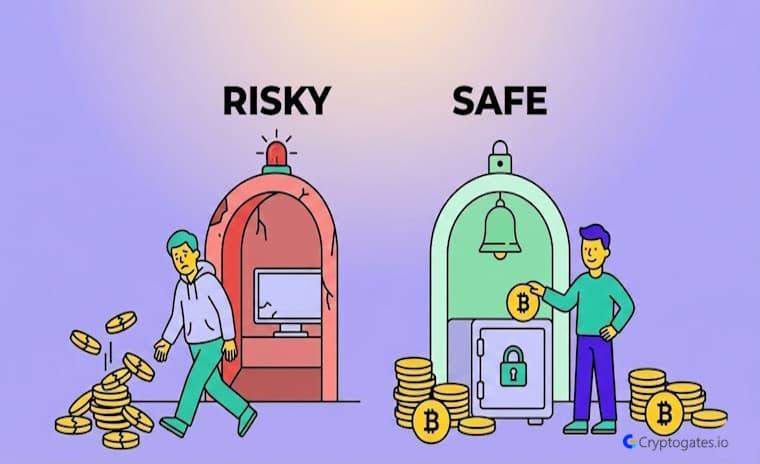
You trusted an exchange once. Maybe it had flashy marketing or someone on Reddit swore by it.
Then fees ate your profits, or worse, the platform froze withdrawals when you needed out most. Sound familiar?
Picking the wrong exchange isn’t just annoying. It can quietly destroy a portfolio. And the frustrating part?
Most traders never actually check what makes an exchange safe before depositing money.
Let’s fix that.
- The Problem: Most traders choose exchanges based on hype or marketing, ignoring hidden fees and weak security that can lead to total portfolio loss.
- The Solution: Focus on verified Proof of Reserves, cold storage policies, and regulatory compliance to ensure your chosen platform is a solid foundation.
- The Incentive: Proper research lets you humanize your trading experience by using tools like the CryptoGates Exchange Picker to match your specific strategy.
- The Risk: Trading on unregulated or low-liquidity platforms leads to slippage and "frozen funds," where technical errors or hacks can wipe out assets instantly.
Why the Exchange You Choose Matters More Than the Coin You Buy
Here’s something most beginners don’t hear: your strategy can be perfect, your timing decent, and you can still lose money because of where you’re trading.
📊 Over 1 million users lost funds when FTX collapsed, with total customer losses estimated at over $8 billion according to court filings reported by Reuters.
Exchange failures aren’t rare. FTX collapsed in 2022 and wiped out billions in user funds overnight.
Smaller platforms have vanished with even less warning.
Some exchanges charge fees so layered and confusing that you’re paying 3-4% on every round trip without realizing it.
Others have weak security practices that leave accounts exposed to hackers, and centralized platforms have paid for it: 88% of all Q1 2025 crypto losses came from centralized exchange breaches.
The exchange isn’t just a place to trade. It’s the foundation everything else rests on. Get that wrong, and nothing else matters.
So what actually separates a trustworthy exchange from a risky one?
Not sure which
exchange fits you?
Bypass the marketing hype. Our matrix cross-references your profile against 50+ institutional metrics—including Proof-of-Reserves and Slippage Models.
Security Has to Come First No Exceptions
Before anything else, look at how the exchange protects its users’ funds.
The gold standard right now is proof of reserves, a verified, on-chain audit showing the exchange actually holds the assets it claims to hold.
This is not a nice-to-have. It’s how you know the platform isn’t running on borrowed time.
Real Backtest Example
Strategy: Grid Trading
Coin: SOL/USDT
Market Condition: 60-day sideways drift in the $80–$97 post-crash range
Objective: Extract profit from a market with no clear directional trend
In one internal test, a grid bot deployed against SOL during a prolonged range-bound period fired 146 trades and generated $462.95 in net profit, outperforming buy-and-hold by 10.88 percentage points over the same window. What made this possible wasn’t the strategy alone — it depended on the bot being able to execute a high volume of small trades without meaningful slippage.
That requirement is exactly why API reliability and deep order-book liquidity aren’t optional extras for grid strategies; a thinly-traded pair or a laggy API would have eaten into (or erased) that edge trade by trade. This is a useful reference point for why the exchange layer, not just the strategy design, determines whether a grid bot’s theoretical edge survives contact with real execution conditions.
View Complete Playbook: https://cryptogates.io/playbooks/sol-usdt-grid-bot-backtest-mar-apr-2026/

Andreas M. Antonopoulos, Bitcoin Educator and Author
Beyond that, check for cold storage policies.
Reputable exchanges keep the majority of user funds in offline wallets that can’t be touched in a cyberattack.
They also offer two-factor authentication, withdrawal whitelisting, and in some cases, insurance funds that cover losses in the event of a breach.
If you can’t find clear answers on any of those things from an exchange’s website, that’s your answer right there.
Before You Deposit — Security Checklist
- The exchange publishes verified proof of reserves
- The majority of funds are held in cold storage
- Two-factor authentication available
- A withdrawal whitelisting option exists
- Insurance or protection fund is mentioned clearly
Fees Are Hidden Until They Aren't
Every exchange has fees. The problem isn’t the fees themselves; it’s that they’re often buried deep in documentation nobody reads before signing up.
By the time you feel them, you’ve already made a dozen trades.
There are a few layers to watch. Maker and taker fees apply when you place or fill orders on the order book.

It depends on the platform. Exchanges with insurance funds may cover losses partially. Without one, recovery is unlikely. This is why cold storage and security audits matter before you deposit.
These typically range from 0.05% to 0.5%, depending on the platform and your trading volume.
Then there are withdrawal fees, which vary by cryptocurrency and can change based on network conditions. Some exchanges also charge deposit fees depending on your payment method.
| Fee Type | Typical Range | When It Hits |
|---|---|---|
| Maker Fee | 0.05% to 0.20% | When you place a limit order |
| Taker Fee | 0.10% to 0.50% | When you fill an existing order |
| Withdrawal Fee | Varies by coin | Every time you move funds out |
| Deposit via Card | 2% to 4% | Instant card deposits |
| Bank Transfer | Usually free | Slower, 1 to 3 days to clear |
A debit card deposit, for example, often carries a fee of 2-4%.
A bank transfer usually doesn’t, but it takes days to clear.
Know what you’re paying before you commit to a platform, not after.
Not Every Exchange Supports What You Actually Need
If you want to run a grid bot, you need an exchange with API access and the right trading pairs.
If you’re doing spot DCA into smaller altcoins, you need a platform with deep liquidity in those markets. If you’re holding mostly Bitcoin and Ethereum, almost any major exchange works, but the moment your strategy gets more specific, your exchange options narrow.
This is why matching your exchange to your strategy matters, and it’s exactly what the Exchange Picker is built to help you do.
CryptoGates.io built an exchange picker exactly for this reason. It filters exchanges based on proof of reserves, supported pairs, fee structures, and whether they’re appropriate for the strategy you’re actually running.
You’re not just picking the most popular name; you’re picking the right fit.
Battle-Test Your Strategy
Before the Market Does.
Eliminate guesswork with institutional-grade backtesting for DCA, Grid, and Rebalance bots. Real historical data. Real-world results.
Regulation and Jurisdiction Aren't Boring, They're Protection
A licensed, regulated exchange has to follow rules. It has to maintain capital reserves. It has to undergo audits. It is legally accountable if something goes wrong.
An unregulated exchange has none of that. You’re trusting the founders entirely, with no legal recourse if the platform shuts down tomorrow.
Check whether the exchange is registered in a real financial jurisdiction, such as under the SEC in the US, the EU, the UK, or similar.
According to Chainalysis, over $3.8 billion was stolen from crypto platforms in a single year, with unregulated exchanges accounting for a disproportionate share of incidents.
Look for whether it complies with KYC and AML requirements.
These aren’t just bureaucratic hoops. There are signs that the platform takes its responsibilities seriously.
Coinbase, for instance, is publicly listed and regulated in the US. Binance, Bybit, OKX, and KuCoin have varying degrees of regulation across different markets.
Gate.io and HTX have been around long enough to build track records.
The point isn’t that “regulated” automatically means “perfect”; it means there’s a layer of accountability that completely unregulated platforms lack entirely.
Liquidity Matters More Than Beginners Realize
Liquidity is how quickly and easily you can buy or sell at the price you expect.
On low-liquidity exchanges, the price you see and the price you actually get can be very different, especially on larger trades or less popular trading pairs. This is called slippage, and it quietly kills returns.
Stick to exchanges with high daily trading volumes for the pairs you plan to trade.
The major platforms Binance, OKX, Bybit, and similar have enough volume that slippage is rarely an issue on common pairs.
Smaller platforms can work fine for very specific assets, but go in with eyes open.
Real Backtest Example
Strategy: DCA
Coin: PEPE (low-cap altcoin)
Market Condition: 112-day, 64% bleed
Objective: Test capital-averaging resilience on a thin, high-volatility market
A DCA bot run against PEPE through one of its worst extended drawdowns completed 100 sessions, closed 99 in profit, and returned $2,542.73 versus a $704.79 loss for a static holder over the same period. What’s easy to overlook in a result like that is market depth: a strategy that relies on frequent, precisely-timed small buys on a lower-cap asset only works if the exchange can actually fill those orders at the expected price.
On a shallow order book, the same DCA logic would face wider spreads and worse average entries, quietly shrinking the edge shown here. It’s a concrete illustration of why liquidity in the specific pair you’re trading — not just the exchange’s overall volume — is the detail that determines whether a strategy’s backtested numbers hold up in practice.
View Complete Playbook: https://cryptogates.io/playbooks/pepe-fell-64-in-112-days-our-dca-bot-still-made-2542/
The User Experience Question
This one sounds trivial. It isn’t. If an exchange’s interface is confusing or unintuitive, you’ll make mistakes.
Wrong order types, wrong quantities, wrong pairs. These errors cost money.
Some platforms are designed for professional traders with advanced charts, multiple order types, and customizable dashboards. Others are clean and simple, better for someone still learning the basics. Neither is wrong.
The question is which one matches where you are right now.
If you’re new to trading, starting with a platform that doesn’t require a manual to navigate makes sense. You can always move to more advanced platforms once your strategy demands it.
How CryptoGates Approaches This
CryptoGates.io doesn’t just recommend exchanges by name.
The Exchange Picker filters by proof of reserves, supported strategies, fee structures, and jurisdiction. The idea is to match you to an exchange that fits how you actually trade, not just the one with the most marketing spend.
The same principle runs through everything on the platform. Backtesting tells you if a strategy actually works before real money is on the line.
The Monte Carlo simulator runs thousands of what-if scenarios, so you understand downside risk, not just upside potential. Strategy tools only make sense when you’re on a platform that supports running them properly.
Verify first. Risk later.
Stop Guessing.
Stress Test Your Edge.
The market doesn't care about your backtest. Our engine simulates 1,000+ "what-if" scenarios to ensure your strategy is built for survival.
Run Crypto Strategy Engine →Before You Deposit a Single Dollar
Run through this yourself before committing to any exchange. Does it publish proof of reserves?
What do its security practices look like?
Are the fees clear and reasonable?
Is it regulated somewhere in reality?
Does it support the trading pairs and strategy types you plan to use?
These aren’t complex questions. But most traders never ask them, and that’s exactly why they end up on platforms they shouldn’t trust with real money.
The exchange is your foundation. Build on one that can hold the weight.
Start at CryptoGates.io and use the Exchange Picker to find the right fit for your strategy before you move any funds.
Quick Exchange Vetting Guide
| What to Check | Why It Matters | Where to Find It |
|---|---|---|
| Proof of Reserves | Confirms funds actually exist | Exchange website or auditor report |
| Regulatory Status | Legal accountability if things go wrong | Exchange's legal or compliance page |
| Fee Structure | Prevents silent profit drain | Fee schedule page |
| Supported Pairs | Matches your strategy need | Markets section of the exchange |
| Security History | Shows track record under pressure | Crypto news search |
FAQs
Which crypto exchange is safest for beginners?
No single exchange is universally safest. Platforms with verified proof of reserves and regulatory compliance, like Coinbase, Binance, or OKX are solid starting points. Always check security features before depositing.
What is proof of reserves, and why does it matter?
Proof of reserves is an on-chain audit confirming an exchange actually holds the assets it claims. Without it, there’s no way to know the platform isn’t operating with a shortfall, which is exactly what happened before several major collapses.
Is it safe to leave crypto on an exchange long-term?
For active trading, short-term storage is fine. For larger holdings, it’s not recommended since exchanges control your private keys. If the platform gets hacked or shuts down, your funds are at risk.