 Bitcoin
  Ethereum
  Solana
  TRON
TRON  Zcash
Zcash  Hyperliquid
  Dogecoin
  Monero
  Chainlink
  Cardano
  Stellar
  Uniswap
  Sui
Sui  Hedera
  Bittensor
  Shiba Inu
  Ripple USD
  Polkadot
  Aster
Aster  World Liberty Financial
  Render
  Artificial Superintelligence Alliance
March Was a Setup. May Was the Payoff. The Bot Traded the Whole Thing.
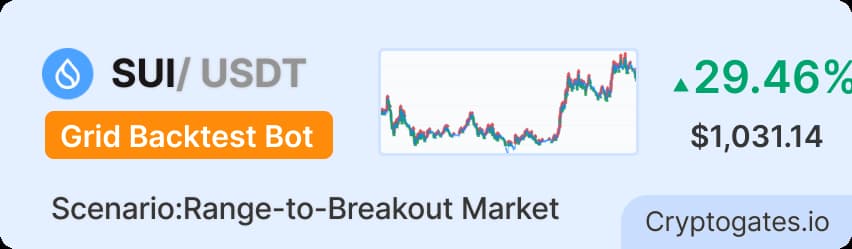
SUI entered March 2025 at $2.83. By May 15, it had climbed to $3.8486 — a 36% move that looked obvious only in hindsight.
Most traders either missed the entry or chased it mid-move. This bot never had to choose. It was already positioned across 45 grid levels, from $2.02 to $4.30, firing buy and sell orders whenever the price oscillated — whether SUI was at $2.80 or $3.90.
We ran this backtest across 75 days using real Binance 1-minute OHLCV data. The question wasn’t whether SUI would go up. It was whether a geometric grid bot could extract consistent profit from an asset that didn’t just consolidate — it trended.
Strategy Parameters
How Each Setting Impacted Performance?
Grid bots aren’t complex — but the relationship between parameters and outcomes is. Understanding why each setting matters is what separates a strategy from a gamble.
Parameter Impact Summary
| Parameter | Impact | The Logic (Why) |
|---|---|---|
| 30-Day Price Range $2.02–$4.30 | 🎯 Wide coverage | Captured full 75-day move |
| 45 Grids | 🔁 High trade density | More levels, more cycles |
| Geometric Spacing | ⚖️ Proportional profit capture | Equal spacing, equal gains |
| $111.11 Grid Size | 💰 Most capital idle | Fixed exposure per level |
| 2% Profit/Grid | 📈 High per-trade profit | Less trades, larger cuts |
| 0.08% Fee Rate | ✅ Minimal fee drag | Only 4.35% of gross profit |
699 trades. $1,545.63 grid profit. $2.13 per completed cycle.
💰 The Bottom Line:
This strategy delivered a net profit of $1,489.15 on $5,000 in capital over 75 days — a 29.78% return. Annualized simply (29.78% ÷ 75 × 365), that projects to roughly 144.9% per year. The bot reports 249.74% annualized, which assumes monthly compounding — an aggressive but mathematically valid projection given consistent market conditions.
⚡ Efficiency or Idleness?
Fee drag here is exceptional. $67.18 in total fees against $1,545.63 in gross grid profit means only 4.35% of earnings went to the exchange. At Binance’s 0.1% rate, that same trade volume would have cost ~$83.97 — a difference of $16.79 that quietly adds up. Running 699 trades at 0.08% is the structural reason Variant C outperformed the Arithmetic variants despite running more trades.
🛡️ The Fee Advantage:
454.98% grid efficiency signals that deployed capital worked extraordinarily hard. The final portfolio shows $5,915.13 in cash USDT — but this reflects the bot’s end-state after SUI’s upward move pushed sells through the upper grid levels, accumulating cash. At peak deployment, far more capital was actively cycling. The $1,489.15 realized profit is confirmed cash, not theoretical.
Here comes our A/B/C strategies quick comparison:
| Variant | Range | Grids | Trades | Grid Profit | ROI % |
|---|---|---|---|---|---|
| A | 7 days | 20 | 134 | $1251.17 | 24.17% |
| B | 7 days | 20 | 455 | $1,233.88 | 22.62% |
| CThis Playbook | 30 Days | 45 | 699 | $1,545.63 | 29.78% |
Variant A ran fewer trades with a high 4% TP, collecting larger profits per cycle — but missed many of the smaller oscillations that Variant C captured. Variant B cranked the TP to 1%, generating 455 trades, yet still underperformed C by 7.16% ROI — proving that more trades alone don’t equal more profit when grid density is too thin for the range.
Variant C’s edge is architectural. Geometric spacing across 45 grids self-calibrated density to where SUI actually oscillated — tighter spacing at lower prices, wider at higher prices — while the 30-day range caught the full March-to-May move. That combination is why it generated $311.75 more in grid profit than the next-best variant.
What the results are really telling you.
✅ what worked
The 30-day geometric range was the decisive parameter choice. It positioned grids from $2.02 to $4.30 — covering SUI’s entire trajectory before the move even began. When SUI climbed from $2.83 to $3.85, it cycled through dozens of grid levels repeatedly, triggering both buy and sell orders on every swing.
The trade log confirms early activity: on March 1, the bot executed SELL orders at $2.85 (+$0.7471 profit), $2.87 (+$3.0201), $2.90 (+$2.4886), and $2.87 again (+$3.0177) — all within the first 22 hours. Four completed cycles, $9.28 in profit, before most traders had decided on an entry. That’s geometric spacing working exactly as designed.
⚠️What didn't work
Buy-and-hold beats the bot. SUI’s +36.24% move over 75 days was a sustained, directional trend — precisely the market condition where grid bots underperform passive holding. The bot collected $1,489.15 net; a spot holder collected approximately $1,812.
The mechanism is structural, not a flaw. When price trends sharply upward, the grid sells inventory at every level on the way up — locking in 2.5% per cycle — but misses the full uninterrupted gain. By mid-May, $5,915.13 sat as idle cash USDT because the bot had sold through its upper grid levels and had little SUI left to cycle.
This isn’t a losing result. It’s the cost of using a range-bound tool in a trending market.
💡 The key insight
🚩 Watch out for - a potential red flag
The max drawdown of 28.19% is the number that demands attention.
This figure means the bot’s unrealized exposure — open buy positions sitting below market price during a dip — reached 28.19% of deployed capital at its worst point. For a $5,000 deployment, that’s a $1,409.50 paper loss sitting on the books before SUI recovered and those positions cycled profitable.
The bot recovered fully and returned 29.78%. But if SUI had continued falling below $2.02 instead of recovering, those positions would never have been sold. You’d hold 149 SUI tokens with no active grid below them and no capital left to buy lower.
Before running this setup: confirm SUI is trading above the lower bound of your current grid range. If SUI is at $2.50 and your lower boundary is $2.02, you have $0.48 of buffer. That’s not much. Widen the lower range or reduce position size before deploying.
Overall Performance Score, Strengths and Limitations
Strong Trending-Market Grid Strategy
29.78% in 75 days on an asset that also rewarded buy-and-hold. Grid efficiency of 455% shows capital was actively cycling throughout. The fee structure (4.35% drag) is among the cleanest we've seen in a high-trade-count backtest.
🧭 STRENGTHS
- 699 trades across 75 days — consistently active throughout
- Exceptional fee efficiency: only 4.35% of gross profit lost to fees
- $2.13 avg profit per grid cycle — meaningful at scale
- Geometric spacing self-calibrated to SUI's proportional volatility
- 249.74% annualized ROI on compounded projection
🚫 LIMITATIONS
- Buy-and-hold outperformed by ~$323 — trending markets favor passive holders
- 28.19% max drawdown is high — requires strong capital reserve and nerve
- $5,915 idle cash at end-state reflects over-sold inventory in an uptrend
- 30-day range must be re-run before any new deployment — this range expires
- Breaks completely if SUI drops below $2.02 with no recovery
Quick Takeaways
- Geometric spacing outperforms arithmetic in trending, volatile assets
- Low fees (0.08%) compound into real advantage over 699 trades
- Grid bots in trending markets generate income but sacrifice full upside
- Max drawdown of 28% requires full capital commitment before starting
- Recalibrate the 30-day range before every deployment — never reuse stale settings
What did spot buy & hold actually return?
If you had simply bought $5,000 of SUI on March 1 at $2.83 and held to May 15 at $3.8486, here’s how it compares:
Winner: Spot Buy & Hold — by ~$322.85 in this specific window
The delta is $1,489.15 minus $1,812.00 = −$322.85 in favor of buy-and-hold over 75 days. But that passive return required holding through every dip without a stop-loss, perfectly timing the entry, and having the conviction to not sell during SUI’s volatile mid-March chop. The grid bot collected $1,489.15 in realized, confirmed profit — systematically, without a single prediction required.
Before you run this playbook, check these off.
Use this as your go/no-go checklist before deploying this exact parameter set.
🧠 Market Suitability Matrix
| Market Condition | Rating | Strategic Notes |
|---|---|---|
| Sideways / Consolidating | ★★★★★ Excellent | Grid fires constantly; every oscillation is a completed cycle |
| High Volatility | ★★★★★ Excellent | Fast cycling through grid levels; maximum trade frequency |
| Mildly Bearish / Slow Bleed | ★★★★☆ Good | Longer hold cycles but price stays in range; drawdown manageable |
| Mildly Bullish / Slow Climb | ★★★☆☆ Moderate | Price drifts toward upper boundary; fewer return cycles |
| Strong Bull Run | ★★☆☆☆ Risky | Inventory sells early, misses full upside |
| Strong Bear / Crash | ★☆☆☆☆ Poor | Capital locked in buys, no exits triggered |
| Very Low Volatility | ★☆☆☆☆ Poor | No price movement within range means no triggered trades; deadweight capital |
April 2025 was a Strong Bull Run scenario. The result — +7.35% vs. buy & hold’s +14.15% — is exactly what this matrix predicts.
The grid worked mechanically. The market condition was simply the worst possible fit for a tight, high-placed 7-day range.
How to tune this playbook for different scenarios.
Disclaimer: All data sourced from CryptoGates Grid Backtest Bot. Results are historical simulations using Binance 1-minute OHLCV data. Past backtest performance does not guarantee future live trading results. DYOR.
Battle-Test Your Strategy
Before the Market Does.
Eliminate guesswork with institutional-grade backtesting for DCA, Grid, and Rebalance bots. Real historical data. Real-world results.