

 Bitcoin
 Ethereum
 Solana
 TRON
 Zcash
 Hyperliquid
 Dogecoin
 Monero
 Chainlink
 Cardano
 Stellar
 Uniswap
 Sui
 Hedera
 Shiba Inu
 Bittensor
 Ripple USD
 Aster
 Polkadot
 World Liberty Financial
 Render
 Artificial Superintelligence Alliance

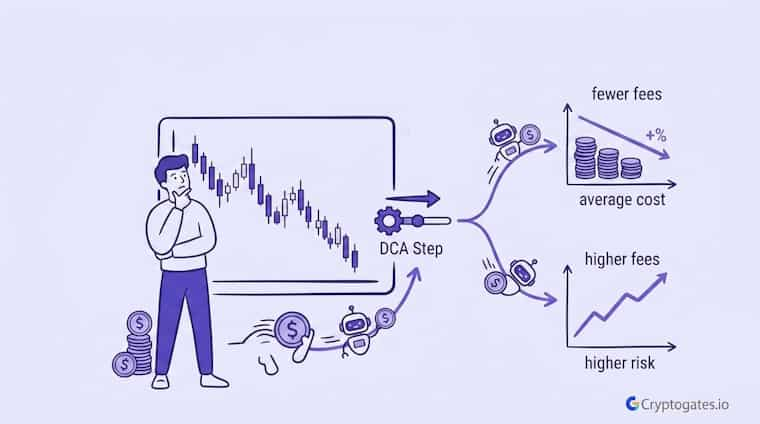
Look, most beginners set their DCA step % and never touch it again.
That’s the mistake.
This one number decides how your bot reacts to every drop, every bounce, every slow bleed the market throws at you.
Set it too tight, and you’re firing orders on every wiggle, watching fees quietly chip away at your average.
Set it too wide, and you miss the meat of the dip entirely, entering higher than you should have.

Source: Binance Research, 2024
Here’s the interesting part.
DCA step percentage isn’t just a technical setting buried in your bot config.
It’s the actual mechanism that decides whether your dollar-cost averaging strategy works with the market or against it.
- The Problem: Traders set DCA step % randomly, then get a worse average price or bigger fee bill than expected.
- The Solution: Know what step % triggers, and how tight versus wide spacing shifts your cost and fees.
- The Incentive: A well-tuned step % means averaging into a real recovery instead of just bag-holding.
- The Risk: Over-optimizing for one market condition can backfire if the next drop behaves differently.
What DCA Step % Actually Controls
Honestly, this is the part most guides skip past too fast.
DCA step % isn’t about how often your bot “checks” the market. It’s the price gap, measured as a percentage drop from your last filled order, that has to happen before the next buy triggers.
So if your step % is set to 3%, your bot won’t fire the next DCA order until the price falls another 3% from where the last one filled. Simple concept.
But here’s the thing: that one number ripples through everything else. Your total number of orders.
Your average entry price. Your fee bill. All of it traces back to this single setting.
Battle-Test Your Strategy
Before the Market Does.
Eliminate guesswork with institutional-grade backtesting for DCA, Grid, and Rebalance bots. Real historical data. Real-world results.
CryptoGates’ DCA Strategy Backtest Bot actually shows this in real time.
Run the same asset, same base order, same take profit, and just change the step % across two or three tests.
You’ll watch the order count and average entry shift session by session, no guesswork needed.
How the Bot Decides When to Trigger the Next Order
Think of it like a ladder. Each rung sits a fixed percentage below the last filled rung. Price has to drop that full distance before your bot places another buy.
It doesn’t matter how choppy the price action gets in between.
Sideways noise, small bounces, none of that counts.
Only a genuine move past that step threshold triggers the next fill.
Stop Guessing.
Stress Test Your Edge.
The market doesn't care about your backtest. Our engine simulates 1,000+ "what-if" scenarios to ensure your strategy is built for survival.
Run Crypto Strategy Engine →That’s why two traders running the same asset with different step percentages can end up with wildly different sessions.
Steps were spaced wider apart.
Tight Step % vs Wide Step %
There’s no universally “correct” step %. What works depends entirely on how the asset is moving.
But let’s break down what happens at each extreme, because the trade-offs are real and they show up fast in a backtest.
1. What Happens When Steps Are Too Tight
A tight step %, something like 1%, sounds appealing at first.
You’re catching more of the drop.
More orders mean more chances to lower your average cost, right?
Real Backtest Example
Most DCA guides talk about tight step spacing in theory. Here’s what it looked like on real data.
Strategy: DCA Bot, 1.5% step spacing
Coin: TAO/USDT
Market Condition: Sharp pump followed by a prolonged bleed, round-tripping from a near-$300 high down to a 17% net loss for anyone simply holding
Objective: Test whether keeping the step gap tight was enough to keep catching entries through a reversal, rather than a straight downtrend
Key Result: 139 of 140 sessions closed in profit. The bot returned +$1,677 over the test window, while spot holders on the same capital were sitting on a 17% loss.
Expert Interpretation: The tight spacing did what tight spacing is supposed to do – it kept firing as TAO gave back its gains, instead of one or two wide-gapped orders sitting idle while the price round-tripped past them. That’s the same mechanic ONDO’s 1% step showed in a straight bleed, just proven again on an asset that moved in both directions first. It’s a reminder that step % isn’t tuned to “the coin” – it’s tuned to how that specific move behaves.
TAO Pumped 36%, Then Bled Back to a 17% Loss — Our DCA Bot Still Banked +$1,677
Not quite.
Here’s the catch.
In the ONDO unlock scenario, a 1% step spacing triggered 80 orders across 16 sessions.
That’s a lot of fills. Fees stack up fast when you’re trading that frequently, and on a coin that’s bleeding slowly rather than crashing in one clean move, you end up buying into every micro-wiggle along the way down.
Some of those fills happen way too early, well before the real bottom forms.
Confused about
market outlook?
Trading without a plan is just gambling. Our strategy architect analyzes your risk tolerance and capital to match you with a proven algorithmic framework.
More orders also means more capital deployed sooner.
If the bleed continues past what your Max DCA Orders setting allows, you could run out of dry powder before the actual bottom shows up.
2. What Happens When Steps Are Too Wide
Now flip it.
A wide step %, say 5%, means fewer orders fire.
Less fee drag, sure.
But you’re also skipping large chunks of the drawdown entirely.
In that same ONDO test, a 5% step spacing only triggered 21 orders across 12 sessions.
Fewer fills sound efficient until you realize your average entry price ends up sitting noticeably higher than the tighter strategy.
You basically missed a chunk of the discount the market was offering.

There's no fixed number that works everywhere. Volatile, lower cap assets often need wider steps (3-5%) to avoid overtrading on noise, while majors like BTC can sometimes handle tighter spacing since their moves tend to be smoother.
This is where things change depending on what you’re optimizing for, as CryptoGates’ ENA DCA bot playbook shows with its own 2.5% step setup.
Wide steps protect your fee bill. Tight steps protect your average cost. Rarely does one setting win on both fronts at once.
Reading the Tradeoff Between Fees and Average Entry Price
So how do you actually find the sweet spot?
Look at both numbers together, not one in isolation. Average entry price tells you how good your cost basis is.
Total fees tell you how much of your eventual profit gets eaten before it ever reaches your wallet.
Data Highlight
Strategy: DCA Bot, order-size multiplier comparison
Coin: TRX/USDT
Market Condition: 105-day post-ATH correction – a slow, grinding bleed from $0.2208 back down and up again, with no clean bounce
Objective: Isolate how much a single parameter change moves the outcome when the strategy and the market condition both stay fixed
Key Result: 27 of 28 sessions closed in profit, and the 1.15× multiplier variant outperformed the next-best tested variant by $192 – on the same coin, same window, same base strategy. Total bot return: $888.51.
Expert Interpretation: This is the same pattern the ONDO step % comparison shows, just with a different dial. Change one number — step %, multiplier, whatever the lever is – and a slow bleed can turn a mediocre session into the best-performing one, or the reverse. The lesson isn’t “use 1.15×” or “use 1.5% step.” It’s that these settings deserve the same session-by-session backtesting scrutiny the article is arguing for, because a $192 swing from one parameter tweak is not a rounding error.
We Ran a DCA Bot on TRX Through a 17% Crash — Here’s How It Made $888.51
In the ONDO comparison, the 1% step strategy posted a P&L of 422 USDT. The 3% step landed at 160 USDT.
The 5% step came in lowest at 103 USDT. On the surface, tighter looks like the clear winner here.
But that’s exactly why context matters more than a single result.
| Step % | Orders Fired | P&L (USDT) |
|---|---|---|
| 1% | 80 | 422 |
| 3% | 31 | 160 |
| 5% | 21 | 103 |
This particular scenario was a slow, grinding bleed with a recovery tail.
Tight steps thrive in that kind of setup because they keep buying all the way down without skipping much.
A sharper, more volatile crash with fast recoveries might tell a completely different story.
When the pattern changes, so does the answer.
Why Order Count Matters More Than People Think
Here’s what most beginners miss.
Every single order carries a fee, and that fee applies whether the trade ends up profitable or not.
Eighty orders at even a small fee rateadds up to real money leaving your account before you’ve locked in a single dollar of profit.
No. Tighter steps work well in slow, grinding bleeds like ONDO's unlock event. In sharper crashes or choppier markets, tight steps can overtrade and rack up fees without meaningfully improving your average cost.
This is exactly why CryptoGates’ Strategy Engine exists alongside the backtest bot. It’s not enough to just see the raw P&L number.
Running a Monte Carlo stress test on your step % setting shows whether that performance holds up across different simulated sequences or whether you just got lucky with one specific price path.
Finding Your Own Step % Before You Risk Capital
The truth is, there’s no magic step % that works for every coin, every market condition, every session.
What ONDO’s unlock bleed shows is that the “right” spacing depends on how the asset actually moves, not on some number you saw in a guide somewhere.
A slow bleed rewards tight steps. A sharp, choppy crash might punish that same setting.
Interactive Checklist
- Check the asset's typical volatility before picking a step %
- Run at least 3 step % values in a backtest before going live
- Compare average entry price against total fees, not just P&L
- Confirm your Max DCA Orders can cover the tightest step % you test
- Stress test the winning setup with a Monte Carlo run before deploying
That’s the whole point of backtesting before deploying real capital.
Run your own parameters through the DCA Strategy Backtest Bot, compare a few step % values side by side, and let the data show you where your fee drag starts outweighing your average cost improvement.
Verify first. Risk later. Scale slowly.
FAQs
What does DCA step percentage mean in a crypto bot?
It’s the price drop required from your last filled order before the bot places the next one. A 3% step means price must fall another 3% before the next buy triggers.
Should I use a tight or wide DCA step percentage?
It depends on the market. Tight steps suit slow, grinding drops. Wide steps work better in choppy or fast-moving conditions where overtrading racks up fees.
Can I change my DCA step percentage after starting a strategy?
Most bots lock settings for an active session. You’d need to test new step % values in a backtest first, then apply them to a new session.