

 Bitcoin
  Ethereum
  Solana
  TRON
TRON  Zcash
Zcash  Hyperliquid
  Dogecoin
  Monero
  Chainlink
  Cardano
  Stellar
  Uniswap
  Sui
Sui  Hedera
  Bittensor
  Shiba Inu
  Ripple USD
  Polkadot
  Aster
Aster  World Liberty Financial
  Render
  Artificial Superintelligence Alliance
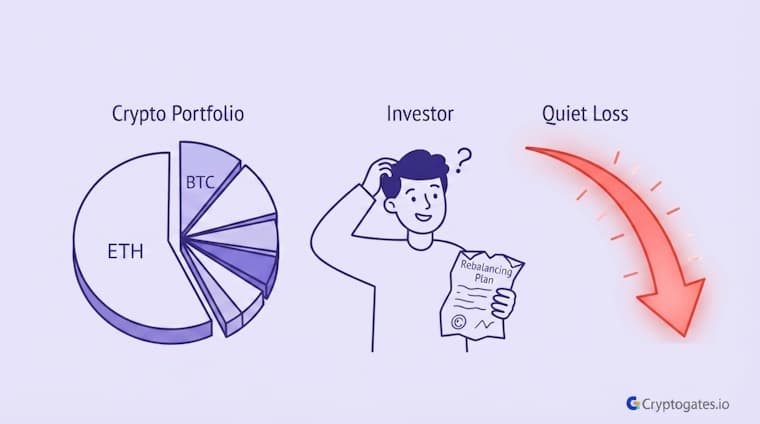
Rebalancing sounds like the boring, responsible thing to do with a crypto portfolio.
Set your target weights, trim what’s grown too big, top up what’s shrunk, repeat.
Simple, right?
Ser, it’s not that simple.
Most portfolios that use rebalancing still bleed value, not because the concept is broken, but because the execution is.
Too often, too late, too random, too expensive. The strategy gets blamed when the real problem was how it got applied.
Research Insight
Our own testing backs this up.
In a backtest running a 50/50 BTC/ETH portfolio through a falling market, active rebalancing actually underperformed simply holding – not because rebalancing is flawed, but because two correlated assets falling together leave little room for the mechanic to add value.
Both BTC and ETH Fell in March — Rebalancing Made It Slightly Worse
Portfolio rebalancing means bringing your holdings back to a target allocation after price moves have pushed them out of line.
In crypto, where a single asset can swing 30% in a week, that drift happens fast, and ignoring it changes your real risk exposure without you even noticing.
Here’s the thing.
Vanguard’s research on threshold-based rebalancing found a real, measurable edge, somewhere around 15 to 22 basis points a year, compared to blind calendar-based rebalancing. That’s in traditional markets, where volatility is tame compared to crypto.
Get the mechanics wrong here, and the gap between doing it right and doing it wrong gets a lot bigger.
- The Problem: Most crypto investors treat rebalancing as a vague good habit instead of a rules-based process, and that vagueness quietly destroys returns.
- The Solution: Understand the nine most common mistakes, tied to real playbook scenarios, and build a fee-aware, rules-based framework instead.
- The Incentive: A disciplined rebalancing process controls risk, protects gains, and keeps a portfolio aligned with actual risk tolerance through every market regime.
- The Risk: Getting rebalancing wrong, through overtrading, bad timing, or ignoring costs, can quietly cost more than doing nothing at all.
This guide walks through the most common portfolio rebalancing mistakes, using real playbook-style examples so you can see exactly where discipline breaks down and how to fix it before it costs you.
What Portfolio Rebalancing Is Supposed to Do
At its core, rebalancing exists to restore your portfolio to the weights you originally decided made sense for your risk profile.
If you set a target of 60% BTC and 40% altcoins, and a BTC dominance rally pushes that to 75/25, rebalancing sells some of the winner and buys back into the laggard to reset the balance.
This matters more than people assume.
A portfolio that’s allowed to drift keeps concentrating risk into whatever’s pumping hardest, which feels great in a bull run and terrible the moment that asset rolls over. Rebalancing isn’t about maximizing gains.
It’s about keeping your actual exposure aligned with the risk level you signed up for in the first place.

Michael Markov, Co-Founder and Chairman, Markov Processes International
Terms like asset allocation, target weights, and portfolio drift all point to the same underlying idea:
Your portfolio has a plan, and drift is what happens when the market quietly rewrites that plan without asking you.
CryptoGates’ Rebalance Backtest Bot lets you run this exact mechanic against real historical data before you ever touch live capital, so you can see how a given allocation and trigger would have actually performed instead of guessing.
Why Target Weights and Portfolio Drift Matter
Target weights are the anchor.
Without them, there’s nothing to rebalance back to, just vibes and reaction.
Drift is the natural byproduct of different assets moving at different speeds, and in crypto, that speed difference can be extreme.
The risk isn’t drift itself.
It’s drift nobody’s tracking. A portfolio can look fine on the surface while its actual risk profile has shifted dramatically underneath.
Mistake 1 - Rebalancing Too Often
Look, more attention doesn’t automatically mean better outcomes.
Rebalancing every time your portfolio shifts by a percent or two sounds disciplined, but it usually just means more trades, more fees, and more slippage eating into whatever edge you had.

Vanguard Research, December 2024
This creates a risk that’s easy to miss.
Small market movements don’t always justify action, but overtrading treats every wiggle like a signal.
Turnover adds up. Transaction costs add up. And net returns quietly shrink even while the strategy “looks” active and hands-on.
Real Backtest Example
One CryptoGates backtest found the opposite failure mode:
A bot rebalancing between two diverging assets sold the outperformer at highs 249 times in a single month, systematically buying the falling asset.
Two of three tested variants lost money — proof that even correct mechanics can misfire in the wrong market regime.
ETH Surged 24% While BTC Dropped 7% — The August 2025 Divergence Autopsy
Playbook Example — 1% Drift BTC/ETH Rebalancing
A trader sets a BTC/ETH rebalance portfolio to rebalance any time weights drift by just 1%. Sounds tight and controlled on paper.
In practice, fees from constant small trades eat into gains fast, and the portfolio ends up underperforming a simple buy-and-hold approach over the same stretch.
The rule wasn’t wrong in spirit. It was just too sensitive to survive contact with real market noise.
Mistake 2 - Rebalancing Too Late
Here’s the flip side.
Waiting too long to rebalance lets allocation drift turn into genuine risk imbalance. One asset quietly grows into a dominant chunk of the portfolio, and the investor doesn’t feel the danger until that asset corrects hard.
Unfortunately, this is one of the easier mistakes to fall into, because letting winners run feels good.
Nobody wants to trim a position that’s still climbing. But the longer that imbalance sits untouched, the more exposed the whole portfolio becomes to a single coin’s next move.
Battle-Test Your Strategy
Before the Market Does.
Eliminate guesswork with institutional-grade backtesting for DCA, Grid, and Rebalance bots. Real historical data. Real-world results.
Delayed action doesn’t just increase risk. It increases the size of the eventual correction needed to fix it.
A portfolio that should have been trimmed months ago now needs a much bigger adjustment, often after most of the damage from the drop has already happened.
Playbook Example — Altcoin Overexposure During a Rally
A portfolio grows heavily into one altcoin during a strong rally, ballooning well past its original target weight.
The investor keeps holding, telling themselves they’ll rebalance “soon.”

There's no single fixed answer, but most disciplined approaches use either a set schedule (monthly or quarterly) or a threshold trigger (rebalance once drift hits 5 to 10 percentage points). What matters more than the exact frequency is having a fixed rule and sticking to it, rather than reacting on feel.
Months pass.
The coin drops hard, giving back a big chunk of its gains, and by the time the rebalance finally happens, the portfolio has absorbed a loss that disciplined, on-schedule rebalancing would have mostly avoided.
Mistake 3 - Ignoring Fees and Spreads
Rebalancing isn’t free, and treating it like it is can quietly wreck the whole strategy.
Every trade comes with a cost, whether that’s a straightforward fee, slippage on a fast-moving order book, or a spread that widens right when you need to execute.
This matters more than most people expect, especially for smaller portfolios or anyone rebalancing frequently.
A $500 account paying the same percentage fee per trade as a $50,000 account feels that cost far more relative to its size. The math that works fine for a whale can quietly bleed a shrimp portfolio dry.
Stop Guessing.
Stress Test Your Edge.
The market doesn't care about your backtest. Our engine simulates 1,000+ "what-if" scenarios to ensure your strategy is built for survival.
Run Crypto Strategy Engine →Execution cost, net return, and trading friction aren’t abstract finance terms here.
They’re the difference between a rebalancing strategy that actually protects your portfolio and one that just moves money around while fees skim the top.
Playbook Example - Weekly Rebalancing on Low-Liquidity Coins
A small account rebalances weekly across several low-liquidity coins, chasing precision on allocation.
Ngl, the intention is good, but the execution isn’t.
Constant trading across thin markets means paying spread costs on nearly every transaction, and over time, that friction destroys much of the portfolio’s actual performance, even if the underlying allocation logic was sound.
Mistake 4 - Using Unrealistic Target Allocations
Some investors set target allocations that look great in a spreadsheet but don’t match their actual risk tolerance.
An aggressive split feels fine when everything’s green. It feels completely different during a 40% drawdown at 2 am.
The smarter approach is picking allocations you can actually hold through a bad week, not just a good one.
Overly aggressive weighting toward high-volatility assets doesn’t just risk bigger losses.
It creates the exact kind of stress that leads to panic decisions, which defeats the entire point of having a rules-based strategy in the first place.
Confused about
market outlook?
Trading without a plan is just gambling. Our strategy architect analyzes your risk tolerance and capital to match you with a proven algorithmic framework.
Portfolio structure, conviction weighting, and risk profile all need to line up honestly with how much volatility someone can actually stomach, not how much they think they can stomach on a calm day.
Playbook Example — 80% Altcoin Basket Allocation
A trader sets 80% into a high-volatility altcoin basket and 20% into BTC, chasing maximum upside.
The portfolio becomes genuinely unstable. Every altcoin dump hits hard, rebalancing trades get bigger and more frequent than planned, and the whole setup becomes difficult to maintain emotionally and financially the moment a real drawdown hits.
Mistake 5 - Rebalancing Without a Clear Rule
Wait, this might be the most common mistake of all.
Random rebalancing, the kind based on gut feeling instead of a fixed method, creates inconsistency that quietly undermines the whole strategy.
A portfolio needs a defined method: periodic (rebalance every set interval), threshold (rebalance once drift crosses a specific percentage), or a hybrid of both. Without one of these, “rebalancing” just becomes an emotional decision wearing a strategic label.
Strategy framework, rule-based investing, and discipline aren’t buzzwords here.
They’re what separates a system from a hunch.
And a hunch, no matter how confident it feels in the moment, doesn’t hold up across a full market cycle.
Playbook Example — "I'll Rebalance When It Feels Necessary"
A trader decides they’ll rebalance whenever it feels necessary, with no fixed threshold or schedule guiding the decision.
The issue shows up fast.
Emotional timing means rebalancing during dips out of fear and skipping it during rallies out of greed, exactly backwards from what disciplined execution should look like.
The outcome is inconsistent, and inconsistent execution rarely compounds well.
Neither is universally "best." Periodic rebalancing is simpler and easier to automate, while threshold rebalancing tends to reduce unnecessary trades by only acting when drift actually matters. Many disciplined traders combine both into a hybrid rule.
Mistake 6 - Overreacting to Short-Term Noise
Not every red candle means something.
That’s the part beginners miss most.
Daily price fluctuations are normal, and treating each one as a trigger for action leads to constant, unnecessary adjustments that add cost without adding benefit.
Proven Setups &
Expert Breakdowns.
We don't just show you the data; we engineer and validate high-performance strategies, providing the "Alpha" behind the numbers.
Market noise, volatility, and the distinction between signal and noise matter here.
A 3% dip during a normal pullback isn’t the same as a structural break in an asset’s trend, but reactive rebalancing treats them identically.
Playbook Example — Constant Adjustment During a Normal Pullback
A portfolio gets adjusted repeatedly during what turns out to be a completely normal pullback– nothing unusual, just typical crypto volatility.
The investor keeps buying and selling in response to short-term moves, and that constant back-and-forth quietly erodes long-term efficiency.
By the time the pullback resolves itself naturally, the portfolio has paid for a problem that would have fixed itself.
Mistake 7 - Ignoring Market Conditions
A static rebalancing style doesn’t automatically fit every market regime.
Bull markets, bear markets, and sideways chop each call for a different level of attention, but a lot of investors run the same settings no matter what the broader market is doing.
Market regime, trend strength, and allocation behavior all shift together.
What works during a slow, range-bound market can actively work against you during a strong directional trend, and vice versa.
Playbook Example — Aggressive Trimming During a Bull Run
A trader keeps an aggressive, tight rebalancing cadence going even during a strong bull run, trimming winners the moment they drift past target weight.
Honestly, this is where discipline can backfire if it’s too rigid.
The constant trimming caps upside way too early, cutting into the exact assets driving the portfolio’s growth, all in the name of a rule that wasn’t designed with trending markets in mind.
Mistake 8 - Rebalancing Illiquid Assets
Low-liquidity assets turn rebalancing into a much harder, more expensive exercise.
Thin order books mean even modest trades can move the price against you, and wide spreads eat into returns before the trade even settles.
DefiLlama
Illiquid pairs, order book depth, and trade impact aren’t just technical terms for advanced traders.
They directly determine whether a rebalancing strategy is actually executable at the size you’re running it.
Playbook Example — Small-Cap Tokens With Thin Order Books
A portfolio includes several small-cap tokens with genuinely thin books, the kind where a mid-sized order visibly moves the chart.
Every rebalance trade ends up moving the market against the trader’s own position, worsening execution each time.
What should be a routine adjustment turns into a costly one, simply because liquidity wasn’t part of the allocation decision from the start.
Mistake 9 - Not Reviewing the Strategy
A rebalancing system isn’t something you set once and forget forever.
Markets change, correlations shift, and a strategy that worked well two years ago might not fit current conditions at all.
Neutralize Volatility.
Own the Growth.
Access systematic playbooks designed to eliminate emotional bias. From Spot HODL frameworks to advanced Grid simulators.
Strategy review, portfolio maintenance, and optimization need to happen on some schedule, even if it’s just once or twice a year.
Allocations, thresholds, and frequency settings all deserve a periodic second look, not just when something’s gone visibly wrong.
Playbook Example — Same Settings Used for Years
A portfolio keeps running the same allocation and rebalancing threshold for years without any review.
The problem isn’t that the original settings were bad. It’s that market behavior evolved while the plan stayed frozen in place.
What was appropriate risk exposure years ago may no longer match current volatility, liquidity, or correlation patterns, and nobody caught it because nobody was looking.
How to Avoid These Mistakes
| Concept / Term | Detailed Description |
|---|---|
| Rule-Based Decisions | Follow predefined portfolio rules instead of making emotional investment decisions. |
| Risk-Tolerant Allocation | Build allocations that reflect your actual ability to handle volatility, not your ideal scenario. |
| Cost-Efficient Rebalancing | Only rebalance when the expected improvement outweighs trading fees, taxes, and slippage. |
| Portfolio Liquidity | Maintain sufficient liquidity to execute rebalancing efficiently without unnecessary market impact. |
| Periodic Portfolio Review | Regularly reassess allocations and strategy instead of leaving the portfolio on autopilot indefinitely. |

Zaheer: Rebalancing isn't about being active. It's about being right on schedule, with rules you actually follow. Most of the mistakes above aren't strategy failures. They're discipline failures.
Risk management, execution discipline, and portfolio efficiency all trace back to the same root idea.
A rebalancing plan only works if it’s actually followed, not just written down somewhere and ignored.
Portfolio Rebalancing Checklist
- Choose a fixed rebalancing rule (periodic, threshold, or hybrid)
- Match target allocations to your actual risk tolerance
- Estimate trading fees and slippage before rebalancing
- Confirm all portfolio assets have sufficient liquidity
- Schedule a future review date for the entire strategy
Best Rebalancing Playbook Framework
The smarter approach isn’t a complicated system with a dozen moving parts.
It’s a simple, rules-based framework that’s actually easy to follow under pressure, because that’s exactly when discipline tends to break down.
The Truth in Numbers.
Designed for the 10% who require absolute clarity. We strip away the hype to reveal the structural reality of the crypto markets.
Start by defining target weights based on real risk tolerance, not aspirational risk tolerance.
Choose either periodic or threshold logic, or combine both into a hybrid rule. Set a fee-aware trigger so trades only fire when the benefit clearly outweighs the cost.
Avoid unnecessary turnover by respecting that trigger even when the market feels like it’s screaming at you to act.
And review outcomes on a set schedule so the framework evolves along with actual market conditions instead of staying frozen.
| Method | How It Works | Best Fit For |
|---|---|---|
| Periodic | Rebalances on a fixed calendar interval (monthly, quarterly) | Investors who want simplicity and predictability |
| Threshold | Rebalances only when portfolio drift crosses a set percentage | Cost-conscious investors avoiding unnecessary trades |
| Hybrid | Combines scheduled reviews with a portfolio drift trigger | Investors wanting structure plus flexibility |
An overcomplicated framework with too many conditions and exceptions tends to fail exactly when it matters most, during high-stress, high-volatility periods when clear thinking is hardest to come by.
A simple rule you’ll actually follow beats a sophisticated one you’ll abandon under pressure.
Research Snapshot
In a low-turnover threshold test on ADA, just 6 trades over 33 days beat passive holding by 2.74% — the bot sold near a spike and sat out the crash that followed.
It’s a clean example of the threshold method in the table above: fewer trades, triggered only when drift actually mattered.
Rebalancing Works Only With Discipline
Portfolio rebalancing is a genuinely powerful tool, but only when it’s paired with a clear process instead of good intentions.
Every mistake covered here, from overtrading to waiting too long, from ignoring fees to skipping strategy review, traces back to the same root cause.
Discipline broke down somewhere between the plan and the execution.
The highest costs rarely come from the market itself.
They come from overtrading, poor timing, unrealistic allocations, and quietly ignored costs that add up trade by trade.
Real playbook examples like the ones above exist to help you spot these patterns before they show up in your own portfolio, not after.
Battle-Test Your Strategy
Before the Market Does.
Eliminate guesswork with institutional-grade backtesting for DCA, Grid, and Rebalance bots. Real historical data. Real-world results.
Test your own rebalancing rules against historical data before risking real capital.
Run your own parameters and see what the data actually shows, using CryptoGates’ Rebalance Strategy Backtest Bot to validate a framework before automating it.
FAQs
What triggers a portfolio rebalance in crypto?
A rebalance typically triggers when an asset’s weight drifts past a set percentage from its target, or when a fixed calendar interval like monthly or quarterly is reached.
Does rebalancing reduce returns compared to holding?
In a strong, one-directional bull run, rebalancing can trim gains early since it sells winners along the way. Over full market cycles, it generally reduces risk more than it costs in upside.
How do fees affect crypto portfolio rebalancing?
Frequent rebalancing across many small trades can rack up fees, slippage, and spread costs that quietly cancel out the strategy’s benefit, especially on smaller accounts or illiquid pairs.