

 Bitcoin
  Ethereum
  Solana
  TRON
TRON  Zcash
Zcash  Hyperliquid
  Dogecoin
  Monero
  Chainlink
  Cardano
  Stellar
  Uniswap
  Sui
Sui  Hedera
  Bittensor
  Shiba Inu
  Ripple USD
  Polkadot
  Aster
Aster  World Liberty Financial
  Render
  Artificial Superintelligence Alliance
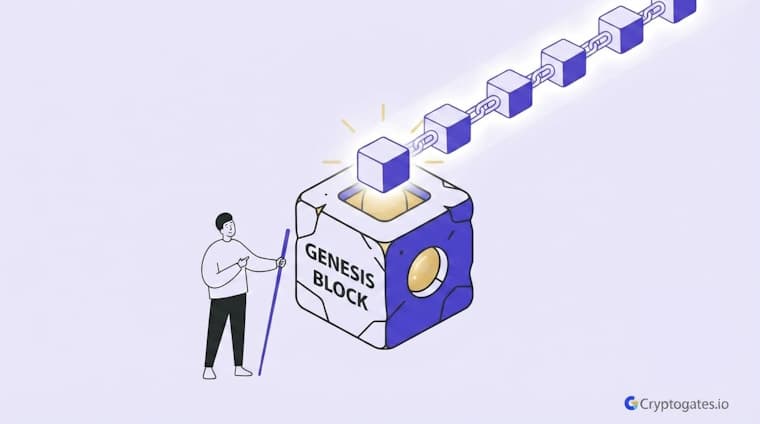
Every blockchain has one block that never changes, never moves, and never gets replaced.
Most people trade for years without ever asking where their favorite chain actually started. But here’s the thing: once you understand the genesis block, a lot of other blockchain logic starts making sense too.
This isn’t some obscure technical footnote either; it’s the literal foundation everything else in crypto builds on.
- The Problem: Most beginners treat "block zero" as a random technical detail instead of the foundation it actually is.
- The Solution: Understanding what a genesis block is, why it exists, and how it anchors an entire network's trust.
- The Incentive: Once you get this, concepts like forks, node syncing, and chain verification stop feeling confusing.
- The Risk: Skipping this basic layer means misunderstanding how blockchain integrity actually works at a deeper level.
What Is a Genesis Block, Really?
Every blockchain needs a starting point.
Not a vague one.
A literal, hardcoded, unchangeable first block that everything else builds on top of. That’s the genesis block.
Think of it like the foundation of a house.
You can’t add a second floor if the ground floor doesn’t exist.
Same idea here. Before miners can add block one, block two, block three, and so on into infinity, someone has to plant block zero first.
Battle-Test Your Strategy
Before the Market Does.
Eliminate guesswork with institutional-grade backtesting for DCA, Grid, and Rebalance bots. Real historical data. Real-world results.
Here’s the interesting part.
The genesis block isn’t mined the normal way.
A developer or founding team writes it directly into the protocol’s code, a practice Binance Academy’s genesis block definition confirms is standard across nearly every blockchain.
No competition, no proof-of-work race, no nodes fighting over who gets credit. It’s just there from day one, baked in.
| Feature | Genesis Block | Regular Block |
|---|---|---|
| Creation Method | Hardcoded into Software | Mined Competitively |
| References Previous Block | No | Yes |
| Can Be Altered Later | No, Ever | Only Through Consensus Forks |
| Reward Spendable | Not Always (Bitcoin's Isn't) | Yes, After Confirmations |
1. Why It's Called "Block Zero"
This trips up a lot of beginners, ngl.
Most people expect counting to start at one. Feels natural, right?
But in blockchain, and honestly in a lot of computer science, counting starts at zero.
So the genesis block gets height zero. The next block is height one. It’s just a counting convention, nothing mystical about it.
But if you’re new to this space, seeing “block 0” referenced everywhere can feel confusing until you’ve spent time in a proper crypto knowledge base.
2. What Makes It Different From Every Other Block
Every block after the genesis block points backward. It references the hash of the block before it. That’s literally what makes a “chain” a chain.
But the genesis block has nothing to point to.
There’s no block negative one.
So its “previous block” field is filled with zeros instead. As CoinMarketCap’s genesis block glossary entry notes, it’s the one exception to the rule that holds the entire system together, which is kind of a wild thing to sit with once you notice it.
Research Insight
Understanding a system’s foundation changes how you evaluate everything built on top of it. The same principle applies once you move from blockchain fundamentals to actually trading on-chain assets. Beginners often assume a strategy needs to predict market direction to be useful, but CryptoGates’ internal DCA testing suggests otherwise.
Strategy: Dollar-Cost Averaging (Bot)
Coin: BTC/USDT
Market Condition: Slow, sideways-to-bearish month
Objective: Test whether small, fixed-step buying holds up without directional prediction
Key Result: 7 of 8 sessions closed in profit, ending +1.93% despite BTC falling 2% over the same period
Expert Interpretation: The bot didn’t need to “know” where BTC was headed, it just needed a consistent, rules-based process.
That’s the same reason understanding a blockchain’s base layer matters before trading on it: structure, not prediction, is what holds up over time.
Full breakdown: BTC Fell 2% in March — Our DCA Bot Made +1.93% Anyway
How the Genesis Block Is Created
Here’s something most explainer articles skip.
The genesis block isn’t just conceptually different, it’s mechanically different too. Someone has to sit down and manually write it into existence before the network can even start syncing.
1. The Role of the Network Founder or Team
In Bitcoin’s case, this fell entirely on one person.
No committee vote, no whitepaper draft reviewed by a hundred contributors. Just code, written and embedded directly into the earliest version of the software.

Source: Phemex Academy
That’s honestly part of why the genesis block carries so much weight in crypto culture. It’s the one moment in an otherwise decentralized system where a single individual had total control.
Every OG in this space knows that story, and every new chain that launches still follows the same basic pattern.
2. What Data Gets Stored Inside It
The genesis block isn’t empty.
It carries a timestamp, a difficulty target, a nonce, and usually one transaction, the coinbase reward that mints the very first coins of the network.
Quick Ways To Spot a Genesis Block
- Check if the block height is zero, not one
- Look for a missing "previous block" reference, it'll be all zeros
- See if the coinbase reward is unspendable or locked
- Check the protocol's source code for a hardcoded first block
- Look for an embedded message or timestamp inside the block data

No. Changing it would break every hash reference built on top of it, forking the entire network into an incompatible chain.
Sometimes founders hide a message in there too.
Not required. But it’s become something of a tradition.
A little Easter egg baked permanently into the chain’s DNA.
No. Changing it would break every hash reference built on top of it, forking the entire network into an incompatible chain.
Famous Genesis Blocks and What They Reveal
Look, this is the part that turns a technical detail into actual culture. Founders don’t just launch chains quietly.
Some of them leave a message behind, and those messages tell you a lot about why the project exists in the first place.
1. Bitcoin's Genesis Block Message
Buried inside Bitcoin’s first block is a headline from a British newspaper referencing a bank bailout.
That’s not a random string of text. It’s a timestamp and a statement rolled into one.

Zaheer says it best. Verify first, risk later, scale slowly. Even Bitcoin's origin story leans into that same idea, proving something before trusting it.
The embedded line reads: “The Times 03/Jan/2009 Chancellor on brink of second bailout for banks.” The message does two jobs at once. It proves the block wasn’t mined before that date, since the headline had to exist first. And it quietly makes a point about the financial system Bitcoin was built to route around.
Proven Setups &
Expert Breakdowns.
We don't just show you the data; we engineer and validate high-performance strategies, providing the "Alpha" behind the numbers.
Honestly, that’s kind of the whole ethos of CT distilled into one embedded headline. Few understand how deliberate that choice actually was.
2. What Other Chains Have Done Differently
Not every project treats its genesis block the same way. Some newer chains use it for branding. Others bake in a founding date, a symbolic number, or even a shoutout to their own community.
It’s a small detail, but it tells you something.
A chain’s genesis block is basically its birth certificate. What gets written there sticks around forever, whether it’s a political statement or just a timestamp nobody thinks twice about.
Why the Genesis Block Still Matters Today
You’d think this is just trivia at this point. It’s not. The genesis block still does real work every single day, mostly behind the scenes where nobody notices.
Verification and Trust in the Network
Every time a new node joins a blockchain, it has to sync from the very beginning. That means checking the genesis block first, then verifying every block after it connects properly through cryptographic hashes.
Confused about
market outlook?
Trading without a plan is just gambling. Our strategy architect analyzes your risk tolerance and capital to match you with a proven algorithmic framework.
The genesis block is a permanent part of the blockchain that cannot be altered or removed, and its role is maintaining the integrity of the entire chain.
If someone tried to swap out the genesis block on a forked version of the network, every wallet, exchange, and node would reject it instantly. It just wouldn’t match.
They use it as the anchor point for the entire chain. If a network's rules change but the genesis block doesn't match, it's recognized as a separate, unrelated chain.
This is why the CryptoGates Strategy Engine treats data integrity the same way. Before you trust a strategy, you stress test it against thousands of scenarios first. Same principle, different layer.
The Foundation Nobody Watches, But Everyone Relies On
At the end of the day, the genesis block is proof that even a decentralized, trustless system had to start with one deliberate, centralized decision. That’s not a contradiction. It’s just how trust gets bootstrapped before a network can stand on its own.
Stop Guessing.
Stress Test Your Edge.
The market doesn't care about your backtest. Our engine simulates 1,000+ "what-if" scenarios to ensure your strategy is built for survival.
Run Crypto Strategy Engine →Every wallet, every node, every fork traces back to that same starting point. Understanding it won’t change your entry price or your next trade.
But it does change how you see the system underneath all of it, and that kind of foundational knowledge tends to matter more than people expect.
If you’re serious about building strategies on top of that system instead of just guessing your way through it, the Strategy Engine is built for exactly that.
Test first. Trust the data. Scale from there.
FAQs
What is a genesis block in simple terms?
It’s the very first block of a blockchain, hardcoded into the software before any other block exists. Every later block traces its history back to this one.
Why can't the Bitcoin genesis block reward be spent?
Due to how the protocol handles that specific transaction, the reward was never added to the spendable coin set. It’s permanently locked by design.
Does every blockchain have a genesis block?
Yes. Any blockchain, whether it’s a major network or a small fork, needs one hardcoded starting block before it can begin operating.