

 Bitcoin
  Ethereum
  Solana
  TRON
TRON  Zcash
Zcash  Hyperliquid
  Dogecoin
  Monero
  Chainlink
  Cardano
  Stellar
  Uniswap
  Sui
Sui  Hedera
  Bittensor
  Shiba Inu
  Ripple USD
  Polkadot
  Aster
Aster  World Liberty Financial
  Render
  Artificial Superintelligence Alliance
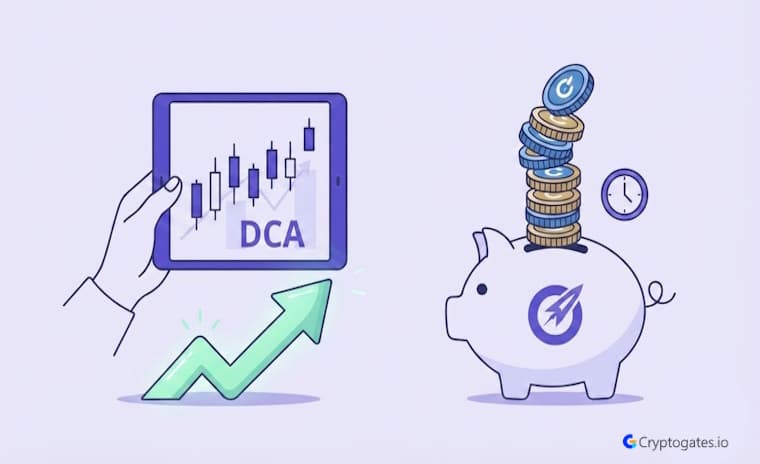
Most people don’t lose money in crypto because they picked the wrong coin.
They lose money because they bought at the worst possible moment, then panicked and sold at the next worst moment.
Sound familiar?
Only 14% of investors who tried to time the market beat a simple dollar-cost averaging approach over a ten-year stretch.
Vanguard research.
If you’ve ever watched a chart at 2am wondering whether to buy now or wait for a dip, you already know why the best crypto DCA strategy exists.
It’s not a secret formula.
It’s a habit that removes the guessing game entirely, and it’s the reason so many long-term holders sleep better than day traders.
- The Problem: Most crypto investors buy on emotion, chase pumps, and panic-sell during drops, which locks in losses instead of building a position.
- The Solution: The best crypto DCA strategy replaces guesswork with a fixed schedule, buying the same amount regardless of price so the average cost balances out over time.
- The Incentive: A repeatable, low-stress system that works in bull runs, bear markets, and everything in between, without needing to predict anything.
- The Risk: DCA doesn't guarantee profit and can still lose value if the underlying asset never recovers, so asset selection still matters.
What Is Crypto DCA?
Crypto DCA stands for dollar-cost averaging, and honestly, the idea is almost too simple.
You pick a fixed amount, you pick a schedule, and you buy on that schedule no matter what the price is doing.
That’s it.
No charts to stare at, no perfect entry to chase.
Here’s the thing.
This isn’t some new trick invented for crypto.
It’s been used in stock markets for decades.
Crypto just makes it more interesting because prices swing so hard in such short windows.
Understanding Average Entry Price
Every purchase adds to your average entry price.
Buy high one week, buy low the next, and over time those numbers blend into a single average.
That average is what actually decides whether you’re in profit, not any single buy.
Why the Best Crypto DCA Strategy Works
Look, most people don’t lose money in crypto because they’re bad at research.
They lose because fear and greed make the decisions instead of a plan.

ZAHEER, CEO CryptoGates
That’s the real problem DCA solves.
1. Smoothing Out Volatility
But here’s what most beginners miss.
Volatility isn’t the enemy of DCA, it’s actually what makes it work.
Wild price swings average out over time instead of wrecking a single lump-sum entry.
2. Avoiding Market Timing Risk
Nobody can consistently call the exact bottom.
Not analysts, not influencers, not you.

It can work well because it spreads risk across price swings instead of betting everything on one entry point. It doesn't guarantee profit, but it removes the pressure of timing.
Disciplined investing through a set schedule means you stop trying, and that alone removes a huge source of stress and bad decisions.
How DCA Strategy Crypto Works in Real Life
Say you decide to put fifty dollars into Bitcoin every single week.
Some weeks the price is high.
Some weeks it dips hard.
You don’t check the news before buying. You just buy, because that was the plan.

Mark Douglas, Trading in the Zone
Wait, doesn’t that feel almost too passive?
Kind of. But that’s the point.
Battle-Test Your Strategy
Before the Market Does.
Eliminate guesswork with institutional-grade backtesting for DCA, Grid, and Rebalance bots. Real historical data. Real-world results.
Buying More When Prices Fall, Less When They Rise
When the price drops, your fixed fifty dollars buys more units.
When it climbs, that same fifty buys less.
Over months, this naturally pulls your average entry price toward the middle instead of leaving you stuck at whatever the price happened to be on day one.
This is portfolio building on autopilot, not a bet on a single moment.
Step-by-Step Guide to Using the Best Crypto DCA Strategy
Here’s what actually matters.
The best crypto DCA strategy isn’t complicated, but skipping a step usually causes people to quit halfway through.
Five steps, done in order, and the whole thing runs itself.
Step 1: Choose the Right Crypto Asset
Pick something with real liquidity and a long track record.
A coin nobody trades or a project with no real use case isn’t a good fit for DCA.
Weak assets can stay weak forever, and no amount of consistent buying fixes that.
Proven Setups &
Expert Breakdowns.
We don't just show you the data; we engineer and validate high-performance strategies, providing the "Alpha" behind the numbers.
Step 2: Decide Your Investment Amount
Set a number you can repeat without stress, not one that hurts if the market turns red for a while.
Ten dollars a week beats a hundred you can’t sustain.
Step 3: Choose Your Buying Schedule
Weekly, biweekly, monthly, it honestly doesn’t matter much which one you pick.
What matters is sticking to it.
Consistent buying beats clever timing almost every time.
Step 4: Automate If Possible
This is where a lot of plans fall apart.
If you have to manually remember to buy, emotion eventually creeps back in.
Setting up recurring buys through a tool like CryptoGates’ DCA Backtest Bot lets you test the schedule first, then automate it so the decision only gets made once.
Step 5: Track and Review Performance
Check your average entry price every so often.
Not daily, that defeats the purpose.
Just enough to confirm the strategy still matches your goals.
Interactive Checklist: Before You Start DCA
- Pick one asset with real liquidity and long-term relevance
- Set a fixed amount you can repeat without financial stress
- Choose a schedule (weekly, biweekly, or monthly) and commit to it
- Automate the buy if the platform allows it
- Review performance monthly, not daily
Best Crypto DCA Strategy in Bull Markets
Bull markets mess with people’s heads.
Prices climb, everyone’s posting screenshots, and suddenly it feels dumb to keep buying small amounts instead of going all in.
Lump-sum investing has outperformed dollar-cost averaging in roughly 66% of crypto market scenarios, especially during strong bull runs.
Research cited by AInvest
But here’s the issue.
Chasing a green candle is exactly how most people buy the top.
The best crypto DCA strategy in a rising market isn’t about buying more, it’s about not stopping.
Research Insight
It’s tempting to assume DCA performs best when a coin is clearly running up, but the data doesn’t fully support that. In a CryptoGates backtest during a strong BTC rally, where price climbed nearly 15% in a matter of weeks, the DCA bot still closed 8 of 9 sessions in profit but ended up earning $119.81 less than a simple buy-and-hold position over the same window.
This isn’t a flaw in the strategy, it’s a structural trade-off. DCA spreads capital across multiple entries instead of committing it all at the start of a rally, so in a fast, one-directional uptrend, lump sum naturally captures more of the move. The takeaway for readers: DCA’s real edge shows up in uncertain or falling markets, not in confirmed bull runs, which is exactly why staying consistent (not chasing bigger buys) still matters even when it looks less rewarding in the short term.
View Complete Playbook: https://cryptogates.io/playbooks/btc-ran-14-5-and-our-dca-bot-only-made-40/
Staying Consistent During Uptrends
So yes, lump sum can win big in a straight-up market.
The problem is nobody knows in advance which run is the straight-up one and which is the one that reverses hard the following week.
Sticking to the schedule means you still participate, just without betting everything on one entry.
Best Crypto DCA Strategy in Bear Markets
Now imagine this. The market’s down, timelines are full of doom, and every buy feels like throwing money into a hole.
This is, weirdly, when DCA earns its keep.
When Bitcoin dropped 78% from its prior high during a past downturn, investors who kept buying on schedule steadily lowered their average entry cost with every purchase.
Analysis by Spoted Crypto.
Building Conviction Through Drawdowns
Lower prices during a downturn aren’t fun to watch.
They are, mathematically, a gift for anyone still buying.
Every scheduled purchase during a drawdown pulls the average cost down, which sets up a much better base once the market eventually turns.
Real Backtest Example
Theory is easy to trust until the chart turns red for weeks straight. In one of CryptoGates’ internal backtests, a DOT/USDT DCA bot ran through a 56% drawdown spanning seven months, one of the coin’s harshest downtrends on record.
Out of 80 scheduled sessions, 79 closed in profit, and the bot finished with a net gain of $380.99, while a buy-and-hold position on the same capital ended down $617. That’s roughly a $998 gap between a disciplined schedule and simply holding through the fall.
The lesson isn’t that DCA avoided losses altogether, it’s that consistent small buys through the decline kept the average entry cost low enough to turn scheduled purchases profitable even while the asset itself was still deeply underwater. That’s the mechanical reason bear-market DCA tends to outperform passive holding over time.
View Complete Playbook: https://cryptogates.io/playbooks/how-a-dca-bot-made-381-while-polkadot-lost-56/
Best Crypto DCA Strategy in Sideways Markets
Sideways markets are honestly the most boring part of crypto, and boring is underrated.
Prices chop up and down without going anywhere obvious, and a lot of traders just stop paying attention.
Pick one asset, set a fixed amount, choose a schedule, then automate it through a recurring buy feature or a bot built for the job.
That’s actually fine for DCA. The strategy doesn’t need direction to work.
Why Consolidation Favors Repeat Buying
Range-bound conditions remove the pressure to guess a breakout.
You keep buying at roughly similar prices, your average cost stays stable, and you’re positioned whenever the market eventually decides to move.
Market stability during consolidation gives the long-term accumulation plan room to breathe without constant second-guessing.
Examples of a Crypto DCA Strategy
Numbers make this click faster than theory does.
Let’s break this down with three quick scenarios.
Example 1: Weekly Bitcoin DCA
Someone buys twenty dollars of Bitcoin every week for a year.
Some weeks the price is near a local high, some weeks it’s deep in a dip.
By the end, they haven’t timed a single entry perfectly, yet their average cost sits somewhere in the middle of the year’s full range.
Example 2: Monthly Ethereum DCA
A slower version of the same idea.
One purchase a month, same amount each time.
Less effort, fewer decisions, and the long-term accumulation still builds steadily.
This suits someone who doesn’t want to think about crypto more than once every few weeks.
Example 3: Bear Market DCA
Now imagine this. Someone starts DCA right as the market drops hard, buying through a stretch where prices fall well below where they started.
Those lower-priced buys pull the average cost down significantly, which sets up a stronger position once prices recover.
This is the scenario where DCA tends to shine the most.
Stop Guessing.
Stress Test Your Edge.
The market doesn't care about your backtest. Our engine simulates 1,000+ "what-if" scenarios to ensure your strategy is built for survival.
Run Crypto Strategy Engine →Best Coins for DCA Strategy Crypto
Not every coin deserves a spot in a DCA plan.
Honestly, most don’t.
DCA works best on assets that have already proven they can survive multiple market cycles.
Blue-chip crypto with deep liquidity and real adoption gives the strategy something solid to work with.
A coin that could vanish in two years doesn’t benefit from patient, consistent buying, it just delays the loss.
Liquidity, Fundamentals, and Long-Term Adoption
Look for coins with heavy daily trading volume, a track record spanning past bear markets, and actual use beyond speculation.
High-conviction holdings, the ones you’d still want to own five years from now, are the ones worth accumulating slowly.
Everything else is a gamble wearing a DCA costume.
Common Mistakes in DCA Strategy
Here’s the issue.
People start DCA with good intentions and quietly sabotage it within a few weeks.
Changing the schedule out of fear is the biggest one. Price drops, panic sets in, and the buy gets skipped, which defeats the entire purpose.
Using DCA on speculative coins instead of proven assets is another.
So is expecting fast profits. DCA isn’t built for quick wins, it’s built for years, not days.
A CoinDesk-cited study found that a weekly Bitcoin DCA plan returned roughly 230% cumulatively over a multi-year stretch, far outpacing investors who abandoned their schedule during downturns.
Stopping too early ranks high on this list too.
A lot of investors quit right before the strategy would have paid off.
And confusing DCA with blind buying, tossing money at random coins on no schedule at all, isn’t the same thing.
That’s not discipline.
That’s just guessing with extra steps.
Neutralize Volatility.
Own the Growth.
Access systematic playbooks designed to eliminate emotional bias. From Spot HODL frameworks to advanced Grid simulators.
DCA vs Lump Sum Investing
Here’s a fair question people don’t ask enough.
If you already have a chunk of money saved, should you drop it all in at once, or spread it out with DCA?

Larry Fink, BlackRock Chairman's Letter
The honest answer is, it depends.
Lump sum wins more often on paper.
But paper doesn’t panic when the market drops 30% the week after you invest.
| Factor | Dollar-Cost Averaging | Lump Sum |
|---|---|---|
| Best for | Risk tolerance is lower, steady mindset | High conviction, can handle volatility |
| Market fit | Volatile or uncertain conditions | Strong, confirmed bull trend |
| Emotional load | Low, spread across time | High, all-in on one entry |
| Typical outcome | Smoother average cost | Higher upside, higher downside |
When DCA Is Safer and When Lump Sum May Outperform
If the market feels uncertain, or you’re new to this, DCA is the calmer path.
If you have strong conviction and a long horizon, and you can stomach a rough entry point, lump sum has historically outperformed more often.
Risk tolerance decides this, not luck.
Is the Best Crypto DCA Strategy Right for You?
Not everyone needs this strategy, and that’s fine to admit.
Who Should and Shouldn't Use DCA
Beginners, long-term investors, and anyone who doesn’t want to check charts daily tend to do well with DCA.
It fits low-stress traders and non-crypto professionals who just want automated exposure.
If you’re chasing fast profits or want to trade actively, this probably isn’t your strategy.
It was never built for speed.
Discipline Beats Timing
So here’s where this lands.
The best crypto DCA strategy isn’t about being smart enough to predict the market.
It’s about being consistent enough to stay in it.
Nobody calls the exact bottom, not even the professionals, and trying to usually costs more than it saves.
Battle-Test Your Strategy
Before the Market Does.
Eliminate guesswork with institutional-grade backtesting for DCA, Grid, and Rebalance bots. Real historical data. Real-world results.
If you want to see how this would have played out before committing real money, CryptoGates’ DCA Backtest Bot lets you test the schedule and amount against real historical data first.
Verify before you risk.
FAQs
Is DCA a good strategy for crypto?
It works well for reducing emotional decisions and smoothing out volatility, especially for long-term holders who don’t want to time entries.
How often should I DCA into crypto?
Weekly or monthly both work fine. What matters more is sticking to whichever schedule you pick without skipping buys.
Can DCA lose money in crypto?
Yes. DCA lowers average cost but doesn’t guarantee profit, especially if the asset never recovers from a downturn.