

 Bitcoin
  Ethereum
  Solana
  TRON
TRON  Zcash
Zcash  Hyperliquid
  Dogecoin
  Monero
  Chainlink
  Cardano
  Stellar
  Uniswap
  Sui
Sui  Hedera
  Bittensor
  Shiba Inu
  Ripple USD
  Polkadot
  Aster
Aster  World Liberty Financial
  Render
  Artificial Superintelligence Alliance
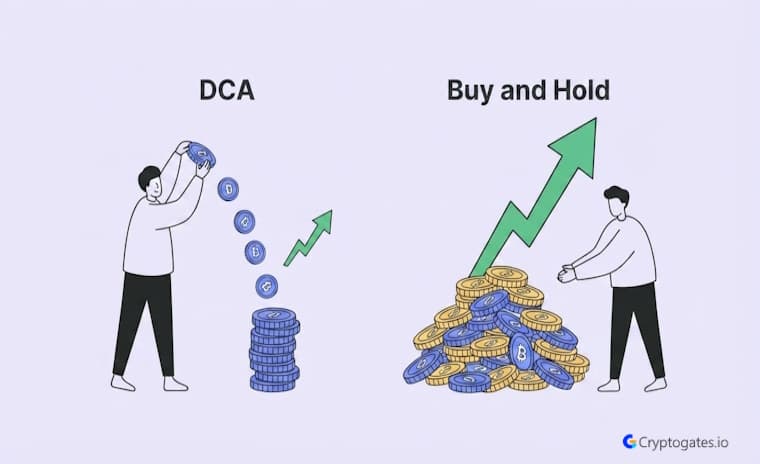
Ser, you’ve probably asked yourself this at 2 am staring at a chart: buy it all now, or drip your money in slowly?
Most people pick a side based on vibes, not data. That’s the problem with the whole DCA vs buy and hold backtest debate.
This piece runs the actual numbers across a full year of price action, across bull, bear, and sideways conditions, in the same spirit as our DCA backtests across three market regimes, and hands you a playbook for each.
- The Problem: Most traders pick DCA or buy and hold based on gut feeling, not tested results.
- The Solution: A structured 1-year backtest across bull, bear, and sideways conditions shows exactly when each strategy wins.
- The Incentive: Knowing which approach fits your market and your coin means fewer emotional decisions and better capital efficiency.
- The Risk: Past backtest results never guarantee future performance, and crypto's volatility can break both strategies if risk isn't managed.
DCA vs Buy & Hold: The Basics
DCA means putting in a fixed amount on a set schedule, no matter what the price does, a method our DCA Strategy Guide breaks down step by step.
You’re not calling the bottom; you’re just smoothing your average entry over time. Buy and hold is simpler: one entry, then you sit on it.

That’s from traditional markets, not crypto, but it’s a useful baseline.
Crypto’s volatility changes these odds quite a bit, which is why we ran our own scenario tests below.
Confused about
market outlook?
Trading without a plan is just gambling. Our strategy architect analyzes your risk tolerance and capital to match you with a proven algorithmic framework.
But here’s the issue: your entry point still carries almost all the risk.
Buy at the wrong moment, and “just hold” can mean staring at red for months.
Why and How We Backtested This
Backtesting isn’t about proving a strategy is “right.”
It’s about replacing assumptions with historical testing. Every scenario below used the same starting capital, the same one-year window, and the same fees.
No cherry-picked coins, no cherry-picked timeframes.
Metrics we tracked
Final portfolio value, average entry price, maximum drawdown, ROI, capital efficiency, and emotional simplicity, yeah, that last one matters more than people admit.

Not always. DCA reduces timing risk but can't protect you from a fundamentally weak coin. Safer usually means smoother, not risk-free.
Backtest 1 — Bull Market Scenario
In our bull run scenario, buy and hold pulled ahead on raw ROI, and that tracks with the Vanguard data too.
When price trends up early and keeps climbing, sitting fully invested from day one just captures more of the move.
Proven Setups &
Expert Breakdowns.
We don't just show you the data; we engineer and validate high-performance strategies, providing the "Alpha" behind the numbers.
DCA still performed fine, ngl; it wasn’t a disaster- a pattern that shows up in our BTC DCA bot backtest during a 14.5% bull run too.
But some of those gradual purchases landed at higher prices than the initial lump sum entry. You get less exposure to timing risk, but you give up some upside during strong momentum.
What This Means
Buy and hold usually wins this one when the trend is clean and sustained.
DCA still holds its own; it just trades some upside for a smoother ride.
Really, the outcome hinges on how early the investor got in, not which strategy is objectively “better.”
Backtest 2 — Bear Market Scenario
Markets don’t always cooperate.
In our bear market scenario, DCA pulled ahead by a solid margin.
Buying at fixed intervals during a falling market means your average cost keeps dropping along with the price.
Meanwhile, a lump sum entry made near the top just sits there bleeding, waiting for a recovery that might take a while.

Zaheer here. This is exactly why we built the backtest bots the way we did. Nobody should find out the hard way that their entry timing was the whole strategy. Test it first. Verify before you risk capital.
That doesn’t mean buy and hold is “bad” here. It means the entry point carried almost all the risk.
What This Means
DCA typically wins on capital preservation, mainly because the average cost keeps dropping with price.
Buy and hold can struggle hard if recovery takes time, especially near a local top. In a bear cycle, patience beats speed.
Raoul Pal, Co-Founder & CEO of Real Vision, former Goldman Sachs macro executive
Backtest 3 — Sideways Market Scenario
Chop is brutal for a different reason than a crash.
In our range-bound scenario, DCA came out feeling like the safer bet, since it kept buying small amounts through the noise instead of committing everything to one flat entry.
Stop Guessing.
Stress Test Your Edge.
The market doesn't care about your backtest. Our engine simulates 1,000+ "what-if" scenarios to ensure your strategy is built for survival.
Run Crypto Strategy Engine →Buy and hold can look weak here.
If price ends the year roughly where it started, a single lump-sum entry just shows a flat line, no real gain for the wait.
A sideways market doesn’t punish you fast, it just wears you down slowly.
Different Coins, Different Outcomes
Same two strategies, same time period, but a completely different coin, and coin quality changes everything.
1. Bitcoin
BTC tends to be the most stable benchmark for testing either strategy.
Its liquidity and market strength make it the fairest asset to judge DCA against buy and hold without extra noise.
2. Ethereum
ETH usually shows bigger swings than BTC, and that volatility works in DCA’s favor.
More dips mean more chances to lower your average entry price, so the gap between the two strategies narrows.
Real Backtest Example
Strategy: DCA
Coin: ETH/USDT
Market Condition: Sharp post-peak decline (32% drop over 46 days)
Objective: Test whether scheduled entries actually reduce damage during a fast bleed
During one of the steeper ETH corrections of the year, a DCA bot running fixed-interval entries closed the window down just 1.81%, while a straight buy-and-hold position on the same capital lost significantly more.
The bot didn’t turn the drawdown into a profit — it never claimed to. What it did was cut the damage by roughly $253 compared to sitting still, purely by spacing entries across the decline instead of taking the full hit at once.
Expert Interpretation: This is the practical version of the volatility argument made earlier — ETH’s bigger swings don’t just create more downside, they create more entry points to average against. The value of DCA here isn’t upside capture, it’s damage control.
View Complete Playbook: https://cryptogates.io/playbooks/eth-crashed-32-in-46-days-our-dca-bot-lost-only-1-81/
H3: The Heading3. High-Volatility Altcoins
This is where it gets spicy.
Buying and holding a high-volatility altcoin can produce a 100x gem outcome or leave you fully rekt; there’s not much middle ground.
DCA can soften bad timing, but only if the coin survives the year at all.
What the Data Actually Reveals
One backtest proves nothing on its own. Robustness only shows up when you run the same comparison across several coins and market types. Once you stack the scenarios together, a pattern shows up clearly:
DCA tends to reduce emotional stress and timing risk across the board. Buy and hold can outperform, but mostly in strong, sustained bull conditions where being fully invested early just pays off.

"The best investment strategy is the one you can actually stick with." Morningstar behavioral finance research team, as cited in due.com's analysis of DCA vs lump sum investing
Playbooks
Playbook 1 — Bull Market
If the trend is already sending it hard, buy and hold works well for coins you have real conviction in.
Prefer a smoother ride?
Use DCA instead. Best for: BTC, ETH, long-term conviction coins.
Real Backtest Example
Strategy: DCA
Coin: BTC/USDT
Market Condition: Sustained bull run (BTC up ~14% in April)
Objective: Check whether DCA still adds value once the trend is clearly up
When BTC climbed roughly $11,674 in a single month, a DCA bot running on autopilot closed the period with zero losing sessions and a modest net gain.
It didn’t beat a simple buy-and-hold position — in a clean uptrend, being fully invested from day one is hard to beat — but it captured a real, positive return without a single closed loss along the way.
Expert Interpretation: This backtest is the clearest evidence for the article’s own conclusion: in strong, sustained bull conditions, buy-and-hold has the structural edge. DCA still works and still protects against bad timing, but it trades some upside for consistency — exactly the trade-off Playbook 1 describes.
View Complete Playbook: https://cryptogates.io/playbooks/btc-rallied-14-in-april-our-dca-bot-still-pocketed-43-with-zero-closed-losses/
Playbook 2 — Bear Market
Build your position gradually.
Avoid dumping a full lump sum at once; you have no way of knowing if this is the bottom. Best for: long-term accumulation in coins with real staying power.
Playbook 3 — Sideways Market
DCA helps you avoid getting stuck on a bad single entry during chop.
Buy and hold only makes sense here if you’re betting on a future breakout. Best for: patient investors with a long time horizon.
Not really. DCA can reduce bad timing on altcoins, but it can't rescue a project with weak fundamentals.
Playbook 4 — High-Volatility Altcoins
Only DCA into altcoins with real liquidity and fundamentals behind them.
Buy and hold on a random microcap is basically a lottery ticket, not a strategy.
Common Mistakes and Which Strategy Actually Wins
Most “DCA vs buy and hold” comparisons online are kind of a mess.
People compare completely different coins without adjusting for risk, ignore fees and timing, or judge an entire strategy off a single market phase.
| Market Condition | Strategy That Tends to Lead | Why |
|---|---|---|
| Bull Market | Buy & Hold | Full exposure captures early upside |
| Bear Market | DCA | Lowers average cost as prices decline |
| Sideways Market | DCA | Smooths entry risk during choppy conditions |
| High-Volatility Altcoins | Depends on fundamentals | DCA reduces timing risk only if the project survives |
So which strategy wins overall?
There isn’t a universal answer. Buy and hold tends to win in strong, sustained bull markets.
DCA tends to win on consistency and lower emotional pressure. Strategy fit depends on coin quality, market cycle, and your own investor psychology.
The Real Takeaway From a Year of Backtesting
A full year of testing across bull, bear, and sideways conditions shows DCA and buy and hold both work, just not in the same conditions, and not for the same kind of investor.
Buy and hold rewards conviction and good timing.
DCA rewards consistency and patience.
Neither one removes risk completely, and that’s exactly why testing beats guessing every time, especially since only a small fraction of retail traders stay profitable across full market cycles.
Before You Pick a Strategy
- Have you backtested this coin instead of assuming the strategy works?
- Are you factoring in trading fees and realistic entry timing?
- Does your risk tolerance actually match the potential drawdown?
- Are you choosing based on data, or just what Crypto Twitter is hyping this week?
- Would you still be comfortable holding through a 50%+ market drop?
If you want to see how these numbers actually play out on your own parameters, the DCA Strategy Backtest Bot lets you run this comparison yourself, no signup, no capital at risk, just real historical data doing the talking.
Battle-Test Your Strategy
Before the Market Does.
Eliminate guesswork with institutional-grade backtesting for DCA, Grid, and Rebalance bots. Real historical data. Real-world results.
FAQs
Is DCA better than buy and hold for crypto?
Not universally. DCA tends to reduce timing risk and stress, while buy and hold often wins in strong bull markets. It depends on the coin and the cycle.
How long should a DCA vs buy and hold backtest run?
A full year captures enough volatility and trend behavior to be useful, though testing across multiple market cycles gives a more reliable picture.
Does DCA work for altcoins the same way it works for Bitcoin?
Not exactly. DCA can reduce bad timing on altcoins, but it can’t fix weak fundamentals. Coin quality still decides the outcome either way.