

 Bitcoin
  Ethereum
  Solana
  TRON
TRON  Zcash
Zcash  Hyperliquid
  Dogecoin
  Monero
  Chainlink
  Cardano
  Stellar
  Uniswap
  Sui
Sui  Hedera
  Bittensor
  Shiba Inu
  Ripple USD
  Polkadot
  Aster
Aster  World Liberty Financial
  Render
  Artificial Superintelligence Alliance
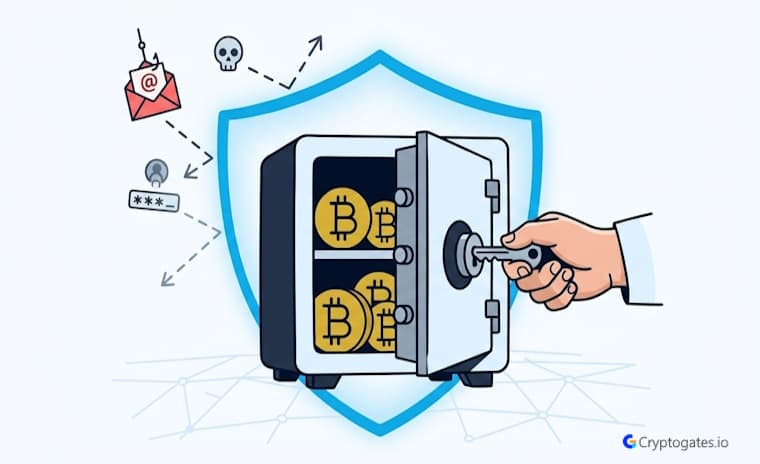
You worked hard to buy your first crypto. Maybe you’re up 40%. Maybe you finally figured out a strategy that’s working. Then one morning, you open your wallet app, and it’s empty.
That’s not a horror story. It happens every single day.
“Over $3.8 billion in crypto was stolen through hacks and scams in a single recent year.” Chainalysis Crypto Crime Report
Most beginner traders spend hours researching which coin to buy and zero hours thinking about how to keep it safe.
That’s backwards.
Because it doesn’t matter how good your strategy is if someone can just reach in and take everything you built.
- The Problem: Most beginners focus on what to buy, not how to protect it. One security mistake can wipe out everything.
- The Solution: Simple habits like cold wallets, 2FA, and verified exchanges block the majority of attacks before they happen.
- The Incentive: Never share your private key or seed phrase. Ever. With anyone.
- The Risk: Crypto has no fraud protection. Lost funds don't come back.
Why Crypto Is a Target (and Why You Specifically)
Here’s something the hype crowd doesn’t tell you: crypto has no fraud protection. No chargebacks. No, we’ll investigate and refund you.
“If your funds are gone, they’re gone. The blockchain is permanent. That’s what makes it powerful, and that’s exactly what makes security non-negotiable.

Andreas Antonopoulos, Bitcoin Security Educator
Here’s something the hype crowd doesn’t tell you: crypto has no fraud protection.
No chargebacks. No, we’ll investigate and refund you.
If your funds are gone, they’re gone. The blockchain is permanent. That’s what makes it powerful, and that’s exactly what makes security non-negotiable.
Hackers aren’t just targeting big exchanges or wealthy whales.
They’re running automated attacks on thousands of small wallets at once. Your $300 in Bitcoin is just as interesting to them as someone else’s $300,000; it’s all automated.
“97% of crypto theft comes from hot wallets connected to the internet.” CipherTrace Crypto Crime Report
They’re playing a numbers game, and individual traders who skip basic security are the easiest wins.
So what actually puts your crypto at risk?
The biggest threats aren’t complicated. Phishing scams where a fake website steals your login.

Yes. Most attacks are automated and don't care how much you hold.
Malware is sitting quietly on your laptop, recording every keystroke.
Weak passwords are reused across platforms.
And the most painful one is losing access to your own wallet because you never backed up your private keys properly.
Research Insight
Panic is not just a security risk. It’s a market risk, too.
CryptoGates research into a 45% single-week collapse in ENA following a stablecoin redemption panic found the same pattern security researchers see in phishing and social-engineering attacks: the damage wasn’t caused by the crash itself, but by reactive decisions made in the middle of it.
A systematic approach that had already defined its rules before the panic started came out with a net profit, while reactive, in-the-moment decisions during that window were consistently the losing move.
The lesson generalizes well beyond trading: whether it’s a market crash or a “your account has been flagged” email, decisions made in a rush, under pressure, are where funds are lost. Discipline set up in advance beats judgment exercised in the moment, every time.
View Complete Playbook: ENA Crashed 45% in the USDe Panic. This DCA Bot Still Banked +$898.19
Your Private Key Is Everything
Think of your private key as the actual ownership of your crypto. Not your password. Not your account login. The private key.
Whoever holds the private key controls the funds. Period. If someone gets yours, they don’t need to hack anything; they just walk in through the front door.

ZAHEER, CEO CryptoGates
Never share it.
Never type it into any website. Never store it in your email, your notes app, or a screenshot.
Write it down on paper and keep it somewhere safe and offline. Yes, actual paper. Old school works.
The same applies to your seed phrase, that 12- or 24-word recovery phrase your wallet gives you when you first set it up.
That phrase IS your wallet.
Anyone with those words can restore your wallet on any device and drain it completely. Treat it like cash in hand.
Your Basic Security Checklist Before You Trade
- Seed phrase written on paper and stored offline
- The private key is never typed into any website
- 2FA enabled on exchange and email
- Using a verified exchange with proof of reserves
- Hardware wallet set up for larger holdings
Hot Wallets vs. Cold Wallets
A hot wallet, as covered in our guide on hot wallet vs cold wallet storage, is connected to the internet.
Your exchange account is a hot wallet. Most mobile crypto apps are hot wallets.
Convenient, yes. Being connected to the internet means being exposed to everything the internet brings.
A cold wallet is offline. Hardware wallets like Ledger or Trezor are small physical devices that store your private keys completely disconnected from any network.
| Metric | Hot Wallet | Cold Wallet |
|---|---|---|
| Connected to internet | Yes | No |
| Best for | Active trading | Long-term storage |
| Hack risk | Higher | Very low |
| Example | Exchange account | Ledger, Trezor |
| Recommended for | Small, active amounts | Larger holdings |
The practical approach most experienced traders use:
Keep only what you’re actively trading on an exchange and move larger holdings to cold storage.
You don’t leave your life savings in a casino chip pile; the same thinking applies here.
Real Backtest Example
Strategy: DCA
Coin: BTC
Market Condition: Sharp macro-driven crash ($87K to $74K)
Objective: Test whether a pre-defined, rules-based plan holds up under a fast, fear-driven sell-off
Key Result: 16 of 17 sessions closed via take-profit, delivering a net gain while spot holders were still underwater.
Expert Interpretation: The bot had no information advantage over anyone else watching BTC fall. What it had was a plan set before the crash began, with no room for mid-panic improvisation. That’s the same principle behind a seed phrase backup done before you ever need it, or 2FA turned on before an attacker tries to log in. Verification and preparation done in advance are what hold up when things move fast, not decisions made in the moment.
View Complete Playbook: The Tariff Trap Playbook — How a DCA Bot Turned BTC’s Worst April in Years Into +$349 Profit
Two-Factor Authentication Is Not Optional
Two-factor authentication, or 2FA, adds a second verification step beyond your password.
Even if someone steals your login credentials, they still can’t get in without the second factor, usually a time-sensitive code from an app on your phone.
SMS-based 2FA is better than nothing, but app-based authentication is significantly harder to intercept.” Jameson Lopp, Bitcoin security researcher and Casa CTO
Turn it on everywhere. Your exchange.
Your email.
Your wallet app. Every account connected to your crypto in any way.
Use an authenticator app like Google Authenticator or Authy rather than SMS codes.
Text messages can be intercepted through SIM swapping attacks. An app-based code lives on your phone and nowhere else.
This one step blocks the majority of unauthorized access attempts.
Battle-Test Your Strategy
Before the Market Does.
Eliminate guesswork with institutional-grade backtesting for DCA, Grid, and Rebalance bots. Real historical data. Real-world results.
Choosing a Safe Exchange Matters More Than You Think
Not all exchanges are equal. Some have been hacked. Some have disappeared with user funds. Some don’t even hold proper reserves to cover withdrawals if things go wrong.
When you’re choosing where to trade, look for exchanges that publish proof of reserves, independent verification that the exchange actually holds the crypto it claims to hold.

"Proof of reserves is the minimum standard any exchange should meet. If they won't publish it, that tells you something."
This transparency matters.
It’s the difference between trading on solid ground and hoping the platform hasn’t quietly made risky bets with your money.
CryptoGates.io built an Exchange Picker specifically to filter this out for you.
It narrows down to exchanges with verified proof of reserves, solid security records, and transparent operations.
You’re not doing random research, hoping you picked a safe one; you’re running it through a filter designed to keep you off platforms that could cost you everything before you even make a trade.
Not sure which
exchange fits you?
Bypass the marketing hype. Our matrix cross-references your profile against 50+ institutional metrics—including Proof-of-Reserves and Slippage Models.
What About the Exchanges Themselves?
Reputable exchanges don’t keep all funds in hot wallets.
Most stores store the majority in cold storage, with only a small percentage available for active withdrawals. They run regular security audits, require multi-signature approvals for large transfers, and encrypt data heavily.
But here’s the truth: even with all those measures, exchanges have been hacked. Mt. Gox lost over 750,000 Bitcoin. That was catastrophic and irreversible. The lesson isn’t “never use exchanges.”
It’s “don’t store more on an exchange than you need to right now.”
Trade on it. Then withdraw to your own wallet.
Basic Habits That Actually Matter
You don’t need to be a cybersecurity expert. You need consistent habits.
Keep your devices updated. Software patches fix the security holes hackers actively look for.
Run antivirus software and keep it current. Use strong, unique passwords for every crypto-related account.
“Only 21% of crypto exchanges publicly verify their proof of reserves.” CoinGecko Exchange Transparency Report
A password manager makes this simple.
And bookmark the exchanges and wallet sites you use rather than Googling them each time.
Fake phishing sites often rank high in search results and look identical to the real thing.
Be skeptical of anything that arrives in your DMs, inbox, or social feeds promising free crypto, special investment opportunities, or urgent account alerts.
Legitimate platforms don’t operate that way.
Proven Setups &
Expert Breakdowns.
We don't just show you the data; we engineer and validate high-performance strategies, providing the "Alpha" behind the numbers.
Security Is Part of the Strategy
Here’s the mindset shift that changes everything. Security isn’t separate from your trading strategy; it’s the foundation of it. You can’t build long-term, sustainable returns if the ground beneath you is unstable.
At CryptoGates.io, the entire philosophy is built around verifying before risking. That means testing strategies before deploying real money. It means choosing exchanges with verified reserves. It means not rushing into positions without a plan.
You'll need your backup codes, which most apps provide during setup. Store those offline the same way you store your seed phrase.
Security fits perfectly into that same thinking: check your setup, tighten what’s loose, then trade with clarity.
Before your next trade, spend twenty minutes on your security posture.
Check that 2FA is active.
Confirm your seed phrase backup is secure and offline. Make sure you’re on a verified exchange.
It’s not exciting.
But it’s what separates traders who build something lasting from traders who eventually have nothing left to protect.
FAQs
What's the safest way to store crypto?
A hardware wallet kept offline is the safest option for any amount you’re not actively trading. It stores your private keys completely disconnected from the internet. Even a basic Ledger or Trezor device makes remote theft nearly impossible.
What happens if I lose my private key?
Your funds become permanently inaccessible with no recovery option. That’s why backing up your seed phrase on paper and storing it somewhere physically secure is non-negotiable before you hold any crypto.
Do I really need 2FA on my crypto accounts?
Yes, and it should be app-based, not SMS. Authenticator apps like Google Authenticator or Authy generate codes that only live on your device, which makes them far harder to intercept than a text message.