

 Bitcoin
 Ethereum
 Solana
 TRON
 Zcash
 Hyperliquid
 Dogecoin
 Monero
 Chainlink
 Cardano
 Stellar
 Uniswap
 Sui
 Hedera
 Bittensor
 Shiba Inu
 Ripple USD
 Aster
 Polkadot
 World Liberty Financial
 Render
 Artificial Superintelligence Alliance

Ser, quick question.
You just set your rebalance bot’s trigger % and hit run, right?
Most traders do exactly that, then wonder later why their bot fired thirty times or barely fired at all.
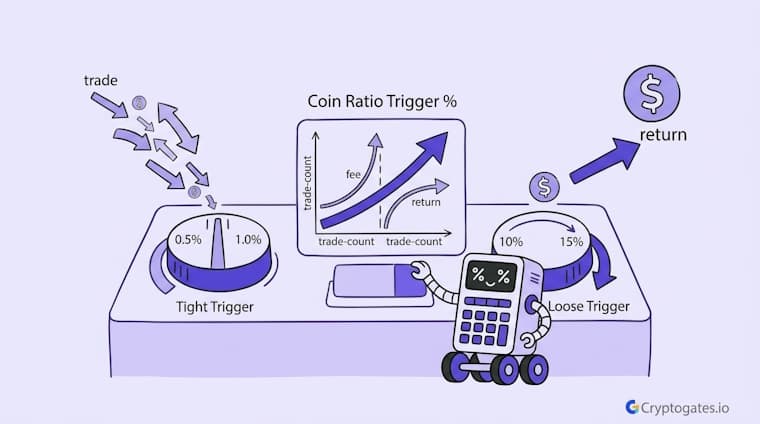
That one number, your coin ratio trigger percentage, decides almost everything about how your rebalance bot behaves.
Set it too tight and fees eat your edge. Set it too loose and the bot misses the exact moves it was built to catch.

Jaconetti, Kinniry, Zilbering, Vanguard (via Kitces.com)
This isn’t a “set it once” kind of setting.
It’s the difference between a bot that works with the market and one that fights it.
- The Problem: Most traders pick a coin ratio trigger % randomly, without knowing it controls trade frequency, fee drag, and how closely the bot tracks market swings.
- The Solution: Backtest a few trigger percentages on the same pair and timeframe before deciding which one fits your strategy.
- The Incentive: A well-tuned trigger % can mean the difference between a bot that quietly compounds gains and one that just racks up fees.
- The Risk: Even a well-picked trigger % can still underperform a simple hold strategy in a strong trending market. Not financial advice.
What Coin Ratio Trigger % Actually Controls
Here’s the thing.
A rebalance bot doesn’t watch the price.
It watches the ratio between your two assets.
Say you’re running BTC/USDC at a 50/50 split. As BTC moves, that ratio drifts away from 50/50, the exact crypto portfolio drift a rebalancing bot exists to correct.
he trigger % is basically your tolerance for that drift before the bot steps in and pulls things back to target.
Reality Check
Strategy: Rebalance Bot (BTC/ETH pair, 50/50 target)
Coin: ETH / BTC
Market Condition: Strong divergent trend — ETH surged +24% while BTC dropped -7% over August 2025
Objective: Test whether a rebalance bot’s drift-based logic holds up when one asset trends hard against the other, instead of chopping sideways
Key Result: Two of three tested trigger variants lost money. The bot did exactly what it’s built to do – sell the outperformer, buy the underperformer – and got punished for it, since ETH kept climbing after being sold and BTC kept falling after being bought. Only the variant with the least activity survived the window.
Expert Interpretation: This is the other side of the tight-vs-loose coin. A trigger that looks disciplined in a ranging market can work directly against you the moment one asset breaks into a sustained trend, because the bot only sees ratio drift – it has no concept of trend direction.
it has no concept of trend direction.
One Asset Soared. One Collapsed. Our Rebalance Bot Picked the Wrong Side 249 Times
Think of it like a rubber band.
A tight trigger means the band snaps back the second it stretches a little.
A loose trigger lets it stretch further before anything happens. Neither is automatically better.
It just changes what kind of bot you’re running.
Stop Guessing.
Stress Test Your Edge.
The market doesn't care about your backtest. Our engine simulates 1,000+ "what-if" scenarios to ensure your strategy is built for survival.
Run Crypto Strategy Engine →1. How the Bot Decides When to Fire
Every time the price moves, the bot checks the current split against your target split.
If the drift crosses your trigger %, it rebalances, the same logic behind Binance’s rebalancing bot threshold settings.
That’s it.
No trend analysis, no prediction. Just a rule based on drift.
This is exactly what makes it a system instead of a gut call. The bot doesn’t get emotional about BTC ripping to a new high. It just checks the number.
2. Why This Single Setting Changes Everything Downstream
This is where things change.
Trigger % isn’t just a technical setting buried in the parameters box.
It’s the lever behind three things that actually matter to your bottom line: how many trades you make (in this BTC/ETH divergence rebalance backtest, that number spiraled to 249), how much you pay in fees, and how closely your returns end up tracking BTC’s own trend versus just sitting flat.
Change the trigger, and you change all three at once.
That’s a lot of leverage sitting in one dropdown menu.
Tight vs Loose Triggers, What Actually Happens
Let’s break this down with an actual test.
Same pair, same investment, same timeframe.
Only the trigger % changes.
This is the fairest way to see what a single-variable shift does to your results, instead of guessing.
Jaconetti, Kinniry, Zilbering, Vanguard (via Kitces.com)
That’s not a crypto-specific study, but the logic holds.
| Trigger % | Trades | ROI |
|---|---|---|
| 1% (Test A) | 30 | 16.64% |
| 5% (Test B) | 2 | 16.69% |
| 2% (Test C) | 9 | 16.71% |
More rebalances doesn’t automatically mean more profit.
Sometimes it just means more fees.
1. Low Trigger (Frequent Rebalancing)
A 1% trigger is trigger-happy.
In the test above it fired 30 times over roughly five and a half months.
That’s a lot of small sells and buys chasing every little wiggle in the BTC/USDC ratio. More trades means more fee events too, and at Binance’s standard 0.1% spot trading fee per rebalance, that adds up fast when you’re doing it thirty separate times.
The upside?
It’s disciplined. It never lets drift build up. The downside, honestly, is that in a smooth uptrend it can be overkill.
2. High Trigger (Rare Rebalancing)
Now flip it.
A 5% trigger barely moved, just two rebalances across the whole test window.
Fewer fees, less noise, way less babysitting, and less exposure to the hidden cost of every trade that frequent rebalancing quietly racks up.
Real Backtest Example
Strategy: Rebalance Bot, 5% ratio trigger
Coin: ENA / ASTER
Market Condition: Dual-asset bearish quarter — both freshly listed coins declining together
Objective: See how a wider 5% trigger threshold behaves when there’s no diverging winner to catch, just two falling assets
Key Result: The wide threshold kept the trade count low and fee drag minimal, and still preserved measurable value over simply holding both coins through the bearish quarter.
Expert Interpretation: This tracks with the loose-trigger pattern from the BTC/USDC test above — fewer rebalances, lower fees — but on a different pair and a different market condition entirely, which is exactly why it’s worth cross-checking before treating 5% as a safe default setting.
A wide trigger can let the portfolio drift far from target before doing anything about it, which means it might sit through a chunk of upside or downside without adjusting.

There's no universal number. It depends on your pair's volatility and how much fee drag you're willing to accept for tighter tracking.
In this specific test it actually landed the highest ROI of the three, 16.69%, but that’s one backtest window.
Chop, dump, or a longer sideways stretch could flip that result completely.
What This Means for a BTC/USDC Rebalance Strategy
Picture this.
BTC in a strong uptrend, USDC just sitting there as flat ballast.
That’s basically the setup in the test above, an uptrend running from spring into fall.
In a run like that, a rebalance bot is constantly selling BTC strength to top up USDC, then buying BTC back on dips. It’s profit-taking on autopilot.
Sounds great. Except.
Reading the Rebalancing Edge Against a Hold Strategy
Here’s the part most beginners miss.
Rebalancing isn’t automatically better than just holding.
In this same test, a straight Buy & Hold on the BTC side alone would’ve returned 17.15%. All three rebalance configs, even Test C at 16.71%, landed under that number.
That gap between your rebalance ROI and the Hold benchmark is sometimes called the rebalancing edge, and here it came out negative across the board.
Confused about
market outlook?
Trading without a plan is just gambling. Our strategy architect analyzes your risk tolerance and capital to match you with a proven algorithmic framework.
Why?
Because BTC didn’t chop, it trended.
Rebalance bots are built to harvest volatility inside a range.
When one asset just runs, taking profit along the way can mean handing back some of the total gain compared to holding the whole ride.
That’s not a flaw in the bot.
It’s math doing exactly what it’s supposed to do given the market condition it was tested in.
How to Pick a Trigger % Before Risking Capital
Realistically, nobody can tell you the “correct” trigger % without testing it on your actual pair.
What worked for BTC/USDC across one six-month uptrend won’t necessarily hold for a different pair, a longer window, or a choppier market.
Interactive Checklist
- Pick your pair and confirm the trend, range, or chop conditions of your test window
- Run at least three trigger % values on the same window (tight, mid, wide)
- Compare trade count and total fees paid across all three
- Check ROI against a simple Hold of the same asset split
- Repeat the test on a different timeframe before trusting the result
The overlooked factor here is that trigger % interacts with market regime.
A setting that looks great in a trend might look mediocre in a range, and vice versa.
What to Watch For in Your Own Test
Watch three numbers side by side. Trade count tells you how active the bot got. Fees paid tells you what that activity cost you.

It plainly. Verify first. Risk later. Scale slowly. A trigger % isn't a guess you make once and forget. It's a number you test, compare, and only then trust with real capital.
And ROI versus Hold tells you whether the activity was actually worth it.
If your rebalance ROI is beating Hold while trades stay reasonable, ser, that’s a genuinely good sign.
No. Tighter triggers mean more trades and more fees, but returns depend on whether the market is trending or ranging during your test window.
If it’s underperforming Hold with a pile of trades and fees on top, the trigger % probably needs adjusting, or the strategy just isn’t suited to that market condition.
Test Your Trigger % Before You Automate
The bottom line here isn’t complicated.
Coin ratio trigger % isn’t a small technical detail buried in a settings panel, it’s the single variable that decides how often your bot trades, how much you pay in fees, and whether you end up ahead of or behind a simple Hold.
The only way to know which trigger fits your pair is to run it through a real backtest first, not guess based on what worked for someone else’s setup on CT.
Proven Setups &
Expert Breakdowns.
We don't just show you the data; we engineer and validate high-performance strategies, providing the "Alpha" behind the numbers.
Test this setup yourself using the Rebalance Strategy Backtest Bot before you automate anything with real capital.
Battle-Test Your Strategy
Before the Market Does.
Eliminate guesswork with institutional-grade backtesting for DCA, Grid, and Rebalance bots. Real historical data. Real-world results.
FAQs
What is a coin ratio trigger % in a rebalance bot?
It’s the amount of drift allowed between your target allocation and current holdings before the bot rebalances. A 2% trigger fires sooner than a 5% one.
Is a lower trigger % always safer for a rebalance bot?
Not necessarily. Lower triggers mean more trades and fees, which can eat into returns even if the strategy feels more disciplined on paper.
Can a rebalance bot underperform a simple hold strategy?
Yes. In a strong trending market, rebalancing can lock in profits too early compared to just holding through the full move, as shown in backtest comparisons.