

 Bitcoin
 Ethereum
 Solana
 TRON
 Zcash
 Hyperliquid
 Dogecoin
 Monero
 Chainlink
 Cardano
 Stellar
 Uniswap
 Sui
 Hedera
 Shiba Inu
 Bittensor
 Ripple USD
 Aster
 Polkadot
 World Liberty Financial
 Render
 Artificial Superintelligence Alliance

Everyone talks about a coin’s chart.
Almost nobody talks about the crypto whitepaper behind it, and that’s exactly the problem. This document is the closest thing crypto has to a project’s DNA.
It tells you what the team is actually building, how the token works, and why it should exist at all.

CoinGecko Research.
Most beginners skip straight to the price chart and skip the one paper that could’ve saved them from a rug.
Ser, that’s backward.
- The Problem: Most people invest based on hype and skip the document that actually explains what they're buying into.
- The Solution: Learning to read a crypto whitepaper properly turns guesswork into an actual evaluation process.
- The Incentive: You catch red flags before your capital is on the line, not after.
- The Risk: A polished whitepaper can still hide weak tokenomics or an unrealistic roadmap, so reading it isn't a guarantee.
What Is a Crypto Whitepaper, Really
A crypto whitepaper is the project’s technical and economic blueprint.
It’s not a pitch deck, and it’s definitely not marketing copy dressed up in charts.

Zaheer says the whitepaper is where you separate builders from marketers. If the paper reads like an ad, treat it like one.
A real one explains the problem being solved, how the technology works, and how the token fits into that system.
Honestly, if a project can’t explain itself clearly in this document, that’s already a signal.
1. Why Projects Publish Whitepapers
Publishing a whitepaper signals the team is willing to put their reasoning on paper, in public, where it can be checked.
It gives builders room to explain the actual problem instead of just promising returns.
The Bitcoin whitepaper is still the reference point for what a clear, technical, no-hype document looks like.
2. Whitepaper vs Litepaper vs Pitch Deck
These three get mixed up constantly.
A whitepaper is the full technical and economic explanation, built for developers and serious researchers.
A litepaper is the same idea, simplified for a broader audience.
A pitch deck is built for investors and, ngl, it’s usually the most biased of the three since its whole job is to sell the round.
The Core Sections Every Whitepaper Should Have
Strong whitepapers tend to follow a pattern.
Once you know that pattern, you can scan any new one in minutes and know where the substance actually lives instead of getting lost in the branding.
| Section | What It Should Tell You | Watch For |
|---|---|---|
| Problem & Vision | The real issue being solved | Vague, generic claims |
| Tech & Architecture | How the system actually works | No technical detail |
| Tokenomics | Supply, allocation, vesting | Huge team allocation |
1. Problem Statement and Vision
This part reveals whether the project is solving something real or just inventing a problem to justify a token.
A serious paper names the problem specifically.
A weak one talks in circles about “revolutionizing” an industry without saying how.
2. Technology and Architecture
Here’s where vague claims usually fall apart.
If a paper can’t explain its consensus mechanism, its data structure, or its actual technical tradeoffs, that’s not a simplification for beginners.
That’s usually a sign there isn’t much technology behind the buzzwords.
Reality Check
Common belief: Automated or “smart” systems are assumed to protect capital the same way a well-vetted whitepaper is assumed to protect an investment.
What CryptoGates research found: Testing a grid bot through a 27% ETH collapse, the bot still lost money — just 8.36% instead of the 26.94% a spot holder lost over the same window.
Why it matters: Verification isn’t about proving something wins. It’s about seeing the real number, even when that number is negative — the same standard a reader should apply to a project’s tokenomics section.
Strategy: Grid Bot
Coin: ETH/USDT
Market Condition: 44-day, 27% collapse
Objective: Measure loss containment during a real breakdown
Key Result: Grid bot lost 8.36% vs. 26.94% for a spot holder, generating $62.74 in live grid profit along the way
Expert Interpretation: A losing result, reported in full, tells a due-diligence-minded reader more than a cherry-picked win would.
3. Tokenomics and Distribution
Token supply, allocation, and vesting schedules show you who actually benefits early.
Wait, this is the part most people skip entirely, and it’s often the most revealing section in the whole document.

No. A whitepaper is a descriptive document, not a legal contract. It outlines intentions and plans, but it usually doesn't create enforceable obligations the way a prospectus or a legal agreement would. Treat it as a research tool, not a guarantee.
A huge allocation sitting with the team and early investors, unlocking fast, tells you exactly who the exit liquidity might be.
How to Actually Read One Without Getting Fooled
Reading a whitepaper is a skill, not a formality.
Most beginners open the PDF, skim the intro, and close it.
That’s not reading; that’s checking a box.
Here’s the interesting part: the paper is designed to be read backward from how most people approach it.
Skip the marketing language up top and go straight to tokenomics and technical architecture first. That’s where the truth usually lives.
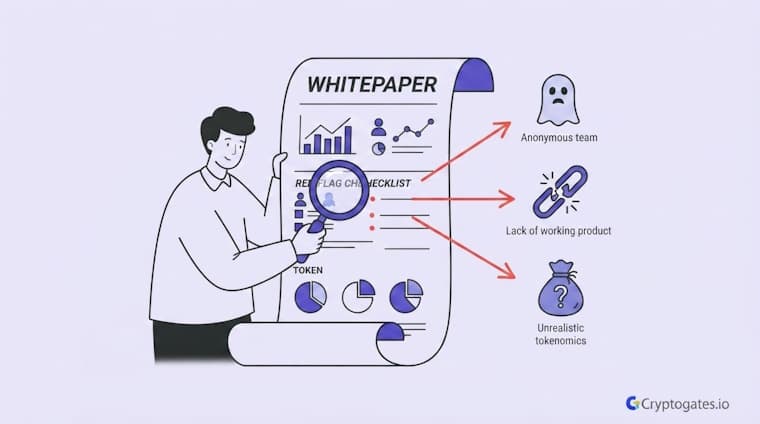
1. Red Flags That Signal Hype Over Substance
Vague language is the first tell. Phrases like “revolutionary ecosystem” or “next-generation infrastructure” without any specifics underneath them are filler, not substance.
An anonymous team with no verifiable background is another one.

"Skepticism is a project's best friend." Vitalik Buterin
Look, teams sometimes have legitimate reasons to stay private, but combined with unrealistic return promises or a roadmap packed with buzzwords and no milestones, it starts looking less like caution and more like a pattern.
Neutralize Volatility.
Own the Growth.
Access systematic playbooks designed to eliminate emotional bias. From Spot HODL frameworks to advanced Grid simulators.
Unrealistic promises deserve extra suspicion too.
If a paper implies guaranteed returns or positions the token as a sure thing, that’s not confidence; it’s one of the classic crypto scam red flags to watch for.
That’s a sales pitch wearing a whitepaper’s clothes.
2. A Simple Verification Checklist Before You Trust It
Interactive Checklist
- Confirm the team's identity and past project history
- Check if the technology claims match what's actually live or on GitHub
- Read the tokenomics section for team and investor allocation size
- Compare the roadmap against actual delivered milestones
- Search for independent audits or third-party technical reviews
A few consistent checks like these separate a serious project from a copy-paste scam dressed up with a fresh logo.
None of this takes long once it becomes a habit.
Research Insight
Skepticism about a whitepaper’s claims really comes down to a data problem: does the stated tech match what’s actually shipped?
The same test applies to any performance claim in crypto, including strategy backtests. A title promising outperformance means little until the mechanics behind it – trade counts, drawdowns, the market condition it was tested in — are visible too.
Strategy: Grid Bot
Coin: BNB/USDT
Market Condition: Post-ATH crash (-33%)
Objective: Test grid resilience against a steep breakdown
Key Result: Bot generated $163.94 in grid profit but still finished at -21.64% total ROI
Expert Interpretation: Grid profit and total ROI are not interchangeable – publishing the loss alongside the trade data is what separates verifiable research from a marketing claim.
BNB Grid Bot vs a 33% Crash: What the Backtest Data Actually Shows
Most whitepapers take 20 to 40 minutes to read properly, depending on length and technical depth. Skimming for tokenomics and team background alone takes far less time and still catches most red flags.
Honestly, it’s less about being an expert and more about not skipping steps just because the branding looks clean.
Verify the Paper Before You Verify the Price
A crypto whitepaper won’t tell you where the price is headed, and honestly, it was never supposed to.
What it does is give you a real look at the logic behind the project, the tokenomics, and whether the team actually knows what they’re building.
Treat it as step one of due diligence, cross-checked against CryptoGates’ Crypto Reality Check, not the final word.
Price action comes later.
Verification comes first.
Stop Guessing.
Stress Test Your Edge.
The market doesn't care about your backtest. Our engine simulates 1,000+ "what-if" scenarios to ensure your strategy is built for survival.
Run Crypto Strategy Engine →FAQs
Do all cryptocurrencies have a whitepaper?
Most legitimate projects publish one, but not all. A missing whitepaper on a project claiming serious technology is itself a red flag worth noting.
Can a good whitepaper still lead to a bad investment?
Yes. Strong writing and clean design don’t guarantee execution, market timing, or that the tokenomics play out the way they’re described.
Where can I find a project's official whitepaper?
Check the project’s official website first, then cross-reference with reputable listing sites to confirm you’re reading the real, unedited version.