

 Bitcoin
  Ethereum
  Solana
  TRON
TRON  Zcash
Zcash  Hyperliquid
  Dogecoin
  Monero
  Chainlink
  Cardano
  Stellar
  Uniswap
  Sui
Sui  Hedera
  Bittensor
  Shiba Inu
  Ripple USD
  Polkadot
  Aster
Aster  World Liberty Financial
  Render
  Artificial Superintelligence Alliance
Look, most traders don’t blow up their account on one bad trade.
That’s not how it usually happens.
They blow up because they hold a losing position way past the point where their own plan said to exit, hoping it bounces back.
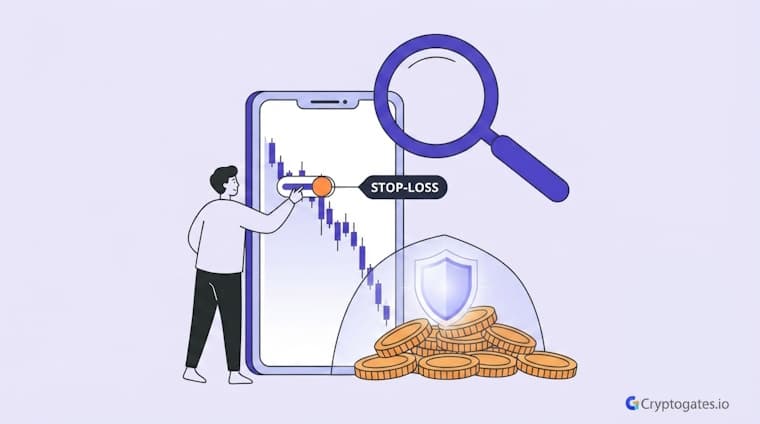
A stop-loss in crypto exists for exactly that moment, the one where hope takes over and logic checks out. It’s a simple tool, but almost nobody sets it up correctly, or at all.

That number isn’t surprising if you’ve ever watched your own portfolio bleed while telling yourself “it’ll come back.”
Here’s the thing.
It usually doesn’t come back in time to save the trade you’re in right now.
- The Problem: Most crypto traders enter positions with a plan to buy, but no plan to exit if things go wrong, so losses run far longer than they should.
- The Solution: A stop loss automates that exit decision ahead of time, closing the trade at a level you define instead of one you panic into.
- The Incentive: Traders who use stop losses consistently protect capital across many trades, which is what actually keeps you in the game long enough to compound gains.
- The Risk: Crypto's volatility means a poorly placed stop loss can trigger on a normal wick and shake you out right before price reverses in your favor.
What Is a Stop Loss in Crypto?
A stop loss is a pre-set exit order, the crypto equivalent of what the SEC defines as a stop order in traditional markets.
You tell the exchange, in advance, at what price you want out of a trade if it moves against you. Once the market hits that price, the order triggers and closes your position automatically.
No emotions involved. No second-guessing at 2 AM while staring at a red candle.
Reality Check
Common Belief: Once a position starts losing, waiting it out is the safer move because “it’ll bounce back.”
What CryptoGates Research Found: A DOT/USDT DCA backtest covering a 56% decline over seven months found that a rules-based bot closed 79 of 80 sessions in profit and finished at +$380.99, while a spot holder running the same capital with no predefined exit was sitting on a −$617 loss by the end of the window — a $998 gap between the two outcomes.
Why It Matters: The difference wasn’t a better market read. It was that one approach had a rule deciding when to act and the other didn’t. That’s the same mechanism a stop loss is built to provide — an exit point set before the trade, not one negotiated with hope in real time.
Expert Interpretation: The bot didn’t avoid the downtrend. It just never let the position run unmanaged through it.
Here’s what most beginners miss.
A stop loss isn’t about predicting the market.
It’s about controlling what happens to your capital when your prediction turns out wrong, because sometimes it will. Even good strategies sometimes lose.
That’s not failure; that’s just how probability works in trading.

Zaheer puts it simply, verify first, risk later, scale slowly. A stop loss is that philosophy turned into a mechanical rule. You're not gambling on hope. You're defining your risk before the trade even opens.
CryptoGates’ Crypto Strategy Engine actually shows why this matters at scale.
Instead of guessing whether your stop placement makes sense, you can run it through thousands of simulated scenarios and see how your Risk of Ruin changes depending on where you set that exit.
1. How a Stop Loss Order Actually Works
There’s a difference between your trigger price and your execution price, and this trips up a lot of new traders.
The trigger price is the level that activates your order.
The execution price is what you actually get filled at, and as Binance Academy notes in its breakdown of placing stop-loss orders, in fast-moving markets those two numbers can be pretty far apart.
Battle-Test Your Strategy
Before the Market Does.
Eliminate guesswork with institutional-grade backtesting for DCA, Grid, and Rebalance bots. Real historical data. Real-world results.
This is where crypto gets tricky compared to stocks. Crypto markets run 24/7; there’s no circuit breaker, and crypto volatility can spike hard in minutes.
A stop set at, say, $60,000 might trigger fine, but if the market gaps down fast during a liquidation cascade, you could get filled at $58,500 instead.
Slippage is real, and it’s worse on lower-liquidity pairs.
2. Stop Loss vs Take Profit
These two get confused constantly, so let’s separate them clearly.
A stop-loss protects you from losing more than you planned. A take profit locks in gains once the price hits a target you’re happy with.
One manages risk on the downside; the other manages greed on the upside.
Honestly, a lot of traders set a take profit and completely skip the stop loss, like they’re only planning for the trade to work. That’s backwards.
Plan the exit for both directions before you’re emotionally invested in the outcome.
Why Crypto Traders Skip Stop Losses (And Regret It)
Most bagholders didn’t wake up one day and decide to hold a losing position forever.
That’s not how it happens.
They just never set an exit point in the first place, so there was nothing forcing the decision when things turned ugly.
Wait, isn’t that kind of the whole problem?
Yeah.
Pretty much.
A lot of traders treat stop losses as optional, something you’ll “figure out if it goes wrong.” But by the time it goes wrong, the fear of locking in a real loss takes over, and the position just sits there, bleeding slowly.
Research from NFTEvening's August 2025 survey
There’s another side to this too.
Skipping the stop loss doesn’t just risk one trade going bad. It builds a habit.
Once you’ve held one losing position “just to see,” it gets easier to justify doing it again next time. And again after that.
The Emotional Trap of "It'll Bounce Back"
Here’s the interesting part.
Hope feels like patience, but it isn’t the same thing. Patience is holding through normal volatility because your original thesis is still intact.
Hope is holding because admitting the trade failed feels worse than watching it slowly get worse.
That gap, between what feels like discipline and what’s actually denial, is where a lot of capital quietly disappears.
In many cases, traders who eventually become bagholders didn’t plan to become one. They just never picked a point where they’d admit the trade was wrong.

Realistically, manual watching fails the moment emotion enters the picture, which is exactly when you need the exit most. A stop loss executes the same decision whether you're watching or asleep.
The simple truth is, an unrealized loss with no stop-loss isn’t a “hold.“
It’s an open-ended bet with no defined risk, and that’s exactly the setup that turns manageable drawdowns into exit liquidity for someone else.
Types of Stop Loss Orders You Should Know
Not every stop loss works the same way, and picking the wrong type for your strategy can cost you just as much as skipping one entirely.
Fixed, trailing, and mental stops each do a different job depending on how volatile the market is and how hands-on you want to be.
Before Placing a Stop Loss
- Does this level sit beyond normal volatility, not right at a round number?
- Am I risking a percentage I can repeat 20 times without ruin?
- Is my risk-reward ratio at least 1:2 before I even enter?
- Would I still take this trade if I assume the stop gets hit?
- Have I backtested this placement instead of guessing?
A fixed stop-loss sits at one price and doesn’t move. Simple, reliable, no decisions to make once it’s set.
A trailing stop loss moves with price, locking in gains as the trade goes your way.
A mental stop-loss exists only in your head, which sounds fine until the moment it actually needs to trigger and you talk yourself out of it.
1. Trailing Stop Loss Explained
A trailing stop loss follows price as it moves in your favor, staying a fixed distance behind it.
If the trade keeps climbing, your stop climbs with it. If the price reverses, the stop stays put and eventually gets hit, locking in whatever gain had built up.
Data Highlight
Strategy: Grid Bot
Coin: BNB/USDT
Market Condition: 33% post-ATH crash over 79 days
Objective: Test whether a predefined, rules-based system limits damage during a sustained decline
Key Result: The bot generated $163.94 in grid profit but still finished the period down −21.64% overall — a real loss, not a workaround.
Expert Interpretation: This is the honest version of what predefined risk rules actually deliver: they don’t prevent losses in a genuine downtrend, they cap what happens inside one. A stop loss works on the same principle — it isn’t a guarantee against being wrong, it’s a mechanism that keeps being wrong from turning into an unbounded, open-ended loss with no defined floor.
This is useful because it lets a winning trade breathe.
You’re not capping the upside with a fixed take profit, but you’re also not giving back the entire move if momentum fades.
The tradeoff is that trailing stops can get clipped by normal pullbacks in a trending market, so the trail distance actually matters.
2. Where to Place Your Stop Loss (Without Guessing)
Here’s what most guides miss.
Stop placement shouldn’t come from a random percentage you saw in a YouTube video. It should come from structure: where’s the last support level, where does the trend actually get invalidated?
Placing a stop 3 to 5% below a support zone tends to work better than placing it exactly at the support level, since that’s usually where everyone else’s stop sits too, and that’s exactly where stop hunts like to go.
Volatility matters as well. A tight 2% stop might make sense on BTC during a calm range, but it’s basically noise-bait on a volatile altcoin.
Chart structure tends to hold up better long term, since a fixed percentage ignores whether that level actually means anything technically. Percentage stops are easier for beginners, but structure-based stops usually get shaken out less by normal noise.
This is exactly the kind of decision that benefits from testing instead of guessing. Running a strategy through CryptoGates’ DCA or Grid backtest bots lets you see how different stop distances would’ve performed across real historical data, instead of hoping your placement logic holds up live.
Stop Losses Are Risk Management, Not Weakness
A stop-loss isn’t you admitting the trade failed.
It’s the tool that keeps you in the game long enough for your good trades to actually matter.
Think about it this way: no single loss should ever be big enough to knock you out of trading entirely, and that’s the whole point of defining your exit before you’re emotionally attached to the outcome.
The traders who last aren’t the ones who never lose. They’re the ones who lose small, consistently, and let the math work in their favor over time. That’s not luck. That’s the process.
Stop Guessing.
Stress Test Your Edge.
The market doesn't care about your backtest. Our engine simulates 1,000+ "what-if" scenarios to ensure your strategy is built for survival.
Run Crypto Strategy Engine →If you’re still guessing where to place your stops, that’s worth fixing before your next trade.
Test your setup on CryptoGates’ Strategy Engine and see how your Risk of Ruin shifts with different stop placements, or run it through the backtest bots to see how it would’ve actually performed on real historical data.
FAQs
Does a stop loss guarantee I won't lose money?
No, it limits how much you can lose on a single trade, but slippage during fast moves can still cause your exit price to differ from your trigger price.
What is a good stop loss percentage for crypto trading?
Most traders use somewhere between 3% and 10%, depending on the asset’s volatility and how far the nearest support level sits.
Can a stop loss get triggered by a wick and then price recovers?
Yes, this happens often in crypto. It’s why placing stops based on structure and volatility, not tight round numbers, matters so much.