

 Bitcoin
  Ethereum
  Solana
  TRON
TRON  Zcash
Zcash  Hyperliquid
  Dogecoin
  Monero
  Chainlink
  Cardano
  Stellar
  Uniswap
  Sui
Sui  Hedera
  Bittensor
  Shiba Inu
  Ripple USD
  Polkadot
  Aster
Aster  World Liberty Financial
  Render
  Artificial Superintelligence Alliance
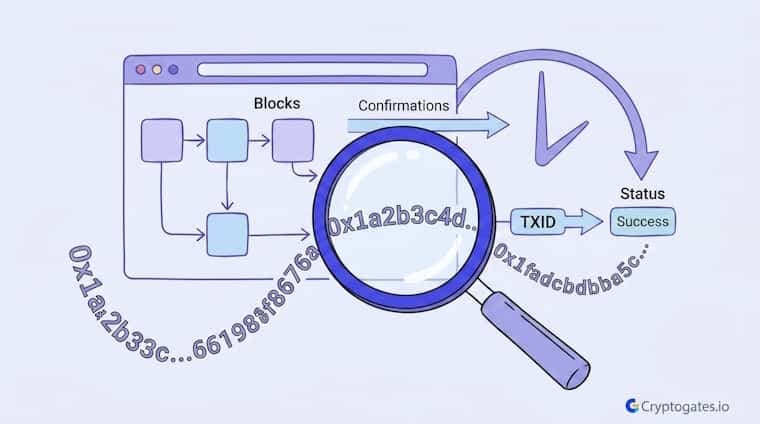
You send crypto to a friend. Or you withdraw from an exchange. The transfer goes through, but something feels off.
No confirmation email. No clear proof it actually happened.
Here’s the thing.
Every crypto transfer leaves behind a code. A transaction hash, or TXID, that acts like a digital receipt.
Ngl, most traders never look at this code until something goes wrong.
A missing deposit. A delayed withdrawal. A support ticket that needs proof.

(Source: Blockchain.com)
That tiny string of letters and numbers?
It’s the difference between “I think I sent it” and “here’s proof I sent it.”
- The Problem: Traders don't know what a transaction hash is until they need one for a dispute or delayed transfer.
- The Solution: Understanding your TXID means you can track, verify, and prove any crypto transaction in seconds.
- The Incentive: Faster support resolutions, scam detection, and full confidence that your funds moved as expected.
- The Risk: Relying on screenshots instead of TXIDs leaves you exposed to fake confirmations and scam claims.
What Is a Transaction Hash (TXID)?
A transaction hash, often shortened to TXID, is a unique string of letters and numbers assigned to every single blockchain transaction.
Think of it like a fingerprint. No two are alike, and once it’s created, it can’t be changed or faked.

Zaheer often says verify first, risk later. A transaction hash is the simplest form of verification crypto gives you. Don't skip it.
Here’s what most beginners miss.
This code isn’t just random. It’s generated through cryptographic hashing, which takes your transaction data and turns it into a fixed-length code that represents everything about that transfer: the sender, the receiver, the amount, the time.
1. How a TXID Gets Generated
The moment you broadcast a transaction, whether it’s a BTC transfer or an ETH swap, the network encrypts the details into that fixed string, the same process broken down in how Bitcoin actually works under the hood.
This happens instantly. You don’t do anything special to create it. It’s automatic.
Battle-Test Your Strategy
Before the Market Does.
Eliminate guesswork with institutional-grade backtesting for DCA, Grid, and Rebalance bots. Real historical data. Real-world results.
The hash is tied permanently to your transaction.
Change even one letter of the data, the amount, or the wallet address, and you’d get a completely different hash.
That’s what makes it tamper-proof.
2. Where to Find Your TXID
Most exchanges show your TXID right after a trade or withdrawal confirms. Look for a “view on explorer” link, or check your transaction history under withdrawal details.
Wallets work the same way.
MetaMask, Trust Wallet, and most others display the hash right in your activity tab. Honestly, it’s usually just one tap away.
Research Highlight
One pattern our internal backtests keep surfacing: active trading strategies generate far more on-chain footprint than most traders expect.
A single automated grid strategy can execute hundreds of trades in just a few weeks, each leaving its own transaction hash.
Strategy: Grid Bot
Coin: XRP/USDT
Market Condition: Flat, near-zero net price movement over 90 days
Objective: Capture range-bound volatility through automated buy/sell cycles
Key Result: 875 executed trades, 27.74% ROI vs 0.24% for buy & hold
Expert Interpretation: At that trade frequency, manually screenshotting each confirmation isn’t realistic. Traders running similar bots reconcile execution history through TXIDs pulled from the exchange or wallet, not visual confirmation pages.
XRP Went Nowhere for 3 Months — Our Grid Bot Made +27.74% Anyway
Why the Transaction Hash Actually Matters
A TXID isn’t just a technical detail buried in your wallet.
It’s your proof of payment. When something goes wrong- a delayed deposit, a missing withdrawal, a support dispute- this code is what actually gets things resolved.

No. A TXID is generated by the blockchain itself based on the transaction data. It can't be copied onto a fake transaction or altered without changing the entire hash.
But there’s a problem.
A lot of traders don’t save their TXID anywhere.
They screenshot a confirmation page instead, and that screenshot means nothing if a scammer can fake one too.
1. Proving a Transaction Happened
Support teams ask for one thing first when you report a missing transfer: the TXID.
Without it, they can’t verify anything on their end.
With it, they can pull up the exact transaction on the blockchain and see what happened, whether it’s still pending, confirmed, or stuck.
2. Spotting Scams and Fake Confirmations
Scammers love faking screenshots of “successful” transfers that never happened, a tactic tracked in CryptoGates’ data on the surge in AI-powered impersonation scams. A fake image is easy to make. A fake TXID that matches a real blockchain record? Not possible.
| Red Flag | What It Means |
|---|---|
| No TXID Provided | Payment may not exist. |
| TXID Doesn't Match Explorer | Fake or altered proof. |
| TXID From Wrong Network | Wrong chain, funds may be lost. |
If someone sends you a screenshot claiming payment, ask for the TXID.
Then check it yourself. Takes ten seconds and ends the argument fast.
How to Track a Transaction Hash Step by Step
Tracking a TXID sounds technical.
It isn’t.
Once you know which explorer matches your blockchain, it takes under a minute.
1. Using a Block Explorer
Every major blockchain has its own block explorer.” Etherscan for Ethereum.
Blockchain.com or Blockstream for Bitcoin. BscScan for BNB Chain.
Copy your TXID, paste it into the search bar, and you’ll see the full transaction, sender, receiver, amount, timestamp, and status.
Real Backtest Example
Strategy: Grid Bot
Coin: SUI/USDT
Market Condition: Volatile, two full crash-and-recovery cycles over 38 days
Objective: Test grid bot resilience through repeated whipsaw price action
Key Result: 1,759 trades executed, +7.46% ROI, beating buy & hold by $861.59
Expert Interpretation: With trade counts in the thousands, transaction-level verification stops being optional. Every closed order corresponds to a TXID on the exchange or chain — that record is what separates confirmed performance from an unverifiable screenshot when a strategy is stress-tested before real capital gets committed.
SUI Fell 7% in 38 Days — Our Grid Bot Fired 1,759 Trades and Banked +7.46%
Wait. One common mistake here.
Using the wrong explorer for the wrong chain gets you a “not found” error, and beginners panic, thinking their funds vanished. They didn’t.
You’re just checking the wrong network.
2. Understanding Confirmation Status
Every transaction needs confirmations before it’s considered final.
Think of confirmations like layers of security stacking on top of your transaction.
The more confirmations, the safer it is from being reversed.
Before Panicking Over a "Missing" Transaction
- Confirm you're using the correct block explorer for that chain
- Double-check you copied the full TXID with no missing characters
- Check the confirmation count, not just the "Pending" status
- Verify the receiving address matches exactly
- Contact support with your TXID ready instead of a screenshot
Bitcoin usually wants 3 to 6 confirmations for larger amounts.
Ethereum tends to finalize faster, often within a couple of minutes.
Exchanges usually wait for a set number before crediting your account, which is why deposits sometimes feel slow even when the transaction has already gone through.
It depends on the network. Bitcoin can take 10 to 60 minutes for full confirmation. Ethereum and other faster chains often confirm within minutes.
A Transaction Hash Is Your Proof, Use It
At the end of the day, a transaction hash turns “I think it went through” into “here’s the proof it went through.”
It’s the one piece of data that can’t be faked, altered, or argued with.
Whether you’re chasing a delayed deposit or checking someone’s payment claim, the TXID is where the truth lives.
Proven Setups &
Expert Breakdowns.
We don't just show you the data; we engineer and validate high-performance strategies, providing the "Alpha" behind the numbers.
If you’re testing strategies that involve frequent transfers between exchanges, verifying transactions manually starts to matter more.
That’s exactly the kind of discipline the Crypto Strategy Engine is built around: stress-testing your approach before you scale it with real capital.
Test this setup yourself → cryptogates.io.
FAQs
What is a transaction hash used for?
It’s used to track, verify, and prove that a crypto transaction actually happened on the blockchain. Support teams and explorers rely on it to confirm details.
Is a transaction hash the same as a wallet address?
No. A wallet address identifies where funds are sent or received. A TXID identifies one specific transaction between those addresses.
Can I track a transaction without a TXID?
It’s much harder. Without a TXID, you’d need the exact wallet address, amount, and time to search manually, and results won’t always be reliable.