
 Bitcoin
  Ethereum
  Solana
  TRON
TRON  Hyperliquid
  Dogecoin
  Zcash
Zcash  Cardano
  Stellar
  Monero
  Chainlink
  Hedera
  Sui
Sui  Shiba Inu
  Bittensor
  Uniswap
  World Liberty Financial
  Aster
Aster  Ripple USD
  Polkadot
  Render
  Artificial Superintelligence Alliance
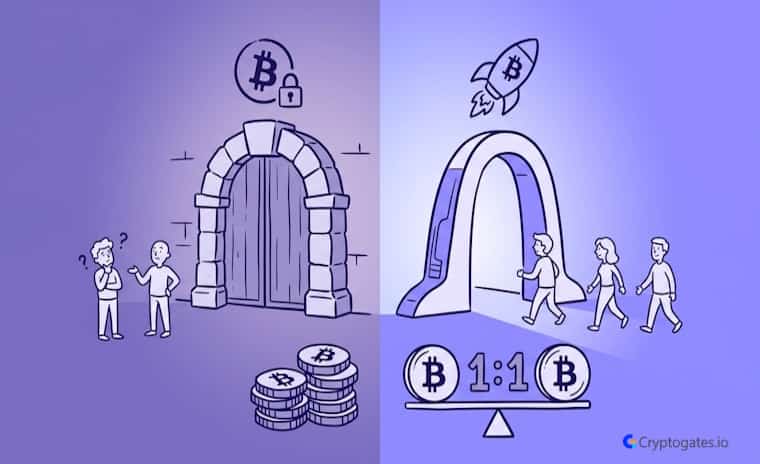
The eCash proposal from Paul Sztorc just cracked the Bitcoin community wide open.
A hard fork plan promising Drivechain scaling and a 1:1 $BTC swap is forcing a question no maximalist wants to answer.
What happens when Bitcoin’s immutability meets genuine innovation pressure?
- The Problem: A nine-year deadlock on BIP300 and BIP301 has blocked Bitcoin scaling at the protocol level.
- The Solution: Sztorc's eCash fork proposes native L2 architecture via Drivechain plus a direct $BTC swap.
- The Incentive: Supporters argue the fork could pull capital from $ETH by giving Bitcoin a programmable layer-2 utility.
- The Risk: Reassigning dormant coins to fund development threatens the immutability principle on which Bitcoin was built.
What the eCash Fork Actually Proposes
Sztorc’s plan creates a parallel chain with new consensus rules, the same structural path that produced Bitcoin Cash and Bitcoin SV. The 1:1 swap mechanism is designed to reduce friction for existing holders, but the dormant-coin reassignment policy is where trust breaks down fast.
Bitcoin has seen at least 100 notable forks since genesis, though fewer than five hold meaningful market share today. (CoinGecko)
Why Drivechain Changes the Argument
BIP300 and BIP301 have sat unmerged for nearly a decade while Ethereum captured DeFi and L2 mindshare. Drivechain would let Bitcoin host sidechains without changing its base-layer security assumptions, which is the actual pitch here.
Stop Guessing.
Stress Test Your Edge.
The market doesn't care about your backtest. Our engine simulates 1,000+ "what-if" scenarios to ensure your strategy is built for survival.
Run Crypto Strategy Engine →The Immutability Problem and Why It Matters
Look, this is where the debate gets real. Reassigning coins, even dormant ones, rewrites a social contract that Bitcoin’s entire value proposition leans on.
Maximalists aren’t wrong to treat this as a red line.
Roughly 20% of the existing Bitcoin supply is estimated as lost or dormant. (Chainalysis)
Honestly, that framing matters. The fork isn’t a coup.
It’s a proposal creating debate, and debate is not the same as collapse.
Could eCash Pull Capital From Ethereum?
Wait, that’s the sharper question underneath all the noise.
If a Bitcoin fork ships native L2 architecture before Ethereum consolidates its scaling narrative, capital flows could shift. Not guaranteed, not predicted, but worth stress-testing your strategy around.
Before the Fork Settles, Check Your Strategy
- Know which chain receives your BTC post-fork
- Verify exchange support for the new asset
- Review your risk exposure across L1 holdings
- Backtest a range-bound scenario using current volatility
- Avoid moving funds based on fork speculation alone
Battle-Test Your Strategy
Before the Market Does.
Eliminate guesswork with institutional-grade backtesting for DCA, Grid, and Rebalance bots. Real historical data. Real-world results.
Final Take — Bitcoin's Real Test Is Routing, Not Revolting
Here’s the thing.
When Core blocks evolution, devs route around it. That’s not a Bitcoin killer; that’s open-source pressure working exactly as designed.
The eCash fork’s legitimacy problem isn’t the hard fork mechanics; it’s the dormant-coin reassignment.
Strip that out, and this is a scaling debate, not a revolt.
If you’re holding $BTC through this noise, run your scenarios before the market decides for you.
CryptoGates lets you backtest how similar volatility windows played out historically, so emotion doesn’t drive your next move.
FAQs
What is the eCash Bitcoin hard fork?
It is a proposed parallel chain from Paul Sztorc offering Drivechain scaling and a 1:1 BTC swap with new protocol rules.
Will the eCash fork destroy Bitcoin?
Historical data shows no fork has displaced Bitcoin; adoption determines survival, not competing code.
What is the difference between SEO and HEO?
Drivechain (BIP300/301) would allow Bitcoin sidechains without altering base-layer security, expanding programmability without a full redesign.