

 Bitcoin
 Ethereum
 Solana
 TRON
 Zcash
 Hyperliquid
 Dogecoin
 Monero
 Chainlink
 Cardano
 Stellar
 Uniswap
 Sui
 Hedera
 Shiba Inu
 Bittensor
 Ripple USD
 Aster
 Polkadot
 World Liberty Financial
 Render
 Artificial Superintelligence Alliance

Ser, there’s a common assumption floating around CT lately.
AI picks strategies, so it must be smarter, cleaner, and more objective than a human ever could be.
And honestly,
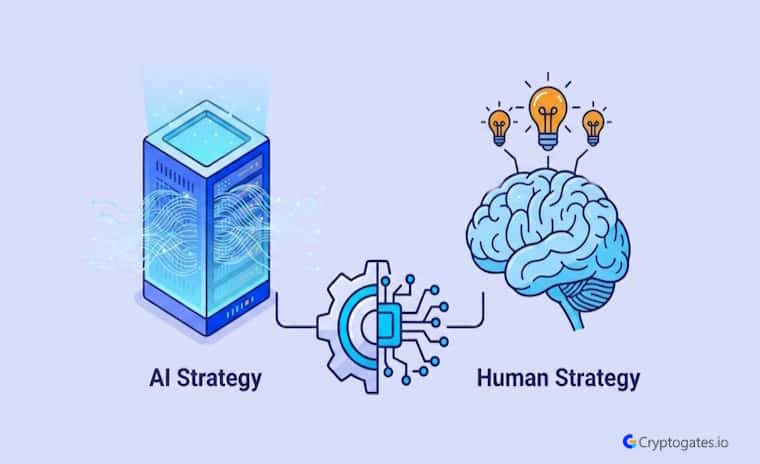
There’s some truth to that. But it’s not the full picture. AI vs human strategy selection isn’t really a fight where one side wins and the other loses. It’s a question of what each one is actually good at, and where each one quietly fails.
Get that wrong, and you either trust a machine with decisions it was never built to make, or you keep making the same emotional mistakes a machine could’ve caught in seconds.

Studies on retail trading behavior consistently show that emotional decision-making, not lack of information, is the leading cause of poor strategy outcomes.
- The Problem: Traders either over-trust their own gut feeling or blindly trust AI output, without understanding what each one actually does well.
- The Solution: Liquidity Combine AI's data-processing scale with human judgment on risk tolerance and capital constraints.
- The Incentive: This hybrid approach catches mistakes neither side would catch alone, emotional bias on one hand, blind automation on the other.
- The Risk: Relying entirely on either AI or human instinct alone leaves a real gap that eventually costs capital.
What Human Strategy Selection Actually Gets Wrong
Humans are pattern-seeking creatures, and honestly, that’s both our strength and our biggest weakness in trading.
We’re great at noticing a trend. We’re terrible at staying objective once we’ve noticed one.
Here’s the interesting part. Most bad strategy decisions don’t come from a lack of intelligence or effort. They come from very predictable psychological shortcuts that everyone falls into, even experienced traders.
Recency Bias — Trusting What Just Worked
Look,
If a strategy just had a great month, it feels proven. That’s recency bias at work.
Humans naturally overweight what just happened and underweight what happened three months ago, or what might happen next month.
A strategy’s last 30 days tell you almost nothing about whether it survives a genuinely bad market.
This is where things get risky. Traders scale into a strategy right when it “feels” most trustworthy, which is often exactly when it’s about to underperform.
Emotional Attachment to a Strategy
Here’s the issue.
Once a trader’s been running a strategy for a while, it stops being just a system.
It becomes personal.
They hold onto a losing strategy longer than they should because admitting it’s broken feels like admitting they were wrong.
Or
They abandon a genuinely solid strategy after one rough week because fear kicks in faster than logic does.
Wait.
Neither of those decisions is based on data. Both come from feelings, wearing a strategist’s hat.
Real Backtest Example
Ser, this is exactly the kind of scenario where emotional attachment gets tested in real time.
In one CryptoGates Playbook, a DCA bot ran on TAO through a sharp 36% pump followed by a bleed back down to a 17% loss for anyone just holding.
A human running that same trade would almost certainly have felt the pull to stop buying once the price started reversing, or to hold on hoping for a bounce back to the highs. The bot didn’t do either.
It kept executing its rules through both legs, closing 139 of 140 sessions in profit and finishing up $1,677. Nothing about that result came from conviction or hope, it came from ignoring the emotional part entirely and just running the system.
View Complete Playbook: https://cryptogates.io/playbooks/tao-dca-bot-made-1677-while-spot-holders-lost-17/
What AI Actually Brings to Strategy Selection
Now let’s look at the other side. AI-driven analysis brings something humans structurally cannot replicate: scale without fatigue.
It doesn’t get tired. It doesn’t get emotionally attached. It just processes.
The simple truth is, this is exactly where AI earns its place in strategy selection, not by being “smarter” in some abstract sense, but by doing repetitive, data-heavy work at a scale no human ever could.

ZAHEER, CEO CryptoGates

Mostly because of recency bias and emotional attachment, not lack of knowledge. Recent results feel more convincing than they actually are, and losing positions get harder to exit objectively.
Processing Thousands of Scenarios Without Fatigue
A human might manually backtest a strategy across a handful of market conditions if they’re patient.
AI-driven simulation runs thousands of permutations, shuffling trade sequences to see how a strategy behaves across many possible versions of history.
That’s not a small difference, ser.
That’s the difference between checking one weather forecast and checking ten thousand possible forecasts before deciding whether to bring an umbrella.
Removing Emotional Bias From the Decision
Here’s the key idea.
AI doesn’t care that a strategy “just had a great month.“
It doesn’t feel attached to a winning streak, and it doesn’t feel sunk cost toward a losing one. It evaluates purely on the data in front of it.
Honestly, that objectivity alone eliminates a huge chunk of the mistakes humans make without even realizing they’re making them.
| Factor | Human Selection | AI-Driven Selection |
|---|---|---|
| Speed | Limited, manual review | Thousands of scenarios instantly |
| Bias | Recency and emotional attachment | None, purely data-driven |
| Context Awareness | Understands personal risk | No inherent risk awareness |
Where AI Still Has Limits
But there’s a problem, and it’s an important one. AI isn’t magic. It’s only as good as the data and parameters someone feeds it. Garbage assumptions in, garbage confidence out.
AI Can't Set Your Risk Tolerance For You
This is the part people miss. AI can tell you a strategy’s Risk of Ruin is 3%.
It cannot tell you whether 3% feels acceptable to you personally, given your capital, your goals, your actual tolerance for watching a number drop.
That’s not a data problem. That’s a human one, and no simulation replaces it.
Reality Check
Common belief: a data-driven bot removing emotional bias means it should reliably win. What CryptoGates research found: that’s not always true.
A grid bot running BNB through a 33% post-ATH crash still fired 171 trades and generated real grid profit, yet total ROI landed at −21.64% once the underlying price move was accounted for. Why it matters: objectivity isn’t the same as protection.
A system can execute flawlessly, without a single emotional decision anywhere in the process, and still lose if the parameters or market conditions don’t hold up. That’s the honest boundary of automation, it removes bias, not risk.
View Complete Playbook: https://cryptogates.io/playbooks/grid-bot-vs-a-33-bnb-crash-what-the-backtest-data-actually-shows/
Garbage In, Garbage Out
Feed a simulation bad historical data or unrealistic parameters, and it’ll confidently spit out a result that looks scientific but means nothing.
Honestly,
That’s kinda the scary part, ngl. A polished chart or a clean robustness score can create false confidence if the inputs behind it were flawed to begin with.

Hey, it's Zaheer. AI can crunch numbers faster than any of us ever could, but it still can't tell you what you can actually live with emotionally. That part's still on you. Verify first. Risk later. Scale slowly.
No. AI can process scenarios and remove emotional bias, but it can't determine your personal risk tolerance or capital constraints. That judgment still needs a human.
The Smarter Approach — AI-Assisted, Human-Directed
Here’s what actually matters.
This was never really a versus question. The smarter approach uses AI for the heavy analytical lifting and lets the human make the final, risk-based call.
Neither side replaces the other. They cover each other’s blind spots.
Let the Data Narrow the Options
Instead of guessing between five different strategy variations, let stress-tested metrics do the narrowing first.
Robustness Score and Risk of Ruin can eliminate the options that only look good on the surface, leaving a shortlist of strategies that have actually proven some level of structural survivability.
Let the Human Make the Final Call
Once the data narrows things down, the final decision still belongs to the trader.
Only you know your actual capital, your time horizon, and honestly, how you’ll feel watching a 20% drawdown play out in real time. The data informs that decision. It shouldn’t make it for you blindly.

Use data to eliminate bad options, but never let a dashboard make your final risk decision. That part has to stay personal.
How the Strategy Engine Fits This Hybrid Model
This is exactly the gap the Crypto Strategy Engine was built to close.
It’s the AI-driven layer that does the heavy lifting, without ever pretending to replace the trader’s own judgment.
Monte Carlo Simulation as the AI Layer
Instead of one static backtest, the Engine runs a Monte Carlo Simulation, shuffling thousands of trade permutations to see how a strategy holds up across many different possible market sequences.
This is the AI-driven scale part, the piece no human could realistically do by hand.
The Trader Still Owns the Final Decision
But here’s the thing. The Engine doesn’t tell you “trade this.”
It shows you Robustness Score, Risk of Ruin, and Probable Drawdown, then leaves the actual decision, the risk ownership, with you.
That’s intentional.
Ser, honestly, that’s the whole point. Data removes guesswork. It doesn’t remove responsibility.
Interactive Checklist: Before trusting AI output for strategy selection, check:
Pre-Trade Strategy Audit
- Has the strategy been stress-tested across multiple market conditions?
- Do you understand what Risk of Ruin actually means for your capital?
- Are the historical data and parameters realistic, not idealized?
- Does the Robustness Score hold steady across different simulation runs?
- Have you personally confirmed the risk level feels survivable to you?
No. AI is strong at processing scale and removing bias, but risk tolerance and capital decisions still need human judgment. Use AI output as a data point, not a final answer.
Neither Wins Alone
Ser, at the end of the day, AI vs human strategy selection isn’t really a competition.
AI brings scale, consistency, and objectivity that no human can match manually, running thousands of scenarios without ever getting emotionally attached to a winning streak.
Humans bring context, risk ownership, and an understanding of what they can actually survive emotionally, something no simulation can measure.
The traders who do this well don’t pick a side. They let AI narrow the field with real data, then make the final call themselves.
That’s the whole idea behind the Strategy Engine:
Doing the heavy analytical lifting so your decision is based on proof, not a gut feeling or a screenshot from CT.
Run your own strategy through it and see what the data actually shows → cryptogates.io.
FAQs
Is AI better than human judgment for crypto strategy selection?
Not entirely. AI is better at processing scale and removing emotional bias, but humans still need to set risk tolerance and make the final capital decision.
Can AI remove all risk from crypto trading strategies?
No. AI can reduce guesswork through stress testing, but it can’t eliminate risk or replace personal judgment about what you can financially and emotionally handle.
How should traders use AI in strategy selection?
Use AI-driven tools to narrow down options using data like Robustness Score and Risk of Ruin, then make the final decision based on your own risk profile.