

 Bitcoin
  Ethereum
  Solana
  TRON
TRON  Zcash
Zcash  Hyperliquid
  Dogecoin
  Monero
  Chainlink
  Cardano
  Stellar
  Uniswap
  Sui
Sui  Hedera
  Bittensor
  Shiba Inu
  Ripple USD
  Polkadot
  Aster
Aster  World Liberty Financial
  Render
  Artificial Superintelligence Alliance
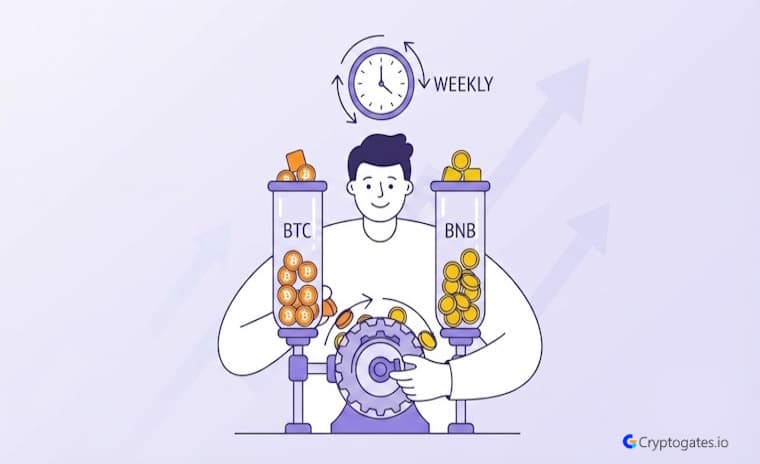
Picture this. BNB is ripping.
Green candles for weeks. Your portfolio feels unstoppable, and honestly, holding just feels right.
But what if you’d rebalanced BNB/BTC every week instead of just letting it ride?

CryptoGates Strategy Lab internal backtesting data
Here’s the interesting part.
Most traders assume rebalancing during a strong trend is a mistake, that you’re just trimming your winners for no reason. But the data tells a more complicated story.
We’re going to walk through the mechanics, the tradeoffs, and what actually happens to your BTC and BNB when you force a reset every seven days.
No hype. Just the process.
- The Problem: Traders don't know whether rebalancing BNB/BTC weekly helps or hurts returns once BNB starts trending hard.
- The Solution: Run a structured, rules-based rebalance and compare it against simple buy-and-hold to see the real tradeoff.
- The Incentive: Understanding this mechanic helps you build a calmer, more systematic crypto portfolio instead of guessing.
- The Risk: Weekly rebalancing can quietly trim your best performer's gains and rack up fees if you're not careful.
BNB and BTC — Why This Pair Makes Sense
BTC and BNB aren’t the same animal, and that’s exactly the point.
BTC moves like the market’s heartbeat. Slower, heavier, and it tends to set the tone for everything else.
BNB moves differently. It’s tied to an entire exchange ecosystem, so its swings often come from utility demand, not just macro sentiment.
Stop Guessing.
Stress Test Your Edge.
The market doesn't care about your backtest. Our engine simulates 1,000+ "what-if" scenarios to ensure your strategy is built for survival.
Run Crypto Strategy Engine →Look, pairing a stability anchor with a higher-beta asset is a classic diversification move, even inside crypto.
The two don’t always move together, and that gap is exactly what a rebalancing strategy tries to exploit.
1. What BTC Brings to the Table
BTC is the benchmark. Most altcoins, including BNB, get measured against it.
It’s less prone to wild single-day swings compared to smaller caps, and it usually holds during broad market stress better than most.
2. What BNB Brings to the Table
BNB has its own drivers: exchange volume, the BNB auto-burn mechanism, and ecosystem activity.
That’s why it can decouple from BTC during certain phases.
When BNB trends, it often trends hard, which is exactly the kind of volatility a rebalance strategy is built to harvest, similar to what played out in our XRP/BNB rebalance bot backtest.
What Weekly Rebalancing Actually Means
Rebalancing sounds technical, but the idea is simple.
You pick a target split, say 50% BNB and 50% BTC, and every week you nudge your portfolio back to that split.
Here’s the key idea. If BNB rallies hard, its share of your portfolio grows past 50%. Rebalancing forces you to sell some of that BNB and buy BTC to reset the balance.
It’s mechanical.
No emotions involved.
Real Backtest Example
Strategy: Rebalance
Pair: XRP / BNB
Market Condition: One asset trending hard, one moving quieter
Objective: Test if a rules-based rebalance captures more value than simply holding both
Over a four-month window, XRP climbed 44.6% while BNB posted a steadier 7.4% gain. A 50/50 rebalance bot, running on just 3 swaps, systematically trimmed XRP into strength and added to BNB on the dips. The result: the bot beat passive HODL by 1.66 percentage points, using minimal trade frequency and no manual intervention.
Expert Interpretation: This mirrors exactly what a BNB/BTC weekly rebalance is designed to do: sell the outperformer in controlled slices rather than all at once, without needing to predict when the trend ends.
1. The Constant-Mix Approach
This is the core method.
You’re not trying to predict tops or bottoms. You just hold a fixed target weight and let the math force trades.
Sell the winner a little, buy the laggard a little, every single reset.

It depends on volatility. Weekly captures more price swings but costs more in fees. Monthly is cheaper but reacts slower to drift.
2. Why Weekly, Not Monthly or Quarterly
Weekly resets react faster to price drift than monthly or quarterly ones.
But there’s a problem.
More frequent rebalancing also means more trades, and more trades mean more fees. Weekly sits in a middle zone, fast enough to capture volatility, but not so fast it drowns in transaction costs.
The Scenario and the Mechanics
Let’s set up the actual test.
This is a hypothetical, backtest-style walkthrough, not live trading advice. Think of it as a lab experiment for your portfolio logic.
| Assumption | Detail |
|---|---|
| Starting Capital | $10,000 |
| Initial Split | 50% BNB / 50% BTC |
| Rebalance Frequency | Every 7 Days |
| Yield or Staking | None Included |
| Style | Simple Spot Holdings Only |
1. Assumptions Behind This Test
We’re keeping this clean on purpose.
No leverage, no staking rewards layered in, nothing that muddies the picture. Just a straightforward split, reset weekly, over a stretch where BNB is clearly outperforming.
2. Step-by-Step Rebalancing Process
Here’s how it actually works, week to week:
You check your portfolio value at the end of the week.
You calculate the current weight of BNB and BTC.
If BNB has grown past its 50% target, you sell a portion of it. Then you use that to buy more BTC, bringing both back to their target split.
3. A Quick Numeric Example
Let’s say you start with $5,000 in BNB and $5,000 in BTC.
Week one, BNB jumps 12% while BTC moves up just 2%. Now BNB sits around $5,600 and BTC around $5,100, so BNB’s share has grown past 52%.
Confused about
market outlook?
Trading without a plan is just gambling. Our strategy architect analyzes your risk tolerance and capital to match you with a proven algorithmic framework.
To rebalance, you’d sell roughly $250 of BNB and add it to BTC, pulling both back toward that 50/50 line. Do that every week, and you’re systematically selling strength and buying weakness inside the pair.
But there’s a catch.
Every one of those trades has a cost. Exchange fees and slippage chip away at the edge, especially during choppy or thin-liquidity weeks.
What Happens During a Strong BNB Uptrend
Now imagine this playing out over a few months of BNB genuinely outperforming BTC. What does weekly rebalancing actually do to your results?
1. Rebalanced Portfolio vs Buy-and-Hold
In a clean, strong uptrend with few pullbacks, rebalancing usually underperforms just holding BNB outright.
You’re literally selling your winner every week, which caps the upside you’d otherwise capture.
DefiLlama historical portfolio data
But here’s the issue.
Markets rarely move in a straight line.
The moment BNB has a rough week or two, that rebalanced portfolio starts looking a lot smarter, because you were already banking gains along the way instead of watching them evaporate on a pullback.
2. What the Backtest-Style Results Suggest
The real answer isn’t “rebalancing wins” or “holding wins.”
It’s that the outcome depends entirely on how bumpy the ride is. Straight-line rockets favor holding. Choppy grinds favor rebalancing.
Not usually in a clean, straight-line uptrend. It tends to trim gains. It performs better when the trend includes regular pullbacks.
Risks, Costs and When This Strategy Fits
Rebalancing sounds clean on paper. Reality adds friction.
Reality Check
Common belief: Rebalancing during a strong uptrend just means selling your winner too early and giving up gains.
What CryptoGates research found: In a separate backtest where one asset surged 27% over 51 days against a slower-moving BTC, a ratio-based rebalance bot ran 22 swaps, locked in $184.24 in profit, and still beat HODL by 1.64%. The trimming didn’t erase the edge; it converted volatility into realized profit while the position kept participating in the rally.
Why it matters: The fear that rebalancing “kills” a trending winner isn’t fully supported by the data. The real cost shows up in fees and reset frequency, not in the mechanic itself. This is the same tradeoff a weekly BNB/BTC rebalance faces during a BNB uptrend.
1. Fees, Taxes and Execution Risk
Every trade is a taxable event in most places under IRS digital asset guidance, and every trade costs something in fees.
Do this weekly for months, and it adds up fast, especially on smaller portfolios where the fee percentage actually matters.

"We don't build strategies around hope. We build them around what the data actually shows, fees included. Verify first. Risk later. Scale slowly." - Zaheer
Unfortunately, there’s also execution risk if you’re using automation.
API failures, exchange downtime, slippage during volatile weeks. None of these are dealbreakers, but they’re real and worth planning for.
2. When It Makes Sense (And When It Doesn't)
This approach tends to shine in choppy, volatile uptrends where BNB doesn’t just go straight up.
It’s less useful in a near-parabolic run with almost no pullbacks, since you’d just be trimming a rocket.
High-fee environments also eat into the edge fast, so it matters where you’re executing these trades.
Proven Setups &
Expert Breakdowns.
We don't just show you the data; we engineer and validate high-performance strategies, providing the "Alpha" behind the numbers.
How to Implement This Yourself
You don’t need to overthink getting started here.
1. Manual Approach
Set a weekly reminder.
Check your exchange portfolio view, calculate your current BNB and BTC weights, and manually place the trades to bring it back to target.
It’s simple, just a bit tedious over time.
2. Automated Approach
Weekly Rebalance Planning Checklist
- Define your target allocation (e.g. 50% BNB / 50% BTC)
- Pick your rebalance frequency
- Estimate trading fees and minimum trade sizes
- Decide how you'll track taxes
- Test the setup on historical data before going live
Honestly, this is where automation earns its keep.
A rules-based rebalance bot removes the emotional part entirely- no second-guessing whether to sell your winner this week, and our crypto rebalancing bot guide walks through the settings and backtesting steps in more depth.
Key Takeaways
Weekly rebalancing BNB/BTC forces a sell-high, buy-low discipline inside the pair.
In a strong BNB uptrend, it usually trims some upside, but it can smooth out the ride when the trend isn’t a straight line. Fees, taxes, and execution matter just as much as the core idea.
The smarter move isn’t guessing which approach wins. It’s testing both on your own numbers first.
Battle-Test Your Strategy
Before the Market Does.
Eliminate guesswork with institutional-grade backtesting for DCA, Grid, and Rebalance bots. Real historical data. Real-world results.
Run your own parameters and see what the data shows using the CryptoGates Rebalance Strategy Backtest Bot.
FAQs
Is weekly rebalancing better than monthly for crypto?
It depends on your priorities. Weekly reacts faster to price swings but costs more in fees over time.
Does rebalancing BNB/BTC increase returns in a strong uptrend?
Usually not in a clean uptrend. It tends to help more when the trend includes regular pullbacks.
Can I automate weekly BNB/BTC rebalancing?
Yes. Rules-based bots can execute the weekly resets automatically, removing the emotional guesswork.