
 Bitcoin
  Ethereum
  Solana
  TRON
TRON  Hyperliquid
  Dogecoin
  Zcash
Zcash  Cardano
  Stellar
  Monero
  Chainlink
  Hedera
  Sui
Sui  Shiba Inu
  Bittensor
  Uniswap
  World Liberty Financial
  Aster
Aster  Ripple USD
  Polkadot
  Render
  Artificial Superintelligence Alliance
Most beginners think a crypto wallet stores their coins.
It doesn’t.
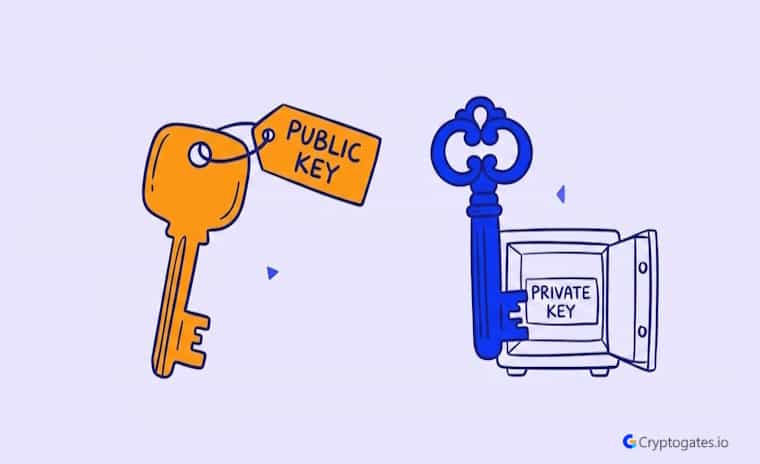
What it actually stores are two things: a public key and a private key.
And the difference between those two things is the difference between receiving crypto safely and losing everything overnight.
Over 3 million Bitcoins are estimated to be permanently lost, mostly due to lost or mismanaged private keys. [Chainalysis]
Here’s what nobody tells you when you first buy crypto.
The exchange handles the keys for you, so you never have to think about them. Then the moment you move to your own wallet, suddenly you’re responsible for something you don’t fully understand.
That knowledge gap is where most beginners make their worst mistakes.
This isn’t complicated once you see how it works.
The concept of public key vs. private key is actually built on a simple idea.
One you share. One you never share. Ever.
- The Problem: Most beginners don't understand the difference between a public key and a private key, leaving them one bad habit away from permanent loss.
- The Solution: Learn exactly what each key does, what to share, what to protect, and how to store your private key in a way that actually holds up.
- The Incentive: Two keys understood correctly means your crypto stays yours. No recovery needed because no mistake was made.
- The Risk: One exposed or lost private key means total, permanent, unrecoverable loss with no support team and no second chance.
What Is a Public Key in Crypto?
Think of your public key as your home address. You can hand it to anyone.
You can post it online. You can send it to a stranger halfway across the world.
None of that puts you at risk. It just tells people where to send crypto.
Your public key is mathematically generated from your private key.
That process only works in one direction. Someone seeing your public key gets zero information about your private key. The math behind it makes sure of that.

Andreas Antonopoulos, "Mastering Bitcoin"
Every wallet address you’ve ever seen is a version of a public key.
Sometimes it gets hashed or shortened for readability, but underneath, it traces back to that same key pair.
How Is a Public Key Generated?
Here’s the interesting part.
Your private key is just a very large random number.
From that number, a mathematical process called elliptic curve cryptography generates your public key.
The process is irreversible. You can run it forward a million times and always get the same public key from the same private key. But you cannot run it backwards.
Not in any practical sense. Not with any computer that exists today.
That one-way property is what makes the whole system work. It lets you prove ownership without revealing the secret itself.
What Can Someone Do With Your Public Key?
Send me crypto. That’s genuinely it.
They can look up your transaction history on a blockchain explorer since all transactions are public.
But they cannot move your funds.
They cannot access your wallet. They cannot do anything that hurts you.
This is why sharing your public key is always safe.
Don’t confuse it with your private key. That confusion is where things go wrong fast.
What Is a Private Key in Crypto?
Your private key is not a password. It’s closer to being the deed to a house.
Whoever holds it owns what’s inside. There’s no “forgot my password” link. No customer support team.
No identity verification process that gets you back in. The private key is the proof of ownership, full stop.
It looks like a long string of random letters and numbers. Unglamorous. Easy to underestimate. But that string controls everything in your wallet.

ZAHEER, CEO CryptoGates
What Happens If You Lose Your Private Key?
Gone. Not temporarily inaccessible.
Not recoverable with enough effort. Gone.
There is no central authority holding a backup copy.
Blockchain doesn’t work that way.
The private key is the only proof the network accepts. Lose it, and the crypto in that wallet becomes permanently unreachable.
It still exists on the blockchain. You just can never move it again.
An estimated 20% of all Bitcoin in existence is considered lost or stranded, largely due to lost private keys and forgotten wallet access. [Chainalysis]
Neutralize Volatility.
Own the Growth.
Access systematic playbooks designed to eliminate emotional bias. From Spot HODL frameworks to advanced Grid simulators.
That number isn’t a scare tactic.
It’s just what happens when millions of people treat a private key the same way they treat a forgotten app password.
What Happens If Someone Else Gets Your Private Key?
They own your wallet now. Not partially.
Completely.
They can transfer every coin out in minutes, and there is nothing you, the exchange, or anyone else can do about it.
Blockchain transactions are final. There’s no fraud department. No chargeback. No dispute process.
This is why how you store your private key matters more than almost any other decision you make in crypto.

Yes. Your public key is designed to be shared. It only allows others to send funds to your wallet. It gives no access to your balance or any ability to move your crypto.
Public Key vs Private Key — The Core Differences
People hear “cryptographic key pair” and assume it’s complex. It’s not.
The relationship between a public key and a private key is actually straightforward once you stop thinking about them as passwords and start thinking about them as roles.
One key has one job. The other key has a completely different job. They were never meant to do the same thing.
Wait…
That’s the part most beginner guides skip over.
They explain what the keys are, but not why they exist as a pair.
The reason is elegant. You need a way to receive funds openly without giving anyone the power to send funds out. Two keys solve that problem cleanly.
| Feature | Public Key | Private Key |
|---|---|---|
| Purpose | Receive crypto | Authorize transactions |
| Safe to share? | Yes | Never |
| Can it be reset? | No | No |
| Generated from | Private key | Random number |
| If lost | Regenerable from the private key | Wallet permanently inaccessible |
The One-Way Street Explained
The math only flows in one direction.
A private key generates a public key.
A public key cannot regenerate a private key.
This is intentional, and it’s the foundation the entire system is built on.
Honestly, you don’t need to understand elliptic curve cryptography to use crypto safely.
But you do need to understand this: the security of your wallet depends entirely on your private key staying private.
The public key can be out in the open without any risk. That asymmetry is the point
“Never store your private key in any form on an internet-connected device. The moment it touches the internet, your risk exposure changes completely.” [Jameson Lopp, Bitcoin Security Researcher]
How Crypto Wallets Use Both Keys Together
Every time you receive crypto, your public key is doing the work.
Every time you send crypto, your private key is doing the work.
They don’t compete. They cooperate.
And that cooperation is what makes trustless transactions possible without a bank sitting in the middle.
Here’s how it actually plays out. Someone sends crypto to your public key address. The transaction gets recorded on the blockchain. When you want to send that crypto somewhere else, your wallet uses your private key to create a digital signature.
That signature proves you authorized the transaction without ever revealing the private key itself.
The network checks the signature against your public key, confirms it matches, and processes the transaction.
Confused about
market outlook?
Trading without a plan is just gambling. Our strategy architect analyzes your risk tolerance and capital to match you with a proven algorithmic framework.
What Is a Seed Phrase and How Does It Relate?
Your seed phrase, sometimes called a recovery phrase, is usually 12 or 24 random words. It feels less intimidating than a raw private key.
But don’t let that fool you. They are functionally the same thing.
Your seed phrase is used to generate your private key.
Whoever has your seed phrase can recreate your private key on any compatible wallet. That means full access. Complete control. Instant.
In a study of crypto theft cases, seed phrase exposure was identified as the leading cause of wallet compromise, ahead of exchange hacks and malware. [CipherTrace]
Hot Wallets vs Cold Wallets — Which Protects Your Private Key Better?
A hot wallet is connected to the internet. That connection is convenient. It's also a permanent attack surface. Your private key lives in a device that touches the web constantly, which means anything that compromises that device can potentially reach your key.
A cold wallet keeps your private key offline. Nothing can remotely access it because it's never online to begin with. This is the trade-off: convenience versus security. For small amounts you actively trade, hot wallets are practical. For anything significant, cold storage is the smarter approach.
Andreas Antonopoulos, "Mastering Bitcoin"
What Is a Hardware Wallet?
A hardware wallet is a small physical device, roughly the size of a USB drive.
It stores your private key inside the device itself and never exposes it to your computer or the internet, even when you plug it in to sign a transaction. The signing happens inside the device. Your private key never leaves it.
This is considered the strongest form of private key protection available to everyday crypto users without running a full air-gapped setup.
If you lose your private key and don't have your seed phrase, access to that wallet is permanently gone. The crypto remains on the blockchain but becomes completely unreachable with no recovery option available.
Common Beginner Mistakes That Put Private Keys at Risk
Most people don’t lose their private key to a sophisticated hack.
They lose it to something embarrassingly simple. A screenshot was saved to cloud storage.
A note in their email drafts—a photo taken on a phone that later gets backed up automatically to a shared account.
The threat isn’t always a hacker in a dark room. Sometimes it’s just a bad habit.
Private Key Safety Checklist
- Never screenshot your seed phrase or private key
- Never store your private key in email, notes apps, or cloud storage
- Never enter your seed phrase on any website or app that requests it
- Always write your seed phrase on paper and store it physically
- Never share your private key or seed phrase with anyone, including support staff
Here’s the issue.
When you first set up a wallet, everything happens fast.
The seed phrase appears on screen, and you’re in a hurry. So you screenshot it.
Or you type it into a notes app. Or you email it to yourself “just temporarily.” That temporary decision becomes permanent exposure.
Why "I'll Remember It" Is Not a Strategy
Look. Memory is not a backup system.
People forget.
People get sick. People die. And when that happens, the crypto in that wallet disappears with them.
This is actually one of the quieter tragedies in crypto.
Families are left with wallets they can’t access. Funds that exist but can never be reached.
It’s not a corner case either. It happens more than most people realize.
How To Store Your Private Key Safely
Offline is the default safe assumption.
If your private key exists anywhere that connects to the internet, the risk is real, regardless of how strong your password is or how reputable the platform is.
This isn’t paranoia. It’s just how the threat model works.
Over 70% of crypto theft incidents involve keys or seed phrases that were stored digitally on internet-connected devices. [CipherTrace]
Proven Setups &
Expert Breakdowns.
We don't just show you the data; we engineer and validate high-performance strategies, providing the "Alpha" behind the numbers.
The good news is that safe storage doesn’t require technical expertise. It requires discipline and a small amount of physical effort.
Should You Use a Password Manager for Your Private Key?
It’s better than a plain text file on your desktop. That part is true.
A good password manager encrypts your data and requires authentication to access it. But password managers are built for passwords, not cryptographic keys.
They are internet-connected by design. They can be compromised if your master password is weak or if the service itself gets breached.
For small amounts or as a secondary backup, a password manager is acceptable. For anything significant, it shouldn’t be your only or primary storage method.
When you’re ready to choose an exchange with strong custody options and security infrastructure, CryptoGates’ Exchange Picker helps you compare platforms based on real security criteria rather than marketing claims.
The Simplest Safe Storage Method Most Beginners Ignore
Write it down.
By hand. On paper.
Then store that paper in two separate physical locations.
Not in the same house. Not in the same bag. Two different places that would survive different types of loss events.
Here’s the thing. This advice sounds almost insultingly simple. But the number of people who actually do it consistently is surprisingly small.
Everyone assumes they’ll do something more sophisticated later. Later usually doesn’t come until something goes wrong.

"Two physical copies in two separate locations is not overkill. It's the minimum viable backup strategy for anyone serious about protecting their crypto."
Keep the Keys, Keep the Crypto
Two keys. Two jobs. One rule that never changes.
Your public key is shared with the world. Your private key never leaves your control.
That’s the entire system in two sentences. Everything else is just detail around that core idea.
Most beginners spend time worrying about which coin to buy or when to enter a trade.
The smarter move is to get the basics right first. Understand what you’re actually holding. Understand what protects it.
Because no trading strategy matters if the wallet holding your funds isn’t secure.
Not sure which
exchange fits you?
Bypass the marketing hype. Our matrix cross-references your profile against 50+ institutional metrics—including Proof-of-Reserves and Slippage Models.
If you’re choosing where to trade or custody your crypto, start with the right exchange.
CryptoGates’ Exchange Picker compares platforms across security, fees, and features so you’re not making that decision blind.
FAQs
Can someone hack my wallet using only my public key?
A public key only allows others to send crypto to your wallet. It gives no access to your funds and cannot be used to authorise any outgoing transaction.
What is the difference between a private key and a seed phrase?
A seed phrase generates your private key. They are functionally equivalent in terms of access. Anyone with your seed phrase can recreate your private key and take full control of your wallet.
What is the safest way to store a private key for beginners?
Write it down by hand on paper and store two physical copies in two separate locations. Never store it digitally on any internet-connected device.