

 Bitcoin
  Ethereum
  Solana
  TRON
TRON  Zcash
Zcash  Hyperliquid
  Dogecoin
  Monero
  Chainlink
  Cardano
  Stellar
  Uniswap
  Sui
Sui  Hedera
  Bittensor
  Shiba Inu
  Ripple USD
  Polkadot
  Aster
Aster  World Liberty Financial
  Render
  Artificial Superintelligence Alliance
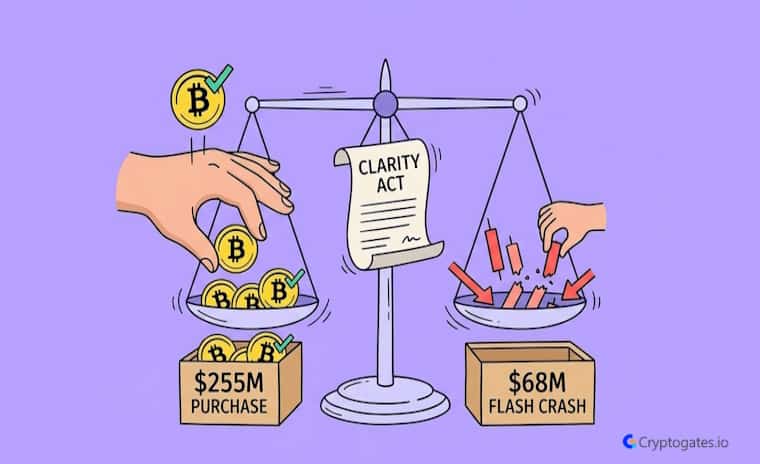
Institutions are going all-in on Bitcoin while the charts are flashing red.
A $255M purchase, a surprise flash crash, and a regulatory bill moving fast — all in the same week.
Look, the market is sending mixed signals, and most traders are only reading half of them.
- The Problem: Retail optimism is masking serious technical warnings beneath the surface.
- The Solution: Regulatory clarity through the Clarity Act may stabilize long-term DeFi and stablecoin markets.
- The Incentive: Institutional Bitcoin accumulation continues, signaling strong conviction at current levels.
- The Risk: A single flash crash wiped $68M in longs, proving fragility is real and present.
Michael Saylor's $255M Bitcoin Bet and What It Actually Means
Strategy’s latest Bitcoin purchase brings its holdings to a scale most retail traders can’t conceptualize.
Honestly, when institutions buy this consistently, it stops being news and starts being a pattern worth studying.
Strategy now holds over 553,000 BTC, representing roughly 2.6% of total supply. (Strategy IR)
Battle-Test Your Strategy
Before the Market Does.
Eliminate guesswork with institutional-grade backtesting for DCA, Grid, and Rebalance bots. Real historical data. Real-world results.
Is Institutional Buying a Signal or Just Noise?
Institutional flows don’t guarantee short-term price movement, but they do compress available supply over time.
The signal is real. The timing, though, is never guaranteed.

Not immediately. Large buys reduce circulating supply, but market sentiment, leverage, and macro conditions still drive short-term price action.
The Clarity Act — Regulatory Progress That Actually Matters
Stablecoin and DeFi regulation is moving through the legislative process faster than most expected.
Here’s the thing: regulatory clarity historically reduces uncertainty premiums priced into crypto assets.
The Clarity Act would cover an estimated $230B+ stablecoin market currently operating in a legal gray zone. (Coin Center)
Flash Crash Liquidates $68M — The Fragility Nobody Wants to Talk About
Sixty-eight million dollars in long positions were wiped out in minutes.
That’s not a glitch; that’s the market showing exactly how thin the order books really are under pressure.
Jake Chervinsky, Blockchain Association.
Before Your Next Long Position
- Check open interest vs price divergence
- Confirm volume supports the move
- Set a hard stop, not a mental one
- Reduce position size in low-liquidity windows
- Backtest the entry setup first
Stop Guessing.
Stress Test Your Edge.
The market doesn't care about your backtest. Our engine simulates 1,000+ "what-if" scenarios to ensure your strategy is built for survival.
Run Crypto Strategy Engine →Ethereum Stagnation and the ETF Inflow Paradox
ETH ETFs are pulling in capital while the price sits flat — wait, shouldn’t those two things move together?
Not necessarily. Structural demand and spot price can disconnect for weeks before reconciling.
ETH Signal Snapshot
| Signal | Status | Implication |
|---|---|---|
| ETF Inflows | Positive | Long-term accumulation |
| Price Action | Flat/Bearish | Short-term pressure |
| Analyst Sentiment | Cautious | Divergence watch |
Final Read — Don't Let the Noise Pick Your Strategy
Bullish institutions, bearish technicals, regulatory hope, and flash crashes all coexist.
This isn’t confusion; it’s a normal, complex market.
Build a strategy that survives both sides, backtest it against conditions like these using CryptoGates’ Strategy Engine, and stop reacting to headlines alone.
FAQs
What is driving Bitcoin institutional accumulation right now?
Firms like Strategy view Bitcoin as a long-term treasury asset, buying consistently regardless of short-term price swings.
How does the Clarity Act affect DeFi and stablecoin users?
It would establish legal definitions and compliance frameworks, reducing the regulatory uncertainty that currently limits institutional DeFi participation.
Can flash crashes be anticipated or avoided?
Not predicted, but position sizing, stop-losses, and avoiding high-leverage entries during low-liquidity periods significantly reduce exposure.