

 Bitcoin
  Ethereum
  Solana
  TRON
TRON  Zcash
Zcash  Hyperliquid
  Dogecoin
  Monero
  Chainlink
  Cardano
  Stellar
  Uniswap
  Sui
Sui  Hedera
  Bittensor
  Shiba Inu
  Ripple USD
  Polkadot
  Aster
Aster  World Liberty Financial
  Render
  Artificial Superintelligence Alliance
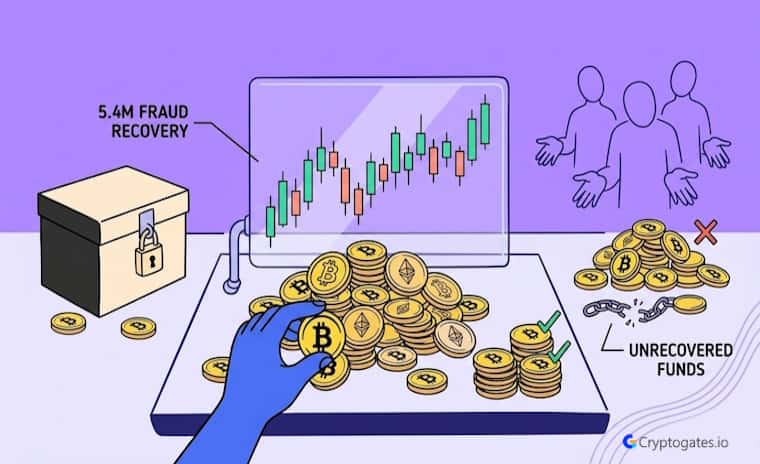
A state attorney general just recovered $5.4 million from crypto fraudsters who specifically hunted older investors.
That’s not a small number. And it’s not an isolated case.
Over $1 billion in crypto fraud losses were reported by people over 60 in a single recent period. FTC Consumer Sentinel Network
- The Problem: Crypto scammers are running coordinated campaigns against older, less tech-familiar investors with devastating results.
- The Solution: A state-level legal recovery action clawed back $5.4 million from active fraud operations.
- The Incentive: Authorities are getting better at tracing and recovering stolen crypto funds.
- The Risk: Most victims never see their money again, and recoveries like this remain rare.
How the $5.4 Million Crypto Fraud Recovery Happened
The attorney general’s office traced the funds through multiple wallet addresses and fake platform operators.
It wasn’t quick.
It took coordinated legal action, blockchain forensics, and victim testimonies to build the case.
That’s what a real recovery actually looks like behind the headlines.
Who Was Targeted and How
Look, this wasn’t random.
Scammers picked their targets deliberately.
Older investors were approached through fake investment platforms, romance-based trust building, and impersonation of real financial firms.
Adults over 60 filed more fraud complaints than any other age group in crypto-related cases. FBI Internet Crime Complaint Center (IC3)
The per-victim losses were also higher.
Not because older investors are careless.
Because the scams were designed specifically around their trust patterns.
The Tactics Scammers Used
The most common method was pig butchering.
That’s where a scammer builds a relationship over weeks, sometimes months, before introducing a “can’t miss” crypto opportunity.
By the time the victim realizes something’s wrong, the money is gone.
Wait, actually, it’s not always that slow.
Some victims reported losing funds within days of first contact. The timeline varies, but the outcome doesn’t.
Stop Guessing.
Stress Test Your Edge.
The market doesn't care about your backtest. Our engine simulates 1,000+ "what-if" scenarios to ensure your strategy is built for survival.
Run Crypto Strategy Engine →
Older investors often hold more savings, respond to trust-based pitches, and are less likely to report losses out of embarrassment.
Roughly 9 out of 10 victims never reported the fraud at all.
That’s the real problem here.
Before putting a single dollar into any platform, run it through CryptoGates’ scam verification tool.
It takes two minutes and can save you everything.
What a Crypto Fraud Recovery Actually Means for Victims
Honestly, $5.4 million sounds like a win.
And it is.
But let’s put it in context.
Less than 25% of crypto fraud losses are ever successfully recovered after theft. Chainalysis Crypto Crime Report
That means most victims get nothing back.
The recovery here is significant because it happened at all, not because it’s the norm.
Legal systems are still catching up to how fast crypto moves.
5 Signs You're Being Targeted by a Crypto Scam
- Someone you met online introduces a "private" investment platform
- Returns are guaranteed or shown as already happening in your account
- You're asked to recruit others to unlock your own withdrawal
- Withdrawing funds suddenly requires an extra "fee" or "tax."
- The platform has no verifiable registration or public audit history
Here’s the issue.
Even when funds are recovered, distribution to victims is slow, partial, and legally complex.
Getting $5.4 million back into the hands of the people it was stolen from takes time.
Battle-Test Your Strategy
Before the Market Does.
Eliminate guesswork with institutional-grade backtesting for DCA, Grid, and Rebalance bots. Real historical data. Real-world results.
Verify First. Always.
Crypto fraud recovery at this scale makes headlines.
But for every recovery, thousands of victims never get their money back.
The system works slowly. Scammers move fast.
Your job is to make sure you’re never the one waiting on a recovery that may never come.
Use CryptoGates’ tools to check platforms and test strategies before any real money moves.
FAQs
How can I check if a crypto platform is legitimate before investing?
Look for verifiable registration and independent audits, and test it with CryptoGate’s scam check tool before depositing anything.
What should I do if I think I've already been scammed in crypto?
Stop all transfers immediately, document everything, and report to your local financial regulator and cybercrime authority.
How much of stolen crypto actually gets recovered by authorities?
Less than 25% of crypto fraud losses are recovered, making prevention far more reliable than waiting on legal action.