
 Bitcoin
  Ethereum
  Solana
  TRON
TRON  Hyperliquid
  Dogecoin
  Zcash
Zcash  Cardano
  Stellar
  Monero
  Chainlink
  Hedera
  Sui
Sui  Shiba Inu
  Bittensor
  Uniswap
  World Liberty Financial
  Aster
Aster  Ripple USD
  Polkadot
  Render
  Artificial Superintelligence Alliance
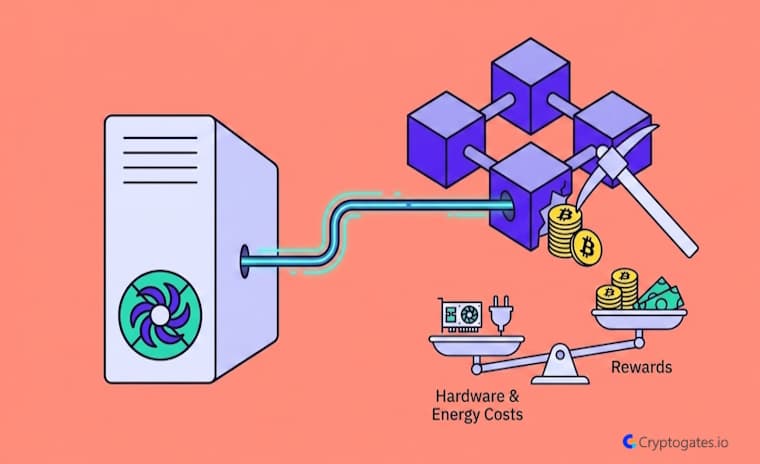
You’ve heard people say they “mine crypto from home.”
Some show off screenshots of earnings. Others quietly sold their rigs six months later.
So what’s actually going on, and is there still a real opportunity here?
- The Problem: 70-90% of beginners buy mining hardware before running a single number and burn money on electricity bills with zero returns.
- The Solution: Understanding how mining works, hardware types, pool vs solo, and coin selection before spending anything.
- The Incentive: Miners who calculate first and invest later can still earn consistent, real income from crypto mining in 2026.
- The Risk: Electricity costs, hardware depreciation, and market volatility can flip a profitable setup into a loss, fast.
Bitcoin’s global mining network consumes an estimated 120 to 150 terawatt-hours of electricity per year, more than many mid-sized countries use in the same period. Cambridge Centre for Alternative Finance (CCAF)
What Crypto Mining Actually Is
Forget the technical jargon for a second. Think of the blockchain as a public notebook.
Every Bitcoin transaction ever made is written in that notebook, permanently, in order. But someone has to write each new page. That’s what miners do.

Most people ask us whether they should mine. We always say the same thing: don't ask us, ask your electricity bill. The numbers either work or they don't. No amount of excitement changes that math.
When you send Bitcoin to someone, that transaction doesn’t confirm itself.
It joins a queue of thousands of other pending transactions.
Miners pick up that queue, bundle everything into a block, and then compete to solve a complex math puzzle.
First one to solve it gets to write that block into the blockchain permanently. As payment for doing that work, they receive newly created coins.
No miners, no confirmed transactions.
It’s that simple.
Mining isn’t a side hustle bolted onto crypto; it’s the engine that makes the whole thing run.
How the Mining Process Works Step by Step
Your mining hardware runs software that generates billions of guesses per second, trying to find a specific number called a hash.
The puzzle isn’t solvable by thinking; it’s only solvable by trying combinations at incredible speed until someone gets lucky.

Nic Carter, Crypto Researcher and Partner at Castle Island Ventures
The more computing power you have, the more guesses you make per second, the better your odds.
When someone wins and adds a new block, the network automatically recalibrates the puzzle difficulty. Too many miners joining?
Difficulty goes up. Miners dropping off?
Difficulty eases. This keeps the pace of new blocks consistent, roughly one every ten minutes for Bitcoin.
The reward for winning a block is new Bitcoin, freshly created. That’s how new coins enter circulation. There’s no central bank printing money. Just math, competition, and electricity.
Stop Guessing.
Stress Test Your Edge.
The market doesn't care about your backtest. Our engine simulates 1,000+ "what-if" scenarios to ensure your strategy is built for survival.
Run Crypto Strategy Engine →The Different Types of Mining Hardware
Your hardware choice shapes everything: your costs, your earning potential, and which coins you can realistically mine.
1. CPU Mining
CPU Mining uses your regular computer processor.
In Bitcoin’s earliest days, this actually worked. Today, it’s basically useless for anything competitive.
The only real exception is Monero, a privacy coin whose algorithm was deliberately designed to resist specialized chips and stay accessible to regular computers.

"Mining is the mechanism by which bitcoin's security is decentralized."
Andreas M. Antonopoulos, Mastering Bitcoin
2. GPU Mining
GPU Mining uses graphics cards, the same ones gamers use.
They’re far more powerful than CPUs for mining math. A decent GPU rig can still mine several altcoins profitably, especially coins with lower network difficulty.
The downside is electricity consumption. These rigs run hot, loud, and expensive around the clock.
3. ASIC Mining
ASIC Mining is an entirely different category. These are chips built for one single purpose: mining a specific algorithm as fast as physically possible.
They’re not computers you can use for anything else. They’re mining machines, full stop.

Not practically. A laptop's CPU and GPU are too weak, and the heat damage alone makes it a losing trade from day one.
Bitcoin ASIC miners today operate at speeds that would’ve seemed science fiction just five years ago.
They’re also expensive, noisy, and generate serious heat.
Large operations build entire facilities around cooling them.
4. Cloud Mining
Cloud Mining means you pay a company to mine on your behalf.
You rent their hashing power and receive a share of the rewards. No hardware to buy, no electricity bills in your name. Sounds ideal.
The problem is that cloud mining has been home to more scams than almost any other corner of crypto.
If you explore this route, the vetting process needs to be extremely serious before any money changes hands.
| Hardware Type | Best For | Difficulty in Starting |
|---|---|---|
| CPU | Monero only | Low |
| GPU | Altcoins, mid-range | Medium |
| ASIC | Bitcoin | High |
| Cloud Mining | Hands-off (risky) | Low (but verify hard) |
Solo Mining vs. Pool Mining
Every block has a unique "fingerprint" called a hash. If you change one digit inside, the fingerprint changes entirely.
Everyone combines their computing power and shares the reward. Your cut is smaller, but payouts are consistent instead of once-in-a-decade lucky.
For anyone starting, pools are the sensible path. The largest pools control significant portions of Bitcoin’s total hash rate.
Andreas Antonopoulos, Bitcoin Educator and Author of Mastering Bitcoin
What Coins Can You Mine?
Bitcoin is the benchmark everyone thinks of, but it’s not the only option, and for many home miners, it’s not the right starting point.
There's no single answer. Profitability shifts with coin price, network difficulty, and your electricity cost. Use a mining calculator with your real numbers every time before deciding.
Ethereum is no longer mineable.
It switched to Proof of Stake in 2022, removing mining from the equation entirely.
That freed up an enormous amount of GPU hardware and reshaped the altcoin mining landscape.
Monero remains one of the most accessible coins for CPU and entry-level GPU miners.
Its algorithm actively resists ASIC dominance, which keeps individual miners genuinely competitive.
Rarely, without very cheap electricity and efficient ASIC hardware. Most small miners find better results with lower-difficulty altcoins or joining a strong pool.
Litecoin, Ravencoin, Kaspa, and Ethereum Classic all have active mining communities with lower barriers to entry than Bitcoin.
The right coin for you depends on your hardware, your electricity cost, and the current difficulty of each network.
There’s no universal answer, only the answer your specific numbers produce.
Battle-Test Your Strategy
Before the Market Does.
Eliminate guesswork with institutional-grade backtesting for DCA, Grid, and Rebalance bots. Real historical data. Real-world results.
Is Crypto Mining Actually Profitable ?
Here’s the honest version nobody selling mining courses will tell you: it depends entirely on four things. Your hardware’s efficiency. Your electricity cost per kilowatt-hour.
The current network difficulty of whatever you’re mining. And the price of that coin.
Electricity is the one that kills most home operations. Large mining farms specifically locate themselves near cheap power sources, hydroelectric dams, solar farms, and regions with subsidized industrial rates.
Miners paying above $0.10 per kilowatt-hour frequently operate at break-even or at a loss during periods of low coin prices, while industrial miners at $0.03 to $0.05 per kWh maintain consistent margins. Braiins Mining Insights
Hardware cost is the second reality check.
A quality ASIC miner for Bitcoin costs thousands of dollars upfront.
GPU rigs aren’t cheap either.
The break-even timeline under favorable conditions is typically many months.
Under unfavorable conditions, a price drop, a difficulty spike, or a new generation of more efficient hardware, that timeline extends or disappears entirely.
None of this means mining isn’t worth exploring. It means exploring it requires real math, not YouTube thumbnails.
Proven Setups &
Expert Breakdowns.
We don't just show you the data; we engineer and validate high-performance strategies, providing the "Alpha" behind the numbers.
Calculate Before You Commit Every Single Time
The biggest mistake beginner miners make is buying hardware before running the numbers.
Don’t do it. Ever.
Before you spend a single rupee or dollar, you need to know your hardware’s hash rate, your exact electricity cost, the current network difficulty, the block reward, and pool fees. Put those numbers into a profitability calculator and let the result tell you what to do, not your excitement about the technology.
Before you buy any mining hardware, check these five things:
- I know my exact electricity cost per kilowatt-hour
- I've looked up my hardware's hash rate and power draw
- I've run my numbers in a profitability calculator
- I've compared at least two to three coins, not just Bitcoin
- I've calculated my break-even timeline under the current difficulty
This is where CryptoGates.io’s Backtesting Lab and Monte Carlo Simulator matter.
You can stress-test scenarios across five years of real historical data and run over a thousand what-if simulations before risking actual capital.
The whole point of tools like these is to answer the question “Will this work?” before you find out the hard way that it didn’t.
Verify first. Risk later.
Calculate Your Swaps
Seamlessly bridge your assets with our lightning-fast conversion engine. Get the best rates across 500+ pairs with zero hidden fees.
The Risks That Don't Get Enough Attention
Hardware failure is real. Mining rigs run at full load, non-stop.
That’s stress on components, cooling systems, and your electrical setup. Poor cooling shortens hardware life significantly. Factor in the cost of maintenance and occasional replacement; it’s not zero.
Tax treatment catches people off guard. In most jurisdictions, mined coins are treated as income at the moment they’re received, valued at market price on that day.
What the price does afterward doesn’t change what you owed when you mined. Keep detailed records from day one.
Market timing risk is the one nobody can predict. Mining profitability can flip fast. A sharp price drop combined with a difficulty increase can turn a profitable operation into one that’s hemorrhaging money monthly.
The miners who survive long-term treat it like a business with proper cost analysis, contingency planning, and no emotional attachment to sunk hardware costs.
Neutralize Volatility.
Own the Growth.
Access systematic playbooks designed to eliminate emotional bias. From Spot HODL frameworks to advanced Grid simulators.
Where to Go From Here
Crypto mining is still real. It still works. It still pays for the people who approach it like operators, not speculators.
If you’ve got access to cheap electricity, a hardware budget you can genuinely afford to lose, and the patience to learn the mechanics properly, it’s worth exploring seriously.
If you’re chasing a shortcut to passive income without doing the math first, the industry will teach you an expensive lesson.
Start with the numbers. Run them on CryptoGates.io.
Let the data tell you whether your specific situation makes sense before your money decides for you.
What happens to Bitcoin mining when all coins are mined?
Once all 21 million Bitcoins are mined, miners will earn only through transaction fees. The idea is that fee volume by then will keep mining economically viable.
Do I need to pay tax on mined cryptocurrency?
In most countries, mined coins count as income the day you receive them, valued at that day’s market price. Keep detailed records from day one and consult a local tax professional.
Is crypto mining still profitable?
It can be, but only if your electricity cost is low and your hardware is efficient. Run your real numbers first. Excitement doesn’t pay the electricity bill.