

 Bitcoin
 Ethereum
 Solana
 TRON
 Hyperliquid
 Zcash
 Monero
 Dogecoin
 Chainlink
 Cardano
 Stellar
 Ripple USD
 Uniswap
 Sui
 Hedera
 Bittensor
 Shiba Inu
 World Liberty Financial
 Aster
 Polkadot
 Render
 Artificial Superintelligence Alliance

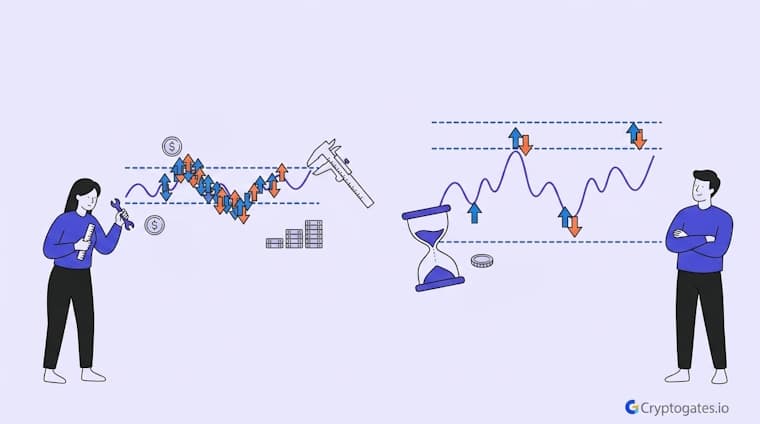
You set the bot to 50/50, picked your coins, and hit start.
Then one number you barely thought about ended up deciding most of the result.
That number is your crypto rebalance threshold. Most traders pick it by gut, copy it from a CT thread, or leave the default on.
And that’s where the quiet damage happens: fees stack up, winners get sold early, and the bot looks busy while the account goes nowhere.
Source: Bank for International Settlements
So how does one setting do all that?
Let’s break it down.
- The Problem: Most traders set their rebalance trigger by feel, so the bot either overtrades or sits idle at the wrong moments.
- The Solution: Treat the threshold as a strategy decision and test several settings on the same data before going live.
- The Incentive: Fewer wasted swaps, lower fee drag, and a rebalancing plan you can actually explain.
- The Risk: A wide band can leave one coin overweight for weeks, and a single backtest never guarantees what comes next.
What Is a Crypto Rebalance Threshold (and Why It Matters More Than the Coins)
Think of it as a leash.
Your target weights say where the portfolio should sit, and the threshold says how far it can wander before the rebalancing bot pulls it back.
Set a 50/50 pair with a 5% band, and the bot only acts when one side drifts past that gap.
That’s it.
But this tiny rule shapes how often you trade, what you pay, and which moves you capture.
| Trigger Type | What Fires the Swap | Best Fit |
|---|---|---|
| Ratio threshold | Weights drift past your set gap | Volatile or divergent pairs |
| Time-based | A fixed schedule, like weekly | Calm, slow-drifting pairs |
| Combined | Schedule plus a drift limit | Hands-off setups that want regular resets |
| No trigger (HODL) | Nothing, ever | Benchmark comparison only |
Strategy architecture beats coin selection, and the trigger is a big piece of that architecture.
1. How Ratio-Based Triggers Work in a Rebalancing Bot
Say you hold two coins at equal weight.
One climbs, so it now makes up more of the portfolio than you planned.
When its share crosses your threshold, the bot sells a slice of the winner and buys the laggard, which rebalances the portfolio back to target.
Real Backtest Example
Strategy: Rebalance bot, 5% ratio threshold
Coin: ENA vs ASTER (dual-asset)
Market Condition: A bearish quarter for two freshly listed coins. Neither side offered a lasting winner to rotate into.
Objective: Test whether a moderate band could protect capital when both assets were falling.
Key Result: The 5% threshold kept the bot from reacting to every small wobble, and it finished with smaller losses than passive holding.
Expert Interpretation: A band doesn’t need to be tight to be useful. In a falling pair, a moderate threshold limited the number of swaps and kept the bot from chasing noise, so the setting did more work than the trade count.
🔗 Rebalance Bot Backtest: ENA vs ASTER in a Dual-Asset Bearish Market
Here’s the interesting part.
The bot doesn’t predict anything.
It reacts to drift.
No staring at charts, no guessing the top, no panic sell when CT turns bearish. It sold strength and bought weakness because the rule said so, and that’s why you can test it.
Same rule, same data, same answer.
2. Threshold vs Time-Based Rebalancing
A calendar trigger sounds safer.
Actually, “safer” is the wrong word, it’s just more predictable.
The bot resets every Friday whether the market did, well, nothing.
Reality Check
Strategy: 50/50 rebalance bot, three threshold variants
Coin: ETH vs BTC (August 2025)
Market Condition: One-sided divergence. ETH rose 24% while BTC fell 7%.
Common belief: A more active rebalancer captures more of the swings.
Key Result: The bot made 249 swaps against the trend, selling the rising coin and adding to the falling one. Two of the three variants lost money. The one that held up barely traded.
Expert Interpretation: When one asset runs, a tight band keeps trimming the leader. Fewer triggers protected the result more than faster reactions did.
🔗 One Asset Soared. One Collapsed. Our Rebalance Bot Picked the Wrong Side 249 Times
Look, that’s the catch in chop.
A schedule can force swaps when weights barely moved, and you pay fees for a reset that wasn’t needed. A threshold stays quiet until price gives it a reason.
Mix both and you’ll get more trades, which means more fees. Sometimes that’s worth it. More often than not, it isn’t.
Tight vs Wide Thresholds: The Trade-Off Nobody Explains
Every threshold is a bet on how fast you want the bot to react.
Tight bands act on small drifts. Wide bands wait for big ones.

I’ve watched traders tweak a bot every other day because it felt too quiet. Quiet isn’t broken. Test the setting, trust the data, and let the rule do its job. Slow and steady still compounds. Zaheer
Neither is “right.” Each one trades speed for patience, and the market decides which one gets paid.
1. Why Tight Thresholds Can Sell Winners Too Early
Picture one coin ripping while the other just chops sideways.
A tight band trims the runner at the first small drift. Then again.
Then again.
Each trim feels responsible.
But every slice you sell is a slice that stops running with the trend, and you’re parking it in a coin that isn’t moving. Paper hands in a bot costume, basically.
Proven Setups &
Expert Breakdowns.
We don't just show you the data; we engineer and validate high-performance strategies, providing the "Alpha" behind the numbers.
In our own rebalance trigger backtests, the tightest setting traded the most and finished behind the wider ones.
Not by a landslide, but the direction was clear.
Speed wasn’t the fix.
Patience was.
2. Fee Drag: The Quiet Cost of Frequent Rebalancing
Here’s the thing about fees.
Each swap costs a little, so nobody notices.
Then the trade count climbs, and a degen-level number of tiny swaps adds up to real money, give or take a few hundred trades over a long run.
Wait, that sounds like fees are the villain.
They’re not, or not the main one.
When Fees Matter Less Than Timing
On most exchanges the maker and taker fees per swap are small enough that a handful of rebalances barely register.
Where it hurts is when a tight band forces dozens of swaps in choppy conditions, because then the fee bill grows and the exit timing gets worse at the same time.

There’s no single best number. A wider band usually suits volatile pairs, while a tighter band suits calmer ones. Backtest a few on your own pair before going live.
So the real leak is selling too soon.
Fees just make it hurt a little more.
And if the trigger fires, the winner keeps running, and you’ve already paid to…well, you see where that goes.
How Divergent Markets Change the Threshold Decision
Pairs don’t always move together.
Sometimes one coin sprints while the other goes nowhere, and that gap is exactly what a rebalancing bot feeds on.
Source: CoinShares Research
So the best band depends on what kind of gap shows up.
That’s where most traders guess instead of checking.
1. Spike-and-Reversal Pairs vs One-Way Trends
Picture a coin that rips for weeks, then gives most of it back.
A wider band can trim near the top, then buy the dip when the reversal comes.
That’s rotation done by rule, not by FOMO.
Stop Guessing.
Stress Test Your Edge.
The market doesn't care about your backtest. Our engine simulates 1,000+ "what-if" scenarios to ensure your strategy is built for survival.
Run Crypto Strategy Engine →Now flip it.
If the coin just keeps climbing with no pullback, the bot trims, finds nothing to buy back, and can lag plain HODL.
Honestly, that’s the part nobody puts in the thumbnail. Rebalancing needs a reversal to pay.
2. Reading Market Conditions Before You Pick a Band
Three things matter most.
Volatility, how closely the two assets move together, and how far apart they’ve drifted lately.
Sometimes. It tends to help when assets swing and reverse, and it can lag in one-way trends. Backtest your pair first.
Here’s a quick example.
If your pair hasn’t moved apart by a fifth or so recently, a wide band may barely fire, and you’ll track HODL closely.
If it swings hard, a tight band can overreact to every wobble.
Zoom out for a second.
Markets don’t move in straight lines, and your trigger shouldn’t assume they will.
How to Choose and Test Your Rebalance Threshold Before Risking Capital
Picking a number is easy. Proving it is the real work.
Pre-Trade Strategy Audit
- Pick one pair and one date range, then keep both fixed.
- Run at least three thresholds, changing nothing else.
- Compare trade count, total fees, and result against plain HODL.
- Check how long one coin stayed overweight between swaps.
- Repeat on a second period before trusting the result.
The fix is simple: run a few settings on the same data and let the results talk.
No hopium, no copium, just a fair fight between thresholds.
1. Backtesting Thresholds Side by Side
Change one setting at a time. Same pair, same capital, same dates. If you change two things, you won’t know which one moved the result.
The CryptoGates Rebalance Backtest Bot runs this on real 1-minute historical data, so you can compare a tight band, a medium one, and a wide one in minutes.
No signup, no capital at risk.
Then read the whole report, not just the headline return.
2. Red Flags That a Threshold Result Is Luck, Not Edge
Look, a tiny edge over HODL is a tie, not a win.
Treat it that way.
Be careful when one pair in one period gives you a pretty chart.
Results can flip with a different date range, and a setup that looks cooked in one market may shine in another.
Ask yourself: would I still trust this if the spike hadn’t happened?
If the answer is “idk,” keep testing.
Pick the Trigger for the Swing, Not the Trade Count
Your crypto rebalance threshold quietly shapes how often the bot trades, what you pay, and which moves you keep.
Tight bands react fast but can sell winners too early and pile up fees.
Wide bands wait, which suits spike-and-reversal pairs but can leave one coin overweight for weeks.
The bottom line: choose the band for the size of the swing you expect, then verify it with data before you automate anything.
Not financial advice, just process.
Battle-Test Your Strategy
Before the Market Does.
Eliminate guesswork with institutional-grade backtesting for DCA, Grid, and Rebalance bots. Real historical data. Real-world results.
Ready to see how your own pair behaves?
Run a few thresholds side by side in the CryptoGates Rebalance Backtest Bot and let the numbers do the talking.
Backtest before risking capital.
FAQs
How often should a crypto rebalancing bot trade?
There’s no fixed number, since it depends on your band and how volatile the pair is. A few well-timed swaps often beat constant tiny ones that mostly add fees.
Can a rebalance threshold be too wide?
Yes. A very wide band may rarely fire in calm markets and can leave one coin overweight for weeks, so you end up tracking plain HODL.
Should I add a time-based trigger on top of a ratio threshold?
Only if you want scheduled resets during slow drift. It adds trades and fees, so backtest both versions before choosing.